
Ghillie Dhu: The Ghillie Dhu is a solitary male fairy from Scottish folklore, renowned for his dark hair and unique attire made of leaves and moss.
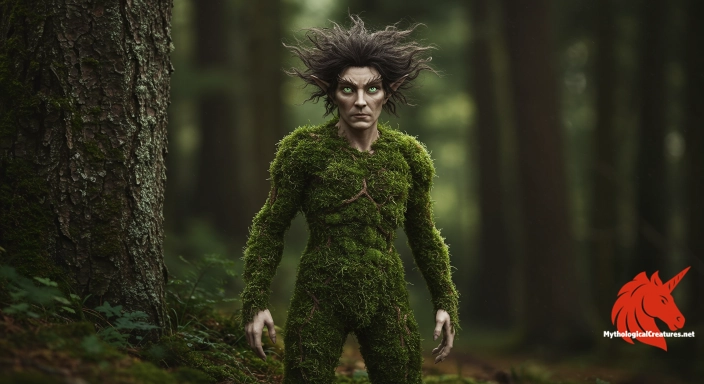
Ghillie Dhu
Ghillie Dhu - Embodies the mysterious and protective spirit of the woodland, safeguarding the forest while nurturing a gentle side towards children.
Origins & First Encounters
Steeped in the mists of Scotland’s ancient woodlands, the Ghillie Dhu emerges as a solitary male fairy whose mystique has captivated local imagination for centuries. Born from Gaelic traditions, his legend is tied deeply to the natural rhythm of the Highlands and the subtle interplay between light and shadow. His earliest known appearances in folklore date back to the late 18th century, though his roots likely extend into a time when nature itself was seen as sacred. He is revered not only as a fierce guardian of the birch woods but also as a gentle presence who offers kindness to the young and vulnerable. His very name, Ghillie Dhu, which hints at his dark, enigmatic nature and natural attire, encapsulates his role as both protector and warden. Many local communities have long honoured his existence, weaving his spirit into the fabric of their cultural identity and connection with the wilderness. His enigmatic presence bridges the practical realities of rural life with the ethereal world of myth. The continuing allure of his story reinforces the importance of tradition and the enduring bond between man and the natural world. His legend serves as a compelling reminder of the mysteries that lie hidden within the ancient forests.
Source Texts & Tale Variants
The narratives surrounding the Ghillie Dhu are rooted in a rich tradition of oral storytelling and have been preserved through generations in the Highlands of Scotland. Although texts from the early periods are scarce, later collections of folklore have captured the essence of his character and the dual nature of his role in the forest. Local storytellers often recounted detailed accounts during evening gatherings, imbuing the tales with a blend of respect and wonder. Multiple versions of the story have emerged, some highlighting his swift protective instincts while others portray him as a benign guide for wayward children. These collected accounts from the late 18th century have been subsequently chronicled in anthologies dedicated to Celtic folklore, ensuring the preservation of his myth. Variations in the retellings illustrate how different regions and families adapted the story to align with local beliefs and natural landscapes. Occasional mentions in early manuscripts expand his context beyond mere legend, suggesting a deeper, pre-Christian connection with ancient nature deities. This layered documentation reflects both the fragility and resilience of oral traditions across time, creating a multifaceted picture of the elusive forest guardian.
Form & Powers
The Ghillie Dhu is described as a slender, enigmatic figure whose appearance harmoniously blends with his woodland surroundings. His dark, flowing hair mirrors the deep shadows of the forest, while his attire—crafted entirely from leaves, moss, and natural fibres—renders him virtually indistinguishable from the undergrowth. Remarkably, this natural camouflage is the inspiration behind the modern ghillie suit, a testament to his enduring influence. His skin is often imagined to have the earthy texture of forest loam, and his eyes are said to emit a subtle glow reminiscent of moonlight filtering through the canopy. Each detail of his appearance speaks to an intimate connection with the natural world, as if his very form is an extension of the ancient trees and ferns. Variations in the folklore suggest that his figure might appear more ethereal at dusk, blurring the lines between mortal and spirit. The aesthetic of his attire, assembled with a careful selection of forest elements, embodies the resilience and beauty of the wilderness. Such visual portrayals not only reinforce his role as protector but also highlight the delicate artistry inherent in nature’s design.
Regional Faces
Although the Ghillie Dhu is most strongly associated with the birch woods of the north-west Highlands, his legend resonates across varied Scottish landscapes. In certain remote glens and beside secluded lochs, local renditions of his story have adapted to reflect regional customs and environmental features. Some communities perceive him as an ever-vigilant guardian who punishes those who disturb the sanctity of his forest, while others admire his benevolence towards children and the disenfranchised. In these different areas, subtle shifts occur in his portrayal: one village might emphasise his fierce protectiveness, whereas another might focus on his mysterious, almost otherworldly charm. The local dialects and traditions further colour the narrative, often attributing to him an almost chameleon-like ability to assimilate into his surroundings. These regional adaptations underline not only the versatility of his character but also the deep-rooted connection between people and the natural world. Rituals and seasonal customs in different parts of the Highlands have occasionally invoked his name as a safeguard against the harshness of nature. In every manifestation, the Ghillie Dhu remains a symbol of the timeless interplay between human culture and the evolving rhythms of the wild.
Cultural Parallels
The figure of the Ghillie Dhu finds intriguing parallels with various nature spirits and woodland guardians from across Europe. Much like the Irish Sidhe or the enigmatic Green Man seen in numerous continental myths, he embodies the spirit of the forest and a deep, almost spiritual connection with the natural world. While many of these figures also encapsulate themes of fertility and renewal, the Ghillie Dhu is distinct in his duality of fierce protection and gentle guidance. His portrayal resonates with the archetypal guardian spirit, a motif that recurs in numerous Celtic and pre-Celtic traditions. His ability to assume both a menacing and nurturing persona is echoed in other mythological entities that straddle the realms of the human and the supernatural. Such comparative analysis highlights shared mythic motifs across British and European lore, particularly in relation to the sanctity of nature and the reverence of its untamed forces. This cross-cultural reflection not only enriches our understanding of his narrative, but also situates him within a broader tapestry of folk beliefs. The resonance of his myth underscores a universal admiration for nature that transcends regional boundaries and cultural specifics.
Legacy & Modern Evolution
Over the centuries, the myth of the Ghillie Dhu has gradually evolved from a local woodland legend to a symbol with far-reaching cultural significance. His early portrayal as a solitary guardian of the birch woods has since been reinterpreted in various artistic and literary contexts, reflecting changing attitudes towards nature and the environment. The very apparel attributed to him, a blend of leaves and moss, has inspired modern military camouflage, thus linking ancient myth with contemporary design. In modern literature and visual arts, he is often depicted as a personification of the forest’s mystery and a reminder of the deep roots of indigenous lore. His dual role as both protector and nurturer has garnered renewed interest in environmental circles, where he is seen as an emblem of nature’s resilience and the need to preserve wild spaces. Contemporary festivals and cultural events in Scotland sometimes invoke his name, celebrating the enduring power of oral tradition and collective memory. The evolution of his legend from a whispered tale among rural folk to an icon in popular culture demonstrates a dynamic interplay between past and present. In reimagining the Ghillie Dhu, modern storytellers continue to draw from the well of ancient myth, ensuring that the spirit of the ancient forest remains vividly alive in today’s world.
Interesting Fact
The modern ghillie suit, widely used for camouflage by military snipers, is believed to have been inspired by the natural disguise of the Ghillie Dhu.
For publishers and studios
Your next readers are already here
Many of our visitors are looking for books, campaigns, and resources that deepen their journey into myth. Position your title or setting here.
Discuss a placementQuick Creature Info
Features:
Associations:
Our Mythic Legendary Rating:

Also Sometimes Known As:
Habitat:
Supernatural Powers:
Physical Attributes:
Abilities:
Behavior:
Lore:
References
Discover Another Mythical Legend You May Not Have Heard Of?
Uncover the mysteries of ancient folklore and expand your knowledge of legendary beings from cultures around the world.
Dare to Meet the Vayu....
Curated by the Mythological Creatures Team
Series editor: Mythological Creatures Directory
Primary desk: Northern & European Folklore Desk
(rev. November 2025)