
Hevioso: Hevioso is an African voodoo deity revered as the god of thunder, lightning, and rain.
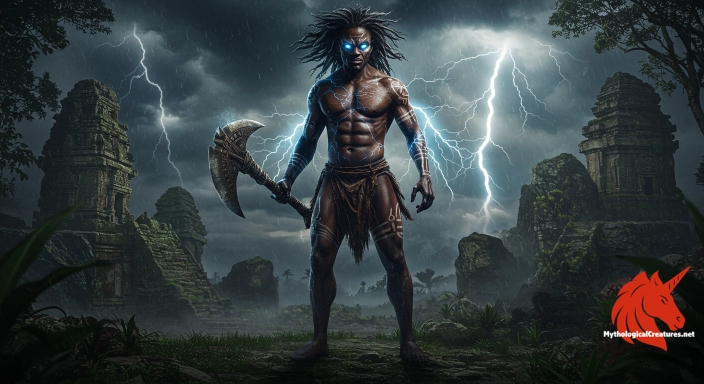
Hevioso
Hevioso - Central figure in voodoo rituals, his strikes are seen as both punishment and divine selection.
the legend in five swipes.
the legend in five swipes.
Hevioso: Origins and First Sightings
Hevioso is venerated as a mighty voodoo deity in West Africa, embodying the formidable forces of thunder, lightning, rain, and the celestial realm. Born from ancient spiritual traditions in southern Benin, his mythos interweaves natural phenomena with the principles of divine justice. He is celebrated as a guardian whose interventions underscore the balance between benevolence and retribution. His narrative fuses the power of nature with the moral imperatives of chastising deceit and malevolence. Over time, aspects of his legend have merged with historical figures, notably resonating with the Yoruba deity Shango. This amalgamation of history and divinity reflects a tradition where the natural world is both honoured and feared. Ritual depictions of Hevioso often symbolise his authority and his essential connection to the elements. Communities view his wrath as a warning and his blessings as a vital source of life-sustaining rain. His enduring story continues to influence local religious practices and community ethics. The layered tradition surrounding Hevioso exemplifies the deep cultural respect for forces that govern both the skies and human destiny.
How did the story of Hevioso change over time?
The body of lore concerning Hevioso is built upon a rich foundation of oral traditions and ritualistic expressions passed down through generations. Ancient bas-reliefs and temple inscriptions depict his iconic image, notably portraying him with an axe in the act of executing divine retribution. Ethnographic accounts and traditional narratives contribute diverse strands to his myth, each highlighting different aspects of his dual nature. Some variants of the myth depict him as a celestial enforcer whose strikes are both awe-inspiring and fearsome. Versions of his story sometimes merge historical accounts with supernatural embellishments, blurring the lines between mortal leadership and divine power. The oral traditions have preserved elaborate stories where his interventions are interpreted through the fa divination system. Local priests and ritual specialists have consistently been the custodians of these narratives, adapting and expanding them during religious ceremonies. Numerous accounts emphasize his role in delivering both life-giving rain and catastrophic storms. The evolving narratives underscore the dynamic relationship between the deity and the communities that revere him. These sources, spanning from visual art to spoken word, collectively reinforce the legacy of Hevioso as a symbol of divine justice and natural power.
How would you recognise Hevioso?
Hevioso is typically depicted as a robust and imposing figure whose physical form conveys both authority and elemental power. His countenance is rendered with a penetrating intensity, mirroring the ferocity of a tempest and the inevitability of his judgments. Artistic portrayals often show him as a tall, muscular man adorned in traditional regalia that combines ancient warrior aesthetics with celestial motifs. A signature attribute in imagery is the ceremonial axe with crescent-shaped blades, emblematic of his role in meting out punishment. Intricate details such as swirling clouds and shimmering streaks of lightning are frequently integrated into representations, suggesting his dominion over the skies. His garments and adornments sometimes include patterns reminiscent of the natural forces he commands, blending human form with the dynamic energy of a storm. Despite the overall martial appearance, subtle elements in his depiction evoke the kindly aspect of his provision of rain essential for fertility. The interplay of light and shadow in these images reflects the duality of creation and destruction inherent in his powers. Variations in his depiction may include the addition of a regal headdress or symbolic markers of mystic energy, further underlining his importance. Thus, the physical portrayal of Hevioso remains a powerful visual narrative that unites the mortal and the divine.
What do different regions call Hevioso?
Across West Africa, regional interpretations of Hevioso display a fascinating array of local adaptations and cultural inflections. In southern Benin, he is primarily revered as the formidable deity of thunder whose strikes serve as both portents and instruments of justice. Among Yoruba communities, his attributes are often interwoven with those of Shango, creating a hybrid figure that encompasses the historical and the divine. Local ritual practices introduce unique symbols, such as distinct configurations of the ceremonial axe and iconographic motifs that highlight his stormy powers. Community-specific traditions emphasise the dual nature of his influence: as a bringer of life-sustaining rain and a punisher whose lightning forewarns misdeeds. Folk narratives in various regions have incorporated elements like the black sokpe stones and fa divination to symbolise his mysterious interventions. Artistic expressions, from carvings to ceremonial dance, reflect these regional differences while maintaining the essence of his thunderous power. Each community adapts his myth in a manner that addresses local environmental conditions and societal values. The result is a mosaic of narratives where Hevioso’s character is both universally formidable and distinctly local. Hence, despite stylistic variations, the core themes of divine authority and cosmic justice remain central to his regional portrayals.
What parallels exist to Hevioso in other traditions?
In the realm of global mythology, Hevioso finds intriguing parallels with other thunder deities, highlighting a shared human fascination with the forces of nature. His attributes resonate with the Norse god Thor, who similarly wields the might of lightning and commands respect through his formidable power. Comparative narratives also draw connections with Zeus, whose authority over the heavens mirrors Hevioso’s dominion in the West African context. Within regional traditions, the close association with Shango reinforces a dual identity that blends historical leadership with divine intervention. The recurring motif of wielding a symbolic weapon, such as an axe or thunderbolt, serves as a unifying element across diverse cultures. This cross-cultural resonance underlines the universal impulse to personify natural forces as guardians and arbiters of cosmic order. Mythological studies reveal that despite distinct cultural settings, such deities often share common roles in sustaining moral order and influencing the cycles of agriculture. The exchange of mythic themes between cultures underscores the adaptability and timeless appeal of storm deities. By considering these comparative dimensions, a richer understanding of Hevioso’s multifaceted character emerges. This analysis not only situates him within a global pantheon but also accentuates the universal symbolism of power, morality, and nature.
Hevioso in Modern Culture
The myth of Hevioso has undergone significant evolution from its ancient origins to a vibrant modern legacy. Historically, he was portrayed as both a divine force and a historical figure, bridging the realms of myth and mortal rule. Over the centuries, his image has been continually reinterpreted within local ritual practices, carving out a central role in ceremonies that govern weather, justice, and communal harmony. Modern reinterpretations often cast him as a symbol of resistance against moral corruption, with his thunderous power representing the inexorable force of natural and ethical order. Contemporary artists and cultural practitioners have embraced his imagery, reimagining ancient symbols like the ceremonial axe in new artistic media. His ongoing presence in festivals and religious observances testifies to a resilient cultural identity that remains connected to ancestral wisdom. Academic and popular discussions alike now view Hevioso as a dynamic emblem of environmental stewardship and the interplay between nature and society. As modern narratives integrate traditional lore with current ecological concerns, his legacy continues to inspire both reverence and reflection. Public art, digital media, and community rituals have all contributed to his resurgence as a potent cultural icon. Ultimately, the evolution of Hevioso’s myth reflects the enduring power of ancient deities to adapt, inspire, and guide communities in ever-changing times.
Interesting Fact
An intriguing aspect of Hevioso is that individuals who survive a lightning strike are considered spiritually chosen, embodying the direct incarnation of this formidable deity.
Mythological Treasures
Greek Myths: A field guide to the monsters of ancient Greece
Every monster here earned its place in legend, and each gets a full page of artwork and the story behind it.
Norse Sagas: A field guide to the beasts of the Viking world
Drawn from the saga accounts themselves, with the powers, weaknesses and doom of each being set out.
Egyptian Legends: A field guide to the gods and monsters of ancient Egypt
Guardians of the living and devourers of the dead, with the role each played in judgement.
the legend in five swipes.
For myth educators and toolmakers
Built a resource for mythology learners?
If you offer courses, teaching tools, or research platforms focused on myth and folklore, consider a discrete placement on our reference pages.
Introduce your resourceQuick Creature Info
Origin:
Associations:
Our Mythic Legendary Rating:

Also Sometimes Known As:
Habitat:
Supernatural Powers:
Physical Attributes:
Abilities:
Behavior:
Lore:
References
Discover Another Mythical Legend You May Not Have Heard Of?
Uncover the mysteries of ancient folklore and expand your knowledge of legendary beings from cultures around the world.
Dare to Meet the Chimera....
-8a8a70c3-fb13-4020-ba30-90af1ac36843_small.webp "Depiction of Chimera")
The Mythological Creatures Book Series
Yokai, Greek, Norse, Egyptian & Chinese. Five illustrated field guides to the creatures the old stories either warned or told you about.
Curated by the Mythological Creatures Team
Series editor: Mythological Creatures Directory
Primary desk: African & Diaspora Traditions Desk
(rev. November 2025)