
Hine-nui-te-pō: Hine-nui-te-pō is the Māori goddess of night and death, tasked with guiding souls into the afterlife.
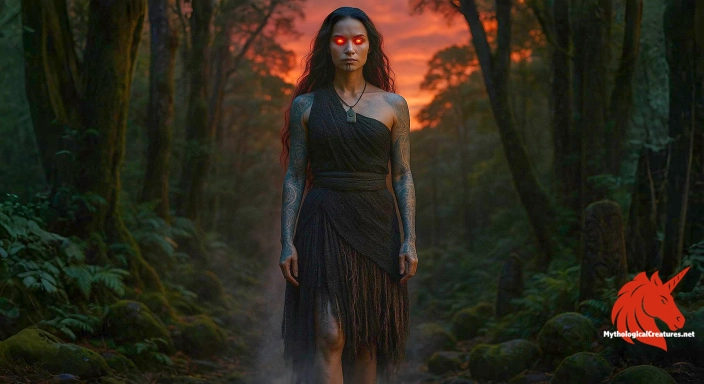
Hine-nui-te-pō
Hine-nui-te-pō - She plays a critical role in Māori beliefs by guiding the souls of the dead and symbolising the inevitable passage from life to the afterlife.
Origins & First Encounters
Hine-nui-te-pō stands as a central figure in Māori mythology, embodying the profound mysteries of life, death, and the natural world. Emerging from a storied lineage as the daughter of Tāne Mahuta and Hine-ahuone, she was originally known as Hine-ti-tama before undertaking a transformative journey. Her evolution from youthful innocence to the formidable goddess of night marks a poignant turning point in the cosmic narrative. The transition reflects deep emotional and spiritual currents, as she retreats into darkness after a personal betrayal. In her new form, she assumes the vital role of guiding departed souls towards the realms beyond mortal existence. This transformation is not merely a change of name, but a symbolic passage from light to shadow, mirroring the universal cycles of renewal and decay. Immersed within the cultural fabric of the Māori, her story intertwines with the natural phenomena observed in the world, such as the red hues of dawn and dusk. As such, Hine-nui-te-pō continues to be revered as a guardian of endings, offering a profound insight into the interconnectedness of all life.
Source Texts & Tale Variants
Ancient oral traditions serve as the primary wellspring for the story of Hine-nui-te-pō, passed down through generations by Māori elders. Early accounts recorded during initial encounters with Europeans offer further glimpses into her myth, capturing a rich tapestry of symbolism and emotional depth. Various recitations emphasize different facets of her tale, with some versions underscoring the sorrow that led her to embrace the eternal night. Other narratives focus on her pivotal role as the guardian who shepherds souls towards the afterlife, thereby ensuring the cosmic balance. Oral genealogies and ceremonial dialogues contribute additional layers of meaning, each echoing regional subtleties and interpretations. Moreover, the fragmented historical texts reflect a spectrum of insights, from personal grief to the majestic inevitability of death. As these stories converge, they create a mosaic of myth that underscores her evolving identity. Through these diverse sources, Hine-nui-te-pō emerges as both a timeless icon and a deeply personal figure within Māori cosmology.
Form & Powers
The physical appearance of Hine-nui-te-pō is often depicted with an ethereal quality that mirrors the mystery of the night. Artists and storytellers alike envision her with flowing, dark hair that cascades like the ink of twilight across the sky. Her eyes are said to glimmer with the dim light of distant stars, evoking both sorrow and wisdom. Clad in garments that seem to be woven from the very fabric of darkness, her presence merges seamlessly with the nocturnal realm. Some portrayals include subtle hints of red, a reminder of the colour that stains the sky and that is intimately linked to her myth. Her stature is depicted as both grand and enigmatic, suggesting a form that is as boundless as the night itself. Elements of her depiction convey a dual nature—a blend of gentleness in her guidance and an uncompromising force in her dominion over death. In this way, her physical form transcends ordinary description, inviting endless interpretation and reverence.
Regional Faces
Among the various Māori iwi, the depiction of Hine-nui-te-pō assumes different nuances that reflect the diverse landscapes of Aotearoa. In inland regions, her image is often intertwined with the dense, shadowy forests, symbolising her role as a guardian of hidden mysteries. Coastal communities, meanwhile, tend to associate her with the vast, starlit ocean, where the meeting of sky and water evokes the fluid boundaries between life and death. Localised traditions sometimes introduce unique elements, emphasising her as a benevolent guide in one context and as a somber arbiter in another. These regional adaptations highlight not only the natural characteristics of each environment but also the cultural priorities that shape local spirituality. Ceremonial practices, specific to certain iwi, may incorporate rituals that invoke her protection or the natural phenomena linked to her myth. Even the colour of the twilight or the rhythm of the seasonal winds can be seen as manifestations of her presence in a given locale. Thus, the regional variations of her story underscore the dynamic interplay between landscape, community identity, and the eternal cycle of existence.
Cultural Parallels
When compared with deities from other mythological traditions, Hine-nui-te-pō shares striking thematic similarities that explore the boundaries between life and death. Figures such as Hel from Norse mythology and Mictecacihuatl from Aztec lore mirror her role as a keeper of the realm of the dead. While Hel presides over a cold and inevitable underworld, Hine-nui-te-pō is portrayed with a gentle yet firm agency in guiding souls. Similarly, elements of her myth resonate with the story of Persephone in Greek mythology, where the journey into darkness signifies an essential part of the cyclical balance of life. Such comparative studies illuminate a recurring cultural fascination with the interplay between light and shadow, creation and dissolution. Each tradition, though unique in its details, recognises the transformative power of death as a precursor to rebirth. These parallel narratives not only reinforce the universal nature of the themes involved but also highlight the distinctive characteristics that define Hine-nui-te-pō. In this broader mythological context, her story stands as a testament to the shared human quest to understand mortality and renewal.
Legacy & Modern Evolution
The portrayal of Hine-nui-te-pō has undergone a notable evolution over the centuries, reflecting shifting cultural contexts and modern reinterpretations. Traditionally a figure of solemn guardianship over the dead, she has emerged as a symbol of both mourning and metamorphosis in contemporary art and storytelling. Modern visual depictions often accentuate her majestic form, imbuing it with a sense of both power and vulnerability. In literature and performance, her narrative is reimagined as an empowering tale of transformation and self-realisation. This re-envisioning parallels broader efforts within Māori communities to reclaim and reinvigorate indigenous narratives in the face of modern challenges. Academic discourse and cultural movements alike have embraced her story as a metaphor for resilience, growth, and the cyclic nature of existence. Over time, the symbols associated with her have expanded beyond the confines of ancient lore to embody universal themes of transition and rebirth. In today’s cultural landscape, Hine-nui-te-pō continues to inspire both reverence and creative exploration, ensuring that her legacy remains vibrant and deeply relevant.
Interesting Fact
Hine-nui-te-pō’s transformation from Hine-ti-tama to the goddess of night highlights the Māori perspective on the duality of life and death, serving as a potent metaphor for transformation and renewal.
For serious myth projects
Feature your work alongside the legends
From academic works to story-rich games, we highlight projects that respect world mythologies. Talk to us about a measured, long-term placement.
Start a conversationQuick Creature Info
Origin:
Features:
Associations:
Our Mythic Legendary Rating:

Also Sometimes Known As:
Habitat:
Supernatural Powers:
Physical Attributes:
Abilities:
Behavior:
Lore:
Related Creatures, Tales or Lore
- NNyx
- NNótt
- HHecate
References
Discover Another Mythical Legend You May Not Have Heard Of?
Uncover the mysteries of ancient folklore and expand your knowledge of legendary beings from cultures around the world.
Dare to Meet the Bakasura....
-3ae1d1a2-0217-4305-80ae-3c69470b97af_small.webp "Depiction of Bakasura")
Curated by the Mythological Creatures Team
Series editor: Mythological Creatures Directory
Primary desk: Asian & Pacific Myth Cycles Desk
(rev. November 2025)