
Itsumade: Itsumade is an eerie reptilian bird from Japanese folklore, vividly depicted in the Konjaku Gazu Zoku Hyakki series.
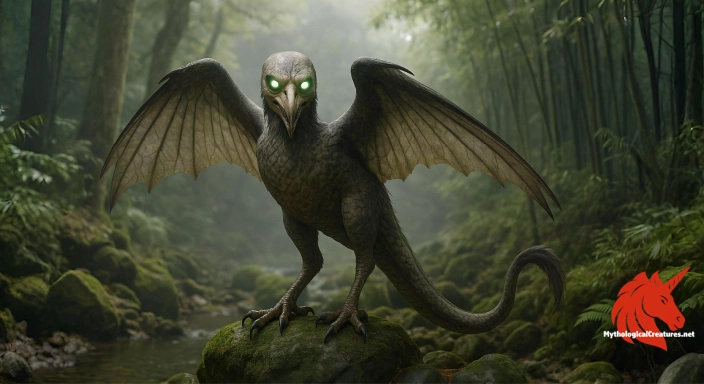
Itsumade
Itsumade - Itsumade is noted for its eerie cry and ambiguous role in folklore, often viewed as a portent of mysterious or significant events.
Origins & First Encounters
Itsumade is a striking creature embedded in the imaginative tapestry of Japanese folklore, merging history with the supernatural in a way that continues to fascinate audiences. Its earliest appearance is recorded in the Konjaku Gazu Zoku Hyakki, a renowned collection of yōkai images published in 1779 by the eminent artist Toriyama Sekien. Emerging from a period that blurred the lines between reality and myth, the creature has captured the imagination of both scholars and storytellers alike. The narrative surrounding it is intricately tied to the medieval chronicle Taiheiki, where the dramatic episode of Hiroari shooting the eerie bird sets the stage for its enduring legend. With its distinctive cry of 'itsumade itsumade', the creature offers a sonic symbol that deepens its mysterious allure. It embodies a convergence of natural and supernatural elements that challenge established classifications in mythical zoology. The synthesis of reptilian and avian features further accentuates its enigmatic presence, inviting interpretations that are as varied as they are compelling. Artists and chroniclers have used the itsumade as a focal point to explore themes of fate, transformation, and the capricious nature of destiny. Its continued resonance in cultural narratives underscores a legacy that bridges the historical with the mythological.
Throughout its evolution, the itsumade has been a canvas upon which shifting cultural values and aesthetic sensibilities are projected, engaging audiences in an ongoing dialogue between past and present.
Source Texts & Tale Variants
The primary textual foundation for the itsumade is found within the Taiheiki, a dramatic historical epic woven with extraordinary and supernatural episodes from 14th century Japan. In this chronicle, a bold figure named Hiroari is depicted as confronting and ultimately shooting the eerie bird, an episode that has resonated through the ages. This incident was later immortalised in the Konjaku Gazu Zoku Hyakki, where Toriyama Sekien’s illustration solidified the creature’s place in the Japanese mythological canon. Early documents provide vivid descriptions that intertwine the creature’s physical aspects with its symbolic function as an omen. Over time, regional manuscripts and oral traditions have enriched this narrative, offering a spectrum of interpretations that amplify its enigmatic nature. Variations in the story reveal alterations in context and detail, with some local renditions casting the itsumade as a harbinger of change while others underscore its dangerous allure. Folktales preserved in rural communities have preserved unique vocal motifs associated with the creature’s cry, thereby expanding its narrative canvas. The reiteration of its story in both visual and literary form has contributed to a rich tapestry that interlaces historical record with imaginative reinterpretation. Each version, whether textual or pictorial, adds layers of depth to its overall mythos, ensuring that its origins remain both fascinating and elusive.
These diverse source materials collectively highlight the dynamic process by which folklore evolves, reinforcing the itsumade’s status as a continually reimagined emblem of Japan’s mythic heritage.
Form & Powers
The physical depiction of the itsumade is a masterful blend of reptilian and avian characteristics that results in an almost otherworldly silhouette. Its smooth, scaly skin is intermingled with tufts of feather-like structures, creating a visual harmony that is as perplexing as it is captivating. An elongated, sinuous body suggests a fluidity of movement that is reminiscent of a serpent, while also echoing the grace of flight. The creature’s sharply curved beak, both elegant and menacing, underlines its predatory nature. Large, luminous eyes lend the itsumade an unnerving yet hypnotic quality, as if they hold untold secrets from ancient times. Broad wings, edged with the appearance of tattered plumage, hint at both the capacity for rapid escape and the burden of its ominous legend. Delicate markings and subtle ridges across its form evoke archaic symbols, which many believe carry mystical significance. Representations sometimes vary in size, with some portrayals emphasising a modest, almost delicate presence, while others imbue it with an overwhelming, monstrous scale. The resulting amalgamation of these elements produces a creature that is as formidable as it is visually intriguing, reinforcing its role as a timeless enigma within the realm of myth.
Regional Faces
Regional interpretations of the itsumade reveal a wealth of diversity within Japan’s vast folkloric landscape. In some parts of the country, particularly in the more temperate regions, the creature is seen as a subtle omen heralding seasonal transitions and a balance between nature and the supernatural. In contrast, among the rugged hinterlands and mountainous areas, local lore paints the itsumade in a far more menacing light, often associated with impending misfortune. These regional narratives frequently adapt the creature’s eerie cry into various cultural motifs, transforming it into a symbol with both poetic and portentous qualities. Variations in artistic depictions are evident as well, with urban illustrations often highlighting its graceful, almost ethereal wings, while rural depictions focus on its foreboding, reptilian scales. Some local traditions even blend the creature’s image with that of protective spirits, suggesting that its presence can simultaneously warn of danger and safeguard the community. The fluidity of its portrayal across regions underscores the broader tendency of folklore to evolve, reflecting the unique cultural and environmental context of each area. Despite these manifold interpretations, the itsumade consistently emerges as a figure of enigma, bridging the local with the universal through its compelling symbolism. Such regional adaptations enrich its myth, ensuring that its legacy endures in a variety of cultural expressions.
Cultural Parallels
The itsumade occupies a fascinating niche among hybrid mythological beings, drawing intriguing parallels with creatures from diverse cultural backgrounds. Its amalgamation of reptilian and avian traits invites comparisons with the Mesoamerican deity Quetzalcoatl, whose serpentine form and vibrant plumes symbolise the unification of earth and sky. In the realms of Arabic legend, the immense roc similarly embodies the awe-inspiring and sometimes terrifying confluence of natural power and myth. Unlike the phoenix, which is celebrated for its rebirth and regenerative cycle, the itsumade carries an aura of persistent mystery and foreboding that challenges the conventional narrative of renewal. Its eerie, echoing cry resonates with the spectral calls attributed to otherworldly beings in European monster tales, underscoring a shared global fascination with uncanny avian forms. The dual nature of its character, oscillating between benign and malevolent aspects, finds a close counterpart in the multifaceted Japanese tengu. Such cross-cultural comparisons extend beyond mere physical similarities, touching on the deeper human need to embody life’s liminality in animal form. The very construction of the itsumade reflects a universal mythic impulse to blend disparate natural elements into a symbol that captures the limits of human understanding. This comparative analysis sheds light on the broader tradition of hybrid creatures that serve as metaphors for the interplay between order and chaos in many cultures. Ultimately, the itsumade stands as a testament to the universal power of myth in challenging and expanding our views of the natural world.
Legacy & Modern Evolution
Over the centuries, the legacy of the itsumade has evolved from a mere footnote in ancient chronicles to a dynamic symbol in modern popular culture. Initially immortalised in historical texts such as the Taiheiki and through Sekien’s iconic illustrations, the creature was once regarded primarily as an ominous harbinger of fate. Its early depictions conveyed a sense of otherworldly dread that resonated with the uncertainties of turbulent eras in Japanese history. As time progressed through the Edo period and into the modern age, the itsumade underwent reinterpretation, its image being polished and recontextualised to suit contemporary sensibilities. Modern iterations extend its influence to various media including literature, manga, anime, and digital art, where its hybrid form is often reimagined as a complex, multifaceted character. This evolution reflects a broader trend where traditional myth is adapted to address modern themes, blending historical gravitas with avant-garde aesthetics. Cultural institutions and art exhibitions now frequently showcase the itsumade as emblematic of Japan’s rich supernatural heritage, bridging the gap between ancient lore and modern creative expression. The creature’s haunting call and mysterious visage continue to inspire both scholarly debate and popular fascination. In essence, the itsumade has transcended its original context, emerging as a timeless emblem of the enduring power of myth to adapt, transform, and captivate across generations and cultural divides.
This transformation not only highlights the dynamism of folklore but also reaffirms the itsumade’s position as an enduring presence in the collective imagination.
Interesting Fact
An interesting aspect of Itsumade is that its repeated cry has been interpreted by some scholars as symbolising the inexorable passage of time, hinting at deeper philosophical themes in Japanese lore.
For authors, artists, and makers
Created something from the realm of myth?
If your book, deck, game, or artwork draws from legendary creatures and lore, you can showcase it here in a tasteful, year-round placement.
Share your projectQuick Creature Info
Associations:
Our Mythic Legendary Rating:

Habitat:
Supernatural Powers:
Physical Attributes:
Abilities:
Behavior:
Lore:
References
Discover Another Mythical Legend You May Not Have Heard Of?
Uncover the mysteries of ancient folklore and expand your knowledge of legendary beings from cultures around the world.
Dare to Meet the Ichneumon....
-b8b1e869-116a-427d-903b-1287773f53ad_small.webp "Depiction of Ichneumon")
Curated by the Mythological Creatures Team
Series editor: Mythological Creatures Directory
Primary desk: Asian & Pacific Myth Cycles Desk
(rev. November 2025)