
Jimmy Squarefoot: Jimmy Squarefoot is a legendary creature from Manx folklore, noted for his unusual pig-headed appearance and upright, bipedal form.
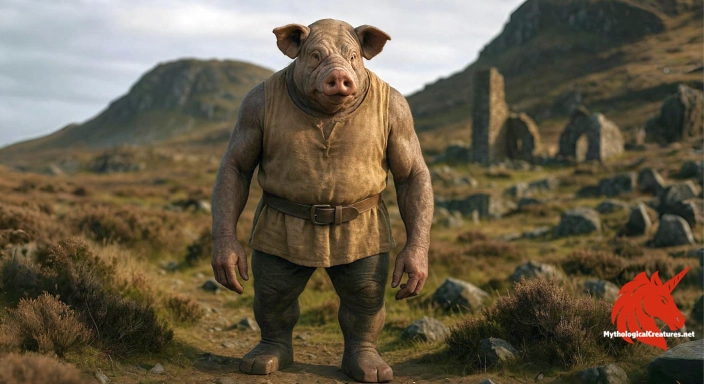
Jimmy Squarefoot
Jimmy Squarefoot - Jimmy Squarefoot is a well-known figure in Manx folklore, embodying the quirky and mysterious aspects of local myth.
Origins & First Encounters
Jimmy Squarefoot stands as one of the most intriguing anomalies in Manx folklore, symbolising a peculiar blend of the natural and supernatural. His tale, emerging from the misty landscapes of the Isle of Man, reflects an amalgamation of ancient Celtic mystique and the island’s distinctive cultural eccentricities. Early whispers of his existence suggest that his legend was born in a time when oral tradition was the keeper of nature’s secrets, handed down from generation to generation. The creature’s bipedal form combined with a porcine head immediately set him apart, challenging conventional ideas of both human and animal. Local narratives imbue him with an aura of mischief interlaced with an undercurrent of omen, serving to remind folk of the unexpected lurking at the boundaries of everyday life. Over time, his myth has subtly shifted, adapting to new cultural sentiments while still retaining the core of its enigmatic allure. Communities have embraced his character as both a charm against misfortune and a reminder of the island’s deep-rooted mystical heritage. The enduring presence of Jimmy Squarefoot in Manx storytelling underlines how folklore can simultaneously entertain, educate, and preserve a community’s unique identity. His continuing influence corroborates his status as a living emblem of local myth and a captivating mystery that endures across the ages.
Source Texts & Tale Variants
Primary accounts of Jimmy Squarefoot are woven into the fabric of local oral tradition rather than being confined to formal textual records. Storytellers in the remote corners of the Isle of Man often recounted his eerie exploits during communal gatherings, ensuring that his legend was transmitted through the generations. Scattered references in local manuscripts and folklore compilations further attest to his presence, albeit in a manner that leaves much open to personal interpretation. Many narrative strands depict him as a solitary wanderer with a penchant for unexpected mischief, while others portray him as a spectral figure whose appearance foretells uncertain fortunes. Variants of his tale frequently reflect situational nuances, with some accounts setting his adventures along fog-bound moorlands and others unfolding within shadowed woodland clearings. The absence of a singular authoritative source has allowed individual communities to embellish his myth with local colour and distinct interpretative flair. Over the centuries, scribes and folklore enthusiasts have collected these varied narratives, preserving a rich yet fluid account of his character. This multifaceted tradition reinforces the idea that Jimmy Squarefoot is as much a product of communal imagination as he is a timeless legend. The diversity of sources ultimately enriches his myth, ensuring that each telling contributes to a dynamic cultural tapestry.
Form & Powers
Jimmy Squarefoot’s appearance is as striking as it is unconventional, merging the traits of human form with distinctly porcine features. His head, unmistakably reminiscent of a pig’s visage, is marked by a prominent snout, rounded cheeks, and ears that seem to stand in a state of perpetual alertness. The intense gleam in his eyes imparts an aura of uncanny intelligence while hinting at the wild unpredictability hidden beneath his unusual exterior. Standing on two legs, his lean yet sturdy body encapsulates the resilience expected of a figure born from the rugged terrain of the Isle of Man. His most distinctive physical attribute is undoubtedly his square-shaped foot, a feature that gives him a unique gait and an instantly recognisable silhouette. Observers have noted that a light dusting of coarse hair or an unruly tuft around his chin sometimes serves to further blur the lines between human and animal. His skin, often described with earthy tones that mirror the island’s landscape, lends him an enigmatic, almost otherworldly presence. The stark combination of human posture with animalistic features creates a visual paradox that both repels and fascinates. Each detail, from the curvature of his snout to the geometry of his square foot, contributes to a portrayal that is as memorable as it is mythically charged.
Regional Faces
Across the varied locales of the Isle of Man, the legend of Jimmy Squarefoot has been subject to numerous local reinterpretations that reveal a rich spectrum of cultural attitudes. In more isolated rural hamlets, his image is often softened into that of a benign yet mysterious guardian whose presence is entwined with the natural rhythms of the land. In contrast, urban retellings tend to underscore his mischievous nature, casting him as a trickster figure capable of subverting conventional order. Coastal communities, with their own superstitions tied to the sea and weather, sometimes portray him as a spectral harbinger linked to sudden storms and shifting tides. Inland narratives frequently tie his existence to agricultural cycles and the mystique of ancient woodlands, where he is seen as both an omen and a protective spirit. These regional adaptations often play with details such as the colour of his skin or the sharpness of his features, highlighting local environmental influences and cultural sensibilities. Folk plays and community festivals further embellish his character, sometimes incorporating humorous elements that contrast with darker canonical depictions. Such variations illuminate how a single mythological figure can be reshaped by different communities to reflect their unique experiences and surroundings. In essence, Jimmy Squarefoot’s regional portrayals exemplify the dynamic interplay between local tradition and legendary narrative.
Cultural Parallels
When examined alongside other hybrid figures from European and Celtic mythologies, Jimmy Squarefoot presents fascinating parallels and contrasts. His unusual fusion of human bipedalism with a distinctly animal, porcine head resonates with a broader tradition of mythic beings who blur the boundaries between the natural and the supernatural. Similar legends, featuring pig-faced spectres or hybrid creatures, underscore a recurring motif of transformation and duality that challenges conventional norms. In many ways, his very existence functions as a metaphor for the liminal spaces between civilisation and wilderness, much like other mythical entities who inhabit borderline realities. This characteristic invites comparisons with shapeshifters and tricksters present in adjacent Celtic traditions, where the ambiguity of form mirrors the ambiguity of moral and societal roles. The thematic resonance found in his legacy is akin to that of other folklore figures whose hybrid natures have come to symbolise transformative power and the mysteries of identity. Cultural narratives from neighbouring regions similarly utilise strange anatomical features as symbols to articulate the tension between order and wildness. Comparative analysis reveals that while the specifics of his appearance and stories are unique, the underlying themes align closely with cross-cultural portrayals of otherness. Such similarities emphasise that Jimmy Squarefoot, despite his localised origins, participates in a continental dialogue about the complex interplay of nature, identity, and myth.
Legacy & Modern Evolution
The myth of Jimmy Squarefoot has evolved remarkably from its ancient oral roots to become a multifaceted icon in both traditional and modern cultural expressions. In earlier times, his legend was an organic part of communal storytelling, shared around flickering fires and during intimate village gatherings. As the passage of time led to the transcribing of these stories, the creature’s narrative was immortalised within manuscripts and folklore anthologies, securing his place in the annals of Manx heritage. In more recent centuries, artistic reinterpretations have reimagined him as both a figure of eerie fascination and a wry emblem of local identity. Contemporary festivals, theatrical productions, and graphic art have all tapped into the enduring allure of his anomalous form, often highlighting the interplay of menace and mirth that lies at his core. Modern adaptations sometimes present him as a symbol of resistance against conventional ideals, celebrating the eccentric and the uncanny. This continual reinvention has kept his legend vivid in the public imagination, allowing for fresh conversations about identity, tradition, and modernity. As academic and artistic interest in regional folklore increases, Jimmy Squarefoot has become a celebrated figure in scholarly discussions as well as community-based creative projects. His enduring legacy is a testament to the power of myth to adapt and flourish in ever-changing cultural landscapes, ensuring that his presence will captivate and inspire future generations.
Interesting Fact
His uniquely pig-headed design combined with an upright, bipedal stance makes Jimmy Squarefoot one of the most memorable and enigmatic figures in Manx folklore.
Partner with Mythological Creatures
Bring your myth-based world into ours
From game settings to narrative worlds, we work with partners who treat myths with care. Share your project for a potential sponsor slot.
Partner with usQuick Creature Info
Features:
Our Mythic Legendary Rating:

Habitat:
Physical Attributes:
Lore:
References
Discover Another Mythical Legend You May Not Have Heard Of?
Uncover the mysteries of ancient folklore and expand your knowledge of legendary beings from cultures around the world.
Dare to Meet the Nixie....
-080578f2-84c2-4998-aac2-2f8c3a99825b_small.webp "Depiction of Nixie")
Curated by the Mythological Creatures Team
Series editor: Mythological Creatures Directory
Primary desk: Northern & European Folklore Desk
(rev. November 2025)