
Jubokko: Jubokko is a blood-sucking tree yōkai from Japanese folklore.
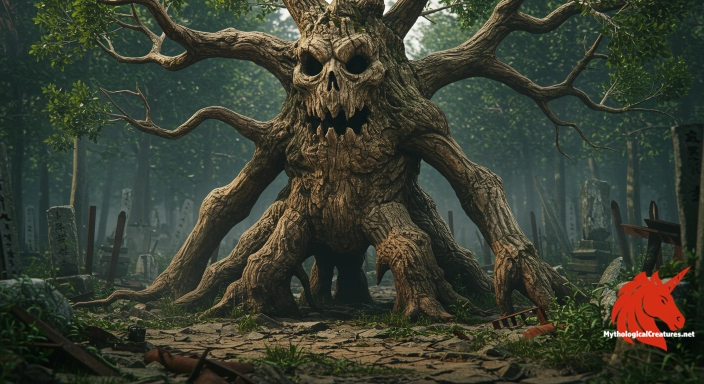
Jubokko
Jubokko - Represents the merging of death and regeneration, embodying the lingering trauma of battle while paradoxically offering healing through its enchanted branches.
Origins & First Encounters
Jubokko, meaning 'tree child', emerges as a fascinating yōkai in Japanese folklore whose origins are steeped in the tragic histories of battlefields. It is said that this spectral tree was once an ordinary tree that transformed after absorbing the blood residue of countless fallen soldiers. The metamorphosis from natural flora into a vengeful spirit is deeply intertwined with themes of loss and the lingering presence of death. Over time, oral traditions and regional narratives have shaped the Jubokko into a symbol of nature's surprising power to both heal and harm. Its early mentions in folklore point to a time when the struggles of war and the mysteries of the supernatural were inseparable in the cultural imagination. The Jubokko has found a lasting place in artistic depictions, most notably in works by Shigeru Mizuki, where it is portrayed with both elegance and menace. The tree’s eerie ability to maintain a fresh appearance while feeding on human blood adds a paradoxical layer to its legend. Ultimately, the Jubokko stands as a compelling reminder of how the impacts of conflict can breathe life into myths that continue to evolve with time.
Source Texts & Tale Variants
Contemporary records of the Jubokko are interwoven with Japan’s rich tapestry of folklore and mythic compilations. Its tale appears in a variety of sources ranging from regional oral legends to modern illustrated anthologies, each recounting a unique aspect of its blood-sucking nature. Some accounts originate in local community narratives where the tree is seen near ancient battlegrounds, its presence a silent witness to past horrors. Variants of the story have been passed down through generations, with vivid details that underscore its connection to the lives lost in warfare. The creature also features in compilations of yōkai lore that bridge historical accounts with imaginative reinterpretations. As these narratives travelled through time, the Jubokko’s image was refined, sometimes emphasising its restorative branch and other times its predatory tendencies. The diversity of these sources mirrors the multifaceted character of the tree itself, reflecting both regional anxieties and the universal human thirst for meaning in tragedy. Thus, the Jubokko’s provenance is as layered as the folklore from which it sprang, embracing both ancient myth and modern reinterpretation.
Form & Powers
The Jubokko is customarily depicted as a seemingly ordinary tree that conceals a secret dark interior. Its bark, which appears smooth and unassuming at first glance, is notorious for shedding a vivid, blood-like fluid when cut. The tree’s branches are said to possess a malleable quality, twisting into tube-like formations that can ensnare unwary passers-by. Despite its unvarnished exterior, several depictions stress an uncanny vitality in the tree’s foliage, which remains lush and vibrant despite its sinister nature. The disparity between its natural beauty and its life-sapping function creates an unsettling visual contrast. Observations of size indicate that while the Jubokko is not necessarily larger than typical trees, its limbs are endowed with an unnerving flexibility. Every element of its form, from the shapeshifting branches to the eerie trails of blood, reinforces its identity as both arboreal and supernatural. This juxtaposition of the familiar and the monstrous in its physical description continues to fascinate and haunt those who encounter its legend.
Regional Faces
Localised interpretations of the Jubokko bring forth a rich variety of details that mirror the cultural nuances of different Japanese regions. In certain rural areas, particularly near historical battle sites, the tree is revered as a cursed sentinel, bearing the weight of ancestral grief and bloodshed. Some regions accentuate its ability to purify and heal, focusing on the belief that its bleeding branches can decontaminate wounds and ailments. Village tales often depict encounters with the Jubokko at dusk, where its presence is both ominous and strangely protective. In other parts, the story shifts to illustrate the tree as an agent of natural retribution, a living emblem of the cycle of death and rebirth. Variations in local lore sometimes recast the creature, portraying it as a guardian spirit of the land that balances sorrow with the promise of renewal. These regional adaptations highlight how the Jubokko’s myth intertwines with the community’s own history and landscape. By embracing both fatalistic and redemptive elements, local narratives ensure that the creature remains a dynamic and influential figure in folklore.
Cultural Parallels
The legend of the Jubokko resonates with similar motifs found across different cultural mythologies, where nature itself takes on a supernatural persona. Comparable to European tales of blood-soaked trees and cursed woodlands, the Jubokko uniquely intertwines the essence of human tragedy with the life force of a living organism. Its transformation from a simple tree into a sentient predator is reminiscent of global narratives where the environment echoes the scars of human violence. Unlike more benign tree spirits, such as the kodama, the Jubokko’s existence is embroiled in both monstrous predation and inadvertent healing, setting it apart within the pantheon of nature deities. Such dualistic qualities invite intriguing parallels with other mythic entities that encapsulate cycles of destruction and regeneration. The creature’s blood-drinking habit and its association with haunted battlefields also evoke images of nature’s revenge, a theme seen in various cultures. While many traditions celebrate the ethereal beauty of tree spirits, the Jubokko stands out for its chilling ability to blur the lines between life and death. This multifaceted nature fosters a rich comparative dialogue between the supernatural portrayals of flora in diverse cultural landscapes.
Legacy & Modern Evolution
Over time, the Jubokko has transcended its status as a mere folktale to become a significant figure in modern Japanese popular culture. Its eerie yet captivating image has been reimagined in graphic novels, television dramas, and contemporary horror films. The evolution of its portrayal mirrors shifting societal themes, where the legacy of historical conflict intermingles with modern anxieties about nature and technology. Modern reinterpretations often highlight its paradoxical traits, balancing its deadly allure with hints of mysterious healing powers. The Jubokko now serves as both a cautionary tale about the scars of past violence and a symbol of nature’s potent, if unpredictable, regenerative abilities. As urban legends and digital narratives continue to evolve, the tree’s spectral presence is increasingly associated with environmental commentary and moral complexity. Its persistent allure has inspired a new generation of artists and storytellers who see in the Jubokko a bridge between folklore and contemporary issues. Today, the creature stands as a multifaceted emblem of the enduring power of myth to capture the human imagination.
Interesting Fact
Despite its gruesome method of feeding, legends claim that a branch from the Jubokko can miraculously heal injuries, highlighting the paradox of its life-giving properties amid its destructive nature.
Support the directory
Promote your myth project and fund more research
Sponsor placements help keep this directory growing and free to use while giving your work a focused, relevant audience.
Learn how sponsorship worksQuick Creature Info
Features:
Associations:
Our Mythic Legendary Rating:

Also Sometimes Known As:
Habitat:
Supernatural Powers:
Physical Attributes:
Abilities:
Behavior:
Lore:
References
Discover Another Mythical Legend You May Not Have Heard Of?
Uncover the mysteries of ancient folklore and expand your knowledge of legendary beings from cultures around the world.
Dare to Meet the Busaw....
Curated by the Mythological Creatures Team
Series editor: Mythological Creatures Directory
Primary desk: Asian & Pacific Myth Cycles Desk
(rev. November 2025)