
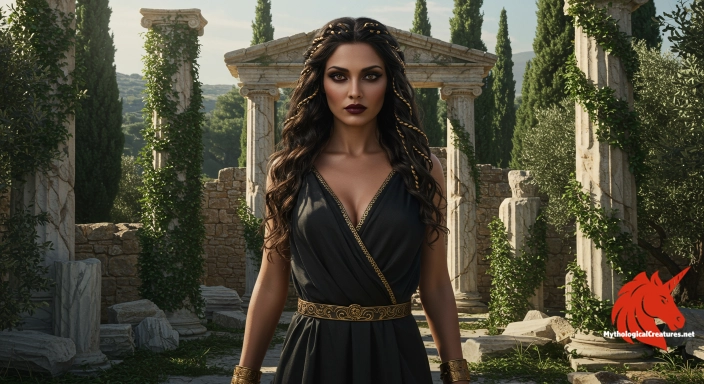
Kakia: Kakia is the Greek goddess of vice and moral badness, depicted as a vain, plump woman in revealing clothes.
Kakia
Kakia - Embodies the harmful effects of immoral behavior and serves as the counterbalance to virtue, notably represented by Arete.
Origins & First Encounters
Kakia emerges as a vivid personification of malice and moral corruption in ancient Greek thought, embodying the very essence of vice and the seduction of the easy life. Her name, deriving from the term for wickedness, is a constant reminder of the inherent dangers of straying from the path of virtue. In early Greek narratives, she is portrayed as a force that readily tempts the noble and the strong, consistently presenting an alluring yet deceptive alternative to a life of rigour and excellence. The cultural backdrop of the time churned with philosophical debates, and Kakia’s presence served as a powerful allegory for the pitfalls of indulgence and moral laxity. Her infamous attempt to sway Heracles underscores how even heroes are not immune to the seductive promises of an untroubled existence. Set against the backdrop of ancient ethical dilemmas, her myth challenges the audience to scrutinise the true cost of an easy reward. Kakia’s character, in contrast to that of Arete, the goddess of excellence, symbolises the eternal struggle between the immediate lure of vice and the long-term rewards of virtue. This enduring myth, rich in cautionary wisdom, continues to resonate as a timeless reflection on human frailty and the consequences of moral compromise. Her tale not only mirrors the anxieties of ancient society but also invites us to engage with our own inner conflicts between virtue and vice. Through her narrative, the delicate balance between ambition and ethical living is vividly illuminated.
Source Texts & Tale Variants
The literary foundations of Kakia’s myth are embedded in texts such as Xenophon’s Memorabilia, where her dialogue with Heracles offers one of the clearest accounts of her temptations. This primary source sheds light on the nature of her promises, contrasting the allure of immediate gratification with the rewards of a challenging life steeped in virtue. Apart from Xenophon, later references and allusions in the New Testament reveal that the concept of evil, or kakia, was a familiar moral reference point in diverse religious traditions. The Gnostic corpus further enriches her narrative by portraying her as a progeny of the earliest angelic beings, thus integrating her into a broader mythological tapestry of human failings. Multiple story variants exist, each emphasising different facets of her character—from the overtly seductive to the subtly insidious. Some accounts accentuate her role as a temporary seductress, while others depict her as an unyielding embodiment of corrupting influence. The evolution of her myth across these texts reflects the shifting cultural and ethical landscapes of the ancient world. By drawing on a variety of sources, the narrative of Kakia not only highlights the varied dimensions of moral decay but also situates her as an enduring symbol in philosophical debates about sin and temptation. Such layered storytelling has allowed her myth to transcend its original context, engaging audiences across generations.
Form & Powers
The physical portrayal of Kakia is as striking as it is symbolically charged, with her image carefully crafted to reflect the excesses of vice. She is frequently described as a plump figure, her body accentuated by an abundance of lavish make-up that underscores her vanity. Her attire, often revealing and boldly styled, is designed to attract and seduce, presenting a stark contrast to the restrained elegance associated with virtuous deities. Every element of her depiction—from the heavy cosmetics to the ornate, form-fitting garments—serves as a visual metaphor for the superficiality of unearned pleasures. In the artistic tradition of ancient Greece, her image was intended to provoke unease as much as to allure, inviting onlookers to recognise the inherent danger in her seductive façade. The deliberate exaggeration of her features highlights the physical manifestation of moral decay, with every detail engineered to symbolise the allure of vice. Although surviving visual representations are scarce, literary descriptions paint a consistent picture of a figure who is both enticing and repellent. This duality is central to her iconography, making her one of the most memorable depictions of moral corruption. In consistently contrasting her appearance with that of honourable deities, the myth of Kakia emphasises how outward aesthetics can mask deeper ethical failings. Her physical characteristics remain a potent emblem of the perilous intersection between beauty and moral disintegration.
Regional Faces
As the myth of Kakia traversed different regions, her depiction adapted to local cultural sensibilities, enhancing certain traits while softening others to meet the prevailing societal values. In the core of ancient Greece, she was predominantly portrayed as a stark embodiment of vice, her image tightly interwoven with ethical lessons on the dangers of indulgence. In more peripheral Greek locales and Hellenistic regions, the focus sometimes shifted to her seductive qualities, with local artists and storytellers infusing her character with an air of dangerous charm. Eastern Mediterranean interpretations even merged her character with local deities of misfortune, thereby amplifying her association with calamity and moral downfall. In these adaptations, nuances were introduced that either highlighted her tragic dimensions or reinterpreted her allure in more complex, symbolic ways. The Gnostic revisions, for instance, reimagined her as part of a familial constellation of negative impulses, thereby broadening her significance beyond classical Greek paradigms. Regional renditions often mirrored localized philosophical debates about morality, prompting a re-evaluation of her role from a mere tempter to a more multifaceted symbol of human frailty. Despite these variations, the heart of Kakia’s myth—her role as a mirror to the inevitable pitfalls of vice—remained intact. Each local interpretation enriched her image, ensuring that her warning against moral decay resonated across different cultural landscapes. The regional metamorphoses of her character are a testament to the elasticity of myth and its capacity to adapt to diverse ethical concerns.
Cultural Parallels
The character of Kakia invites a rich comparative exploration with analogous figures across various mythological traditions, each representing the allure and danger of immoral choices. Much like the personifications of Vice found in Roman allegories or the modern depictions of temptresses in literature, Kakia stands as a universal symbol of the human predisposition toward self-indulgence. Her portrayal, particularly through her seductive promises and ostentatious appearance, parallels narratives found in both Eastern and Western myths where a single figure encapsulates the perils of abandoning virtuous living. In medieval European allegories, characters embodying sin and decadence bear striking resemblances to Kakia, indicating a shared cultural apprehension about the seductive nature of vice. The dichotomy between Kakia and Arete in Greek mythology mirrors the broader, global motif of duality between vice and virtue. This theme is recurrent in various cultural narratives where characters are charged with symbolically representing the cost of moral compromise. The similarities extend to the psychological dimensions of these myths, where the seduction of an easy life is a metaphor for overcoming internal resistance to ethical rigour. In comparing her to figures in other traditions, one finds that Kakia’s influence transcends geographical and temporal boundaries, offering insights into how different cultures conceptualise and respond to the temptations of moral decay. This comparative perspective fosters a deeper understanding of the universal struggles between ethical discipline and the alluring promise of immediate gratification. Kakia’s myth, therefore, serves as a bridge linking diverse cultural explorations of vice and the eternal challenge of choosing rightly.
Legacy & Modern Evolution
The legacy of Kakia has experienced a dynamic evolution from her origins as a literal goddess in early Greek myth to a multifaceted symbol in modern cultural dialogues about ethics and temptation. Over the centuries, her story has been reinterpreted by philosophers, artists, and writers, evolving into an allegory for the ever-present conflict between easy gratification and the pursuit of noble endeavours. Renaissance thinkers and artists, fascinated by classical mythology, revived her image to caution against moral decay, embedding her in allegorical artworks that warned of the perils of abandoning virtuous living. In contemporary times, Kakia’s archetype continues to influence narratives that scrutinise excess, consumerism, and the transient allure of vice. Modern interpretations often focus on the psychological and sociocultural implications of her myth, presenting her as a metaphor for the internal battles between self-discipline and self-indulgence. Her character inspires not only artistic endeavours but also philosophical debates on the nature of sin and the consequences of ethical compromise. The evolution of her portrayal reflects broader changes in societal values, where the lessons of ancient morality are continuously re-examined in the light of modern challenges. Despite shifts in artistic style and cultural contexts, the fundamental warning embedded in her myth remains resoundingly relevant: the seduction of vice often carries a steep, enduring cost. Kakia endures as a timeless reminder that the battle between short-term indulgence and long-term integrity is a perennial human struggle. Through reinterpretation and reinvention, her legacy bridges ancient wisdom and modern discourse, continuing to inspire reflection on the true price of moral compromise.
Interesting Fact
Interestingly, despite being the personification of vice, Kakia is once referred to by her followers as 'Happiness', highlighting the deceptive allure that vice can present.
Mythology commerce, done carefully
Align your store with our global myth audience
If you sell myth-inspired jewellery, prints, decks, or collectibles, we can feature your brand without overwhelming the reading experience.
Partner with usQuick Creature Info
Origin:
Features:
Our Mythic Legendary Rating:

Also Sometimes Known As:
Supernatural Powers:
Physical Attributes:
Abilities:
Behavior:
Lore:
Related Creatures, Tales or Lore
- AAtë
- EEris
- HHybris
References
Discover Another Mythical Legend You May Not Have Heard Of?
Uncover the mysteries of ancient folklore and expand your knowledge of legendary beings from cultures around the world.
Dare to Meet the Guhuoniao....
Curated by the Mythological Creatures Team
Series editor: Mythological Creatures Directory
Primary desk: Hellenic & Ancient Mediterranean Desk
(rev. November 2025)