
Kamapuaʻa: Kamapuaʻa, the hog child of Hawaiian mythology, is a fertility demigod known for his hybrid human-pig form and transformative powers.
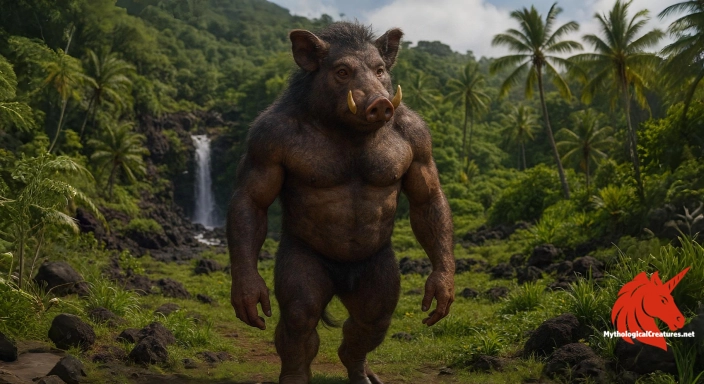
Kamapuaʻa
Kamapuaʻa - Represents fertility, transformation, and the untamed forces of nature in Hawaiian mythology
Origins & First Encounters
Kamapuaʻa is a striking figure in Hawaiian mythology whose narrative has been passed down through centuries of oral tradition.
Rooted in the lush cultural landscape of Hawaii, his origins intertwine divine and earthly influences as he is the progeny of Hina and the chief Kahikiula of Oahu.
Emerging as a hog-man fertility superhuman, Kamapuaʻa embodies the essential forces of nature and human desire, symbolising both virility and the transformative power of life.
His close association with Lono, the god of agriculture, underscores his role in nurturing the land and ensuring the cycles of growth and renewal.
The myths that celebrate his existence vividly capture the interplay between human aspiration and nature’s wild, untamed spirit.
Early attestations of his legend, though primarily transmitted orally, reflect the deep spiritual connection the Hawaiians held with their natural surroundings.
Told and retold amidst the resonance of ritual chants and communal gatherings, his story is equally a celebration of fertility and defiance.
Kamapuaʻa’s myth bridges the tangible realities of agrarian life with the intangible, potent forces of the divine, making him a timeless archetype of balance between order and chaos.
Source Texts & Tale Variants
Ancient Hawaiian chants and oral genealogies provide the primary sources for Kamapuaʻa’s legend, ensuring that his tale has endured through countless generations.
Traditional storytellers recited his adventures during significant cultural festivals and rites that linked humanity to the cycles of nature.
Various local accounts recount his persistent pursuit of the fire goddess Pele, a narrative that has undergone rich and varied reinterpretations over time.
Some narratives focus on his ingenious ability to transform destructive lava into fertile soil, symbolising regeneration and hope.
Other versions of the myth highlight his unruly character and his defiance toward both mortal authority and divine order.
Folkloric manuscripts and chants preserved in the traditions of the Hawaiian Islands further confirm the depth of his mythic presence.
As his stories were handed down orally, slight variations emerged, each colouring his character with unique regional and contextual nuances.
The diversity within these sources reflects not only the dynamism of oral heritage but also the flexible interpretation of his qualities as a demigod.
In modern times, efforts to document these accounts have enriched our understanding of Kamapuaʻa’s role in ancient Hawaiian society, thereby preserving his multifaceted legend.
These narrative strands, gathered from both sacred recitations and informal renditions, underline his continuing relevance in cultural history.
Form & Powers
Kamapuaʻa is depicted with an impressive blend of human and swine characteristics, symbolising his dual heritage that marries the natural with the supernatural.
His physique is robust and muscular, suggesting not only the physical vigour of a warrior but also an inherent connection to the untamed qualities of the wild boar.
A distinctive elongated snout and subtle tusks lend him a striking, almost otherworldly visage that is both imposing and enigmatic.
The texture of his hair is often compared to a wild, bristling mane, merging elements of coarse animal fur with the refined strands of human hair.
Artistic representations frequently capture his deep-set, expressive eyes, which shimmer with the unpredictable spirit that unites the realms of the earthly and the divine.
The warm, tawny hue of his skin echoes the rich volcanic soil, a metaphor for renewal and the fertile power of nature.
Adorned with traditional tattoos that interlace motifs of the land and sea, his body is a living canvas of Polynesian art and spiritual symbolism.
Variations in his portrayal sometimes emphasize a larger-than-life stature, reinforcing his status as a mythic entity beyond normal mortal limits.
Every element of his physical description is laden with metaphorical significance, articulating the intersection of natural instinct and cultivated civilisation.
Regional Faces
Regional variations in the legend of Kamapuaʻa reveal a rich tapestry of interpretations that highlight his multifaceted nature.
On Maui, he is often celebrated as a passionate force of nature, with stories that accentuate his ability to convert the harshness of volcanic eruptions into verdant, life-giving soil.
A contrasting portrayal is found in certain Oahu traditions, where his noble lineage and leadership qualities are underscored, reflecting a closer tie to the island’s historical hierarchy.
Along the coastal communities, local lore sometimes interweaves his identity with the image of the reef triggerfish, a creature symbolising agility and adaptability.
In these renditions, his interactions with both land and sea take on a symbolic significance that mirrors the duality of Hawaiian life.
Some remote island narratives imbue him with a more unpredictable and wild character, further emphasising his connection to untamed natural forces.
The visual and ritual depictions of Kamapuaʻa vary significantly across the islands, with some communities accentuating his swine-like features while others focus on his charismatic human traits.
The influence of Polynesian migration patterns has also introduced subtle elements from neighbouring mythologies, enriching his character further.
Throughout the Hawaiian archipelago, festivals, songs, and recitations continue to adapt his image in ways that reflect local environmental and cultural nuances.
Cultural Parallels
Kamapuaʻa’s myth resonates with similar dual-natured figures found in various parts of the world, creating fascinating points of cultural comparison.
His half-animal, half-human persona invokes images of Greek satyrs and Roman fauns, figures that similarly embody the untamed energies of nature alongside human impulses.
The motif of fertility linked with the wild boar can also be seen in mythologies where the pig is revered as a symbol of prosperity and renewal.
This duality further draws comparisons with shamanistic deities who operate at the border between civilization and the wild.
The transformation of destructive elements into creative, life-affirming forces in Kamapuaʻa’s legend has echoes in Western alchemical symbolism, where chaos often yields order.
His rebellious spirit and capacity for change link him to trickster deities in Native American lore, who challenge the established norms and stimulate transformation.
The universal narrative of reconciling the primal with the cultured is a recurring theme across many mythologies, underscoring the shared human experience of navigating the tension between nature and society.
These cultural parallels not only highlight the universal appeal of such hybrid figures but also illustrate how local myths can reflect broader, global narratives.
In comparative analysis, Kamapuaʻa’s character emerges as a dynamic archetype whose symbolism transcends regional boundaries, resonating with diverse audiences worldwide.
Legacy & Modern Evolution
Across the ages, Kamapuaʻa has evolved from a primarily agrarian demigod into a multi-dimensional symbol that embraces themes of resilience, transformation, and environmental stewardship.
Initially celebrated in hushed chants and communal ceremonies, his legend served as a cornerstone for fostering agricultural abundance and communal well-being.
With the passage of time, artistic renditions and literary reinterpretations have expanded his narrative, infusing it with modern sensibilities that speak to universal struggles between chaos and order.
Contemporary artists and cultural custodians have reimagined him as a living emblem of nature’s enduring spirit, a figure who transforms adversity into fertility and hope.
His myth has also been embraced in environmental discourses, where his power to convert destructive elements into land capable of yielding life echoes the modern challenges of ecological restoration.
Public celebrations and festivals continue to place Kamapuaʻa at the heart of Hawaiian cultural identity, reinforcing the importance of heritage and tradition amidst a rapidly changing world.
The association of his legend with symbols such as the reef triggerfish not only cements his place in local lore but also reinforces the connection between myth and the natural environment.
In academic and popular discussions alike, he stands as a figure who bridges ancient wisdom and contemporary values, offering insights into how communities can harness the transformative power of nature.
Today, Kamapuaʻa endures not merely as a relic of the past but as an evolving myth that continuously inspires reinterpretation, bridging the gap between tradition and modernity.
Interesting Fact
Kamapuaʻa’s myth uniquely intertwines volcanic fire and fertile earth, symbolising the transformative power of nature in Hawaiian culture.
For serious mythcraft
Your project belongs among the legends
If your work deepens how people understand, play with, or teach mythology, a sponsor placement here keeps it in front of the right readers all year.
Submit a sponsorship enquiryQuick Creature Info
Origin:
Associations:
Our Mythic Legendary Rating:

Habitat:
Supernatural Powers:
Physical Attributes:
Abilities:
Behavior:
Lore:
Related Creatures, Tales or Lore
- MMaui
- PPigsy (Zhu Bajie)
- MMinotaur
References
Discover Another Mythical Legend You May Not Have Heard Of?
Uncover the mysteries of ancient folklore and expand your knowledge of legendary beings from cultures around the world.
Dare to Meet the Tašmišu....

Curated by the Mythological Creatures Team
Series editor: Mythological Creatures Directory
Primary desk: Asian & Pacific Myth Cycles Desk
(rev. November 2025)