
Karnabo: Karnabo is a hybrid creature from Ardennes folklore with the appearance of a man, an elephant's trunk, and basilisk-like eyes.
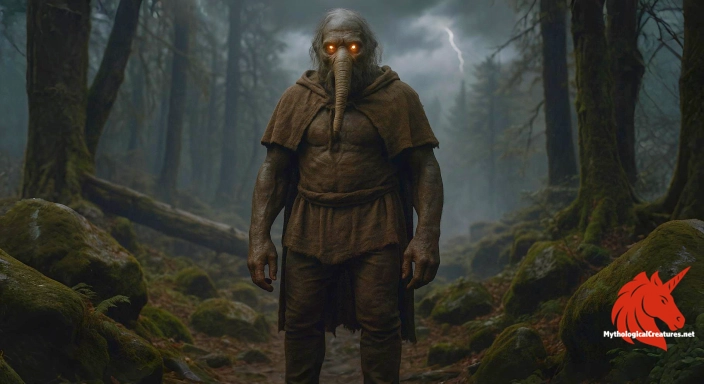
Karnabo
Karnabo - Serves as a cautionary emblem of the dangers lurking in the wild and the unexpected consequences of unnatural unions.
Origins & First Encounters
The Karnabo emerges from the shadowed mists of Ardennes folklore as a creature both enigmatic and fearsome, capturing the imagination of local villagers and travelling storytellers alike. Born of an uncanny union between a supernatural entity and a Bohemian traveller reputed to possess sorcerous qualities, the Karnabo has long been a subject of deep local myth and speculation. Its origins, steeped in mystery and tragedy, suggest a lineage that bridges the natural world and a realm of dark magic. Throughout the ages, this hybrid being has been portrayed as a living symbol of the precarious interplay between man and the supernatural. Local oral traditions recount its early sightings during turbulent thunderstorms, creating an indelible link between natural phenomena and myth. Its very first attestation is believed to be embedded in the pre-modern narratives of the Ardennes, where the creature served as a harbinger of both wonder and terror. Artists and minstrels of yore portrayed the Karnabo as a cautionary emblem whose features defied the ordinary, inviting both admiration and dread. Over time, its legend has evolved into a rich tapestry of human ingenuity and the mysterious forces that haunt the darker corners of folklore.
Source Texts & Tale Variants
The primary sources for the lore of the Karnabo are as varied as the tales told around ancient hearths, with several manuscripts and oral accounts preserving its memory. In fragmented medieval chronicles, the creature is described as the offspring of a demonic force and a travelling sorcerer, a detail that has been alternately rendered as either an act of cursed fate or forbidden magic. Some local folktales expand on this origin story by suggesting that its supernatural attributes were born of an ill-starred pact with dark powers. Diverse story variants depict the Karnabo not only as a terror of the night but also as a warning against the perils of untethered ambition and the crossing of sacred boundaries. The creature’s mythos is interwoven into ballads recited by travelling minstrels and chronicled in the oral traditions of isolated mountain hamlets. Intriguing discrepancies have been noted in older recitations where the features of its monstrous appearance are sometimes accented, while other times, the focus falls on the sorrowful tale of its alleged abduction of a young girl. In some accounts, the creature appears as an omen during storms, its presence used to rationalise the unpredictable wrath of nature. Despite the fragmentary nature of these sources, each variant contributes to a composite picture of a being that has both haunted and fascinated generations.
Form & Powers
The Karnabo’s physicality is as extraordinary as it is unsettling, combining humanoid traits with features of the animal kingdom in a most uncanny manner. Its overall form is that of a man, yet the most striking aspect is the elephantine trunk that replaces what would normally be a human nose, lending an aura of both majesty and menace. The creature’s eyes, reminiscent of a basilisk, are said to gleam with a perilous intensity that can freeze onlookers in their tracks, adding a layer of supernatural terror to its appearance. Its skin is often depicted as rough and earthy, mirroring the texture of ancient tree bark and lending a sense of timelessness to its form. Variations in descriptions suggest that the Karnabo’s stature can range from imposing to deceptively deceptive, with some versions detailing a towering presence and others hinting at an agile, wiry build. The juxtaposition of human posture with animalistic attributes creates a visual that is at once familiar and alien. Notably, the creature’s breath is as infamous as its gaze, reputed to emit a noxious, paralyzing vapour that can immobilise humans and prove deadly to animals. Every element of its anatomy, from the muscular structure beneath its skin to the eerie, trumpet-like quality of its vocal expressions, reinforces the impression of an otherworldly being born from both myth and malady.
Regional Faces
While the Karnabo is most closely associated with the distinctive folklore of the Ardennes, its legend has found echoes in neighbouring regions through subtle shifts in narrative and description. Variants of the tale appear in neighbouring parts of Western Europe, where local colour has woven new attributes into the creature’s already complex myth. In some areas, the Karnabo is reimagined as a spectral guardian of ancient woodlands, its formidable presence tied to specific natural landmarks or weather patterns. Rural communities have sometimes portrayed the creature as a portent of misfortune, its appearance linked with fluctuations in the local environment such as unusually fierce storms or bountiful harvest failures. Urban adaptations, though rarer, tend to emphasize its tragic origins and the cursed legacy of its mixed heritage. The creature’s portrayal in these different locales often reflects local concerns, with its monstrous visage serving as a metaphor for the disruptive forces that challenge established social orders. In the far reaches of regional lore, slight modifications to its physical attributes—as in a more subdued trunk or a subtler menacing gaze—reflect regional tastes and the varying intensity of local superstitions. Yet, despite these regional variations, the core elements of the Karnabo myth remain steadfast, ensuring it retains a universally recognisable identity across the folklore of Europe.
Cultural Parallels
A comparative exploration reveals that the Karnabo shares intriguing similarities with other mythic hybrids found throughout European folklore and beyond. Much like the Chimera of ancient mythology, the Karnabo embodies a fusion of disparate elements—a blending of human, animal, and supernatural traits that challenges conventional boundaries of form and nature. Its basilisk-like eyes evoke parallels with other legendary creatures whose gazes are imbued with lethal power, such as the feared Medusa of Greek lore. In a similar vein, the creature’s petrifying breath calls to mind other mythic entities whose mere presence can bring calamity, echoing the ominous legends of serpentine and vampiric figures across cultures. This cross-cultural phenomenon, where hybrids symbolise both the potential for greatness and the inherent danger of unbridled power, is a recurring theme in myth. The Karnabo also resonates with the archetypal motif of the fallen or cursed entity, a narrative found in the stories of beings like the Wendigo in North American folklore. Such comparisons highlight a universal human tendency to personify and mystify the unknown by crafting beings that reflect society’s deepest anxieties and moral quandaries. Through these cultural parallels, the Karnabo stands as a distinctive yet interconnected figure within a rich tapestry of mythological tradition.
Legacy & Modern Evolution
Throughout history, the depiction of the Karnabo has undergone a significant evolution, mirroring shifts in cultural attitudes toward the supernatural and the unknown. Initially, the creature was recounted in oral traditions as an almost exclusively malevolent force, emblematic of nature’s unpredictability and the dire consequences of straying into forbidden territories. Over centuries, its imagery has been refined and reinterpreted, transitioning from a mere spectral terror into a more nuanced symbol reflecting the complex interplay between fate and free will. In modern literature and visual arts, the Karnabo is occasionally cast in the light of an antihero, whose tragic origins and peripheral humanity invite a reevaluation of its monstrous nature. Contemporary adaptations often infuse its character with layers of psychological depth, exploring themes of isolation, transformation, and the burden of ancestral curses. This modern legacy is bolstered by creative reinterpretations in films, graphic novels, and even digital media, where the creature embodies the eternal struggle between light and dark forces. Festivals and cultural exhibitions in the Ardennes sometimes honour the Karnabo through artistic representations that pay homage to its storied past while inviting new narratives. This enduring evolution of the myth ensures that the Karnabo remains a potent symbol, bridging the ancient mysteries of folklore with the innovative expressions of modern storytelling.
Interesting Fact
An intriguing aspect of Karnabo is its composite nature, merging features from different species—a human body, an elephant's trunk, and basilisk eyes—which symbolically underscores the unpredictable outcomes of unions between the natural and supernatural worlds.
Curated sponsor space
One subtle banner. Thousands of myth lovers.
We offer a small number of curated sponsor spots for relevant books, courses, games, and art. No clutter, just well-matched partners.
Partner with usQuick Creature Info
Features:
Our Mythic Legendary Rating:

Habitat:
Supernatural Powers:
Physical Attributes:
Abilities:
Behavior:
Lore:
Related Creatures, Tales or Lore
References
Discover Another Mythical Legend You May Not Have Heard Of?
Uncover the mysteries of ancient folklore and expand your knowledge of legendary beings from cultures around the world.
Dare to Meet the Olokun....

Curated by the Mythological Creatures Team
Series editor: Mythological Creatures Directory
Primary desk: Northern & European Folklore Desk
(rev. November 2025)