
Keres: The Keres are female death-spirits from Greek mythology that personify violent death, particularly on battlefields.
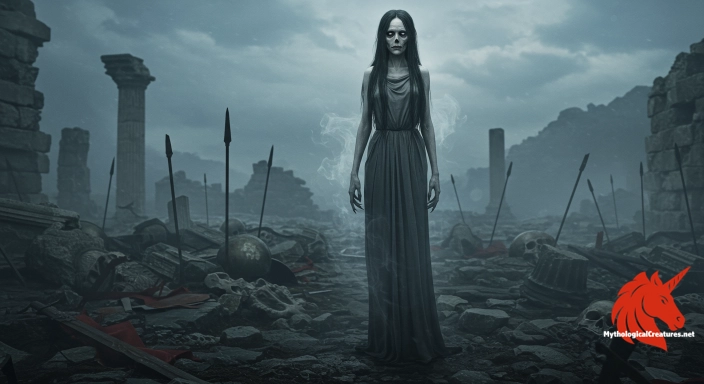
Keres
Keres - The Keres embody the grim aspects of violent death and the inevitability of mortality, serving as a poignant reminder of death's omnipresence in battle.
Origins & First Encounters
The Keres represent one of the most chilling aspects of ancient Greek mythology, embodying the relentless force of violent death on battlefields. Born of the primordial night goddess Nyx, they emerged amidst a pantheon of enigmatic entities that framed the ancient understanding of fate and mortality. Their earliest mentions place them at the intersection of life and death, where the raw chaos of combat meets the inexorable pull of the afterlife. As female death-spirits, the Keres were not the agents who actively ended life but rather ominous presences who waited to partake in the aftermath. Their existence reflects a complex cultural engagement with the darker dimensions of human experience, particularly in societies frequently scarred by warfare. They are often depicted as silent harbingers whose very presence foreshadows doom and the inescapability of demise. The integration of their myth with the destinies overseen by accompanying deities like the Moirai and Thanatos deepens the symbolic network of fate. Ambiguities in their portrayal—such as the distinction introduced by Hesiod through the singular form Ker—underscore a layered mythological nuance. In this way, the Keres encapsulate both terror and fascination, resonating through ancient narratives as much as through modern reflections on death. Their legacy, steeped in darkness and inevitability, continues to capture the imagination of those who seek to understand the mysteries surrounding the end of life.
Source Texts & Tale Variants
Classical texts such as Hesiod’s Theogony provide some of the earliest glimpses into the realm of the Keres, painting them as inexorable witnesses on the battlefields of mortal strife. These ancient sources offer succinct yet potent references that situate the Keres within the broader framework of divine agents linked to death. Later Roman writers, including Cicero, expanded upon this myth by referring to them as the Tenebrae, thus integrating Greek traditions into a Roman narrative of darkness. Some literary accounts introduce variations in their origin, with certain texts naming Erebus alongside Nyx as their progenitor. Fragments of epic poetry and scholia further allude to these intimidating spirits during moments of violent conflict. Over time, folk traditions absorbed and expanded these early narratives, embellishing them with local interpretations and symbolic resonances. These diverse sources collectively enrich our understanding of the Keres, even as they leave aspects of their nature open to interpretation. Multiple narrative threads converge, reflecting evolving cultural attitudes towards destiny, death, and the supernatural. Variations in the stories underscore a broader mythological dialogue about the forces that preside over mortality. In sum, the interplay between different ancient and medieval texts underscores the versatility and enduring intrigue of these spectral figures.
Form & Powers
Visually, the Keres are often imagined as shadowy, spectral figures whose forms oscillate between ethereal beauty and stark terror. Artists and ancient poets alike have struggled to definitively capture their appearance, resulting in a legacy of ambiguity and mythic allure. Their manifestations are sometimes depicted as shifting silhouettes, with flowing, tattered vestments that seem to merge with the darkened skies of nocturnal battlefields. In various interpretations, hints of elongated limbs and an eerie luminescence are discernible, lending them an otherworldly quality. Many accounts evoke the unsettling image of eyes that glow with a supernatural light, symbolising their eternal vigil over the slain. The descriptions remain purposefully vague, reinforcing the idea that the Keres are embodiments of death rather than conventional human forms. This inherent vagueness allows for a rich tapestry of visual interpretations, where mood and atmosphere take precedence over precise anatomy. The interplay of light and shadow in artistic renditions enhances their role as liminal figures caught between corporeality and the immaterial. Such fluid visual identities invite ongoing reinterpretation, reflecting the timeless nature of their myth. Ultimately, the physical portrayals of the Keres underscore their function as both terrifying omens and essential components of the ancient mythological cosmos.
Regional Faces
Ancient Greek lore provides the primary backdrop for the Keres, yet their depiction has been subject to significant regional variation across different cultures and epochs. In many parts of the Hellenic world, they are intimately associated with the brutality of warfare and the inevitable decay that follows violent death. Local traditions often imbue these spirits with additional layers of ritualistic significance, positioning them as both omens and preservers of cosmic balance. Under Roman influence, the transformation of their identity into the Tenebrae brought forward new symbolic associations with darkness and despair. Distinct regional artistic traditions incorporated local motifs into their depiction, thereby producing a diverse array of visual representations. During the Renaissance in parts of southern Europe, revived interest in classical mythology saw the Keres reimagined with both fearsome and elegiac overtones. In the Eastern Mediterranean, narratives sometimes extend their influence to matters of destiny beyond the battlefield, portraying them as multifaceted arbiters of fate. Local folklore, with its rich blend of superstition and ritual, has enriched the myth with nuances that vary markedly from one region to another. Such diversity in portrayal speaks to a universal human drive to explain and personify the forces behind mortality. Ultimately, these regional adaptations highlight how a single mythological concept can traverse cultural boundaries and acquire multiple layers of meaning.
Cultural Parallels
A comparative exploration across world mythologies reveals that the Keres resonate with similar figures found in many cultural traditions. Norse mythology, for example, introduces the Valkyries, who, while primarily tasked with selecting the honoured dead for Valhalla, share an association with the dramatic realities of battle. In the realm of Japanese folklore, shinigami fulfil a somewhat parallel role, guiding souls between worlds much like the Keres signal the transition from life to death. These cross-cultural echoes underscore a shared human preoccupation with the impermanence of life and the mysteries surrounding death. While the Keres are often observed as passive yet fearsome witnesses to demise, other traditions sometimes portray their equivalents as more proactive agents in the fate of souls. This diversity in narrative function illustrates the broad spectrum of ideas regarding mortality that have emerged in different societies. Both Eastern and Western cultural narratives frequently blend elements of terror and transcendence, using such figures to symbolise the delicate balance between creation and destruction. The symbolic overlap among these diverse mythic entities reveals a universal dialogue on the nature of the end of life. By juxtaposing the Keres with their counterparts in other traditions, we gain insight into the shared cultural motifs that underpin humanity’s understanding of death. In essence, the comparative study of these mythological figures speaks to a timeless, cross-cultural engagement with the inevitable and enigmatic nature of mortality.
Legacy & Modern Evolution
Over the centuries, the myth of the Keres has undergone significant transformation, adapting to shifting cultural and philosophical landscapes. In classical antiquity, they were integral to a cosmology that embraced both the beauty and brutality inherent in the cycle of life and death. The Middle Ages saw a subtle reconfiguration of their image as Christian interpretations gradually overshadowed the classical pantheon, though the allure of these dark spirits remained intact. The Renaissance rekindled interest in ancient myths, prompting artists and writers to explore and evoke the enigmatic qualities of the Keres. In modern literature, film, and art, these death-spirits have been reimagined in myriad ways, from spectral antiheroes in horror genres to potent symbols in graphic novels and video games. Contemporary interpretations often intertwine the myth with broader discussions on mortality, loss, and the human condition. Digital media have further opened up avenues for dynamic portrayals that bridge ancient imagery with modern existential themes. Their persistent presence in popular culture and academic discourse attests to the timeless resonance of their mythic power. As modern storytellers continue to delve into themes of fate and demise, the Keres stand out as enduring icons of the inevitable collision between life and death. In this way, their evolving legacy serves as a powerful reminder of how ancient myth continues to shape and reflect contemporary concerns about existence.
Interesting Fact
Despite their association with death, the Keres possess no power to kill; they are merely drawn to the fallout of battle, feasting on the dead and epitomising the inevitability of mortality.
Mythology-aligned partners
Showcase your myth-friendly brand here
Run a store, studio, or platform that lives in the world of myth and folklore? A curated sponsor panel on these pages may fit.
Explore partnership optionsQuick Creature Info
Origin:
Associations:
Our Mythic Legendary Rating:

Also Sometimes Known As:
Habitat:
Supernatural Powers:
Physical Attributes:
Abilities:
Behavior:
Lore:
Related Creatures, Tales or Lore
- EErinyes (Furies)
- VValkyries
- BBanshee
References
Discover Another Mythical Legend You May Not Have Heard Of?
Uncover the mysteries of ancient folklore and expand your knowledge of legendary beings from cultures around the world.
Dare to Meet the Nerites....
-6022acfe-120c-49e2-b22f-bc4c5fed7efa_small.webp "Depiction of Nerites")
Curated by the Mythological Creatures Team
Series editor: Mythological Creatures Directory
Primary desk: Hellenic & Ancient Mediterranean Desk
(rev. November 2025)