
Kinnara: The Kinnara are mythological hybrids from Hindu and Buddhist traditions, combining human and avian features.
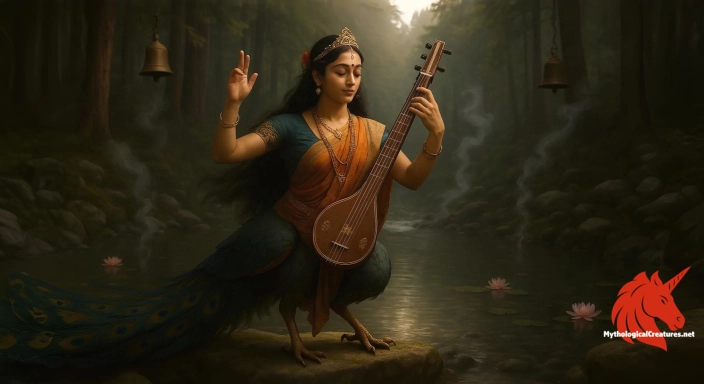
Kinnara
Kinnara - Kinnara symbolize eternal love, artistic excellence, and protective oversight of human well-being.
the legend in five swipes.
the legend in five swipes.
How did the legend of the Kinnara begin?
The kinnara is one of the most captivating figures in Hindu and Buddhist mythology, a creature that seamlessly blends human sensibilities with the ethereal qualities of birds. Emerging from the ancient cultural tapestry of the Indian subcontinent, the kinnara has long been celebrated as a symbol of music, love, and divine beauty. Its origins are shrouded in the mystique of the Himalayas, where the interplay of earthly passion and celestial grace is deeply embedded in local lore. The creature embodies a dual nature that reconciles human emotion with the natural elegance of an avian spirit. Over time, its portrayal in art and literature has cemented this being as a guardian of human well‐being during moments of peril. Rich narratives passed down through generations depict the kinnara as both a muse to artists and a benevolent protector. Its association with music is underscored by the ancient kinnari vina, an instrument that evokes the sublime harmony of its nature. The kinnara’s legendary status is further enhanced by its portrayal in epic texts and temple carvings, where its timeless beauty fascinates devotees and scholars alike. Legends present it as a creature of perpetual allure, inspiring meditations on love and aesthetic perfection. This synthesis of myth and artistry has rendered the kinnara an enduring emblem of the cultural and spiritual heritage of its region.
The Documented Accounts of the Kinnara
Ancient epic texts such as the Mahabharata have provided some of the earliest attestations of the kinnara, where narratives celebrate it as an eternal romantic duo. Vivid passages in the Adi Parva articulate the intimacy and unbroken union of these celestial beings. Buddhist literature, including the Jataka tales and the profound Lotus Sutra, further embellishes their myth through tales of supernatural benevolence and sublime artistry. These ancient sources collectively position the kinnara as a figure who melds human passion with divine aura. Over centuries, a range of story variants has emerged, each highlighting different aspects of their musical and loving nature. Some texts focus on their role as guardians who offer solace in times of trouble, while others accentuate their association with creative genius. Local oral traditions, especially in parts of Southeast Asia, have adapted these foundational narratives with distinct regional flavours. TheMultiple textual versions underline a common thematic focus on eternal love and artistic expression. Such diverse sources attest to a rich tradition where myth, music, and romance intertwine to celebrate the kinnara's multifaceted persona. Through these myriad literary sources, the creature has come to symbolize a harmonious balance between the mortal and the divine.
What did the Kinnara look like?
The kinnara is traditionally depicted with an exquisite fusion of human and avian characteristics, creating an image that is both otherworldly and graceful. Its human form is often complemented by features such as delicate wings, a feathered tail, and bird-like feet, which collectively evoke a sense of celestial splendour. Artists have portrayed its visage as radiating calm intelligence and an inherent musicality, setting it apart from ordinary mortals. The wings, depicted with intricate detail, are not merely symbolic but serve as an artistic celebration of nature’s beauty. In some illustrations, the creature’s plumage shimmers with variations of soft, natural hues, imbuing it with a luminous quality that enhances its divine image. The anatomical balance between its human torso and avian appendages symbolizes the convergence of earthbound emotion and heavenly grace. Its posture is often rendered with a refined elegance that accentuates both strength and delicacy. Variations in size and proportion can be observed across different artworks, reflecting regional aesthetic choices and cultural influences. Every element, from the curve of its beak to the subtle texture of its feathers, is carefully crafted to evoke feelings of awe and enchantment. This meticulous integration of features ensures that the kinnara remains a striking and enduring icon of mythological artistry.
How does the Kinnara differ by region?
Regional depictions of the kinnara reveal a rich tapestry of cultural reinterpretations and local artistic flourishes. In the Indian subcontinent, traditional depictions often integrate the kinnara into temple carvings and classical literature, emphasising its associations with divine love and musical brilliance. Conversely, in Southeast Asia, the emphasis frequently shifts toward the female counterpart, the kinnari, celebrated as a figure of grace and beauty. In these regions, the creature is often adorned with intricate motifs and vibrant colours reflective of local cultural aesthetics. The regional narratives infuse the kinnara with unique roles, such as protectors of sacred spaces and embodiments of natural harmony. Distinct variations in physical attributes—such as the length and pattern of feathers, the shape of the wings, and even subtle differences in attire—underscore the vibrant interplay between local myth and pan-Asian traditions. Traditional dance and performance art across these cultures further illustrate how the kinnara’s image has been adapted to suit festive, spiritual, and communal expressions. Such local adaptations not only demonstrate the versatility of the myth but also reinforce its universal appeal. By merging indigenous artistic traditions with the broader mythological framework, regional communities have imbued the kinnara with diverse layers of meaning. This multiplicity of interpretations has enriched its legacy, ensuring that the creature resonates with audiences across various cultural landscapes.
Is the Kinnara unique, or found elsewhere?
The kinnara occupies a unique niche in the realm of mythological hybrids, offering a fascinating parallel to other legendary beings that merge human and animal traits. Unlike Greek sirens or harpies, which are often portrayed with malevolent intent, the kinnara is celebrated for its embodiment of art, music, and eternal love. This positive portrayal starkly contrasts with some Western depictions of similar creatures, highlighting the cultural divergence in mythic symbolism. The dual nature of the kinnara, blending terrestrial human qualities with the freedom of avian forms, is reminiscent of hybrid creatures found in other Eastern mythologies. Comparisons can be drawn to the Persian Simurgh and even to deific figures in Chinese lore, where the confluence of natural beauty and spiritual insight is a recurring theme. Unlike many hybrids that symbolise chaos or dualism, the kinnara represents a seamless fusion of contrasting realms and ideals. Its presence as both muse and guardian underscores an underlying philosophy that values balance and harmonious coexistence. These cross-cultural parallels shed light on universal human aspirations towards beauty, artistic expression, and transcendence. The kinnara thus serves as a bridge connecting distant mythological traditions, promoting a shared cultural dialogue that transcends geographical boundaries. In doing so, it reinforces the idea that beauty and art are fundamental to diverse human experiences across time and space.
Kinnara: The Modern Legacy
The historical evolution of the kinnara is a testament to its enduring power as a symbol of artistic and spiritual aspiration. From ancient carvings and classical manuscripts to modern artworks and literature, its image has continuously evolved while remaining true to its core themes of love, music, and celestial beauty. The creature has long been a favourite subject in temple art and traditional performances, where its image serves both decorative and allegorical purposes. Contemporary artists and storytellers have reimagined the kinnara as a dynamic emblem of freedom, creativity, and eternal passion. Modern cultural expressions incorporate its myth into various media, bridging the gap between ancient iconography and modern aesthetics. The evolving depictions also reflect ongoing dialogues between Eastern and Western artistic traditions, highlighting the kinnara’s versatility in symbolising universal values. Its representation in festivals, literature, and even cinematic portrayals underscores a legacy that is as vibrant as it is enduring. As interpretations shift with the times, the kinnara continues to inspire new generations with its timeless allure and mystical resonance. By adapting to contemporary narratives while honouring its mythological roots, the kinnara maintains its role as a potent cultural symbol. The creature’s legacy, imbued with themes of eternal love and creative excellence, ensures that its myth remains an ever-evolving part of our collective imagination.
Interesting Fact
An intriguing observation about the Kinnara is that their eternal union manifests in a love so perfect that they never become parents, emphasising the purity and continuity of their bond.
Mythological Treasures
Chinese Beasts: A field guide to the dragons and demon kings of Chinese myth
From river dragons to demon kings, with the legends that shaped five thousand years of storytelling.
Japanese Yokai: A field guide to the spirits and demons of Japanese folklore
Fifteen spirits, with the signs to watch for and what the old tales say to do if you meet one.
Greek Myths: A field guide to the monsters of ancient Greece
Every monster here earned its place in legend, and each gets a full page of artwork and the story behind it.
the legend in five swipes.
Partner with Mythological Creatures
Bring your myth-based world into ours
From game settings to narrative worlds, we work with partners who treat myths with care. Share your project for a potential sponsor slot.
Partner with usQuick Creature Info
Features:
Associations:
Our Mythic Legendary Rating:

Also Sometimes Known As:
Habitat:
Supernatural Powers:
Physical Attributes:
Abilities:
Behavior:
Lore:
Related Creatures, Tales or Lore
- KKinnari
- KKalaviṅka
- GGandharva
References
Discover Another Mythical Legend You May Not Have Heard Of?
Uncover the mysteries of ancient folklore and expand your knowledge of legendary beings from cultures around the world.
Dare to Meet the Oilliphéist....

The Mythological Creatures Book Series
Yokai, Greek, Norse, Egyptian & Chinese. Five illustrated field guides to the creatures the old stories either warned or told you about.


Curated by the Mythological Creatures Team
Series editor: Mythological Creatures Directory
Primary desk: Asian & Pacific Myth Cycles Desk
(rev. November 2025)