
Kulilu: Kulilu is a Babylonian destructive spirit, depicted as a hybrid of man and fish.
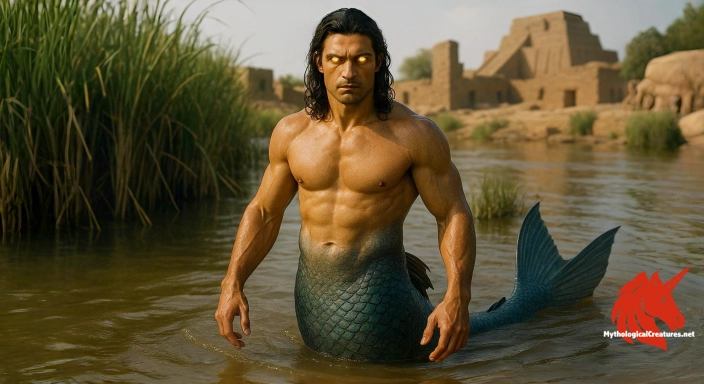
Kulilu
Kulilu - Represents chaos and destructive forces in Babylonian mythology.
Origins & First Encounters
Kulilu emerges from ancient Babylonian lore as a captivating symbol of nature's unpredictable ferocity and enigma. Born from a world where myth and the human condition intertwine, his hybrid form of man and fish encapsulates the tension between civilisation and the untamed wild. His origins are deeply embedded in the fertile yet volatile mythic traditions of Mesopotamia, offering a glimpse into a time when natural forces were both revered and feared. Early impressions in the annals of myth hint at a creature whose ambiguous nature defied simple categorisation as either divine or demonic. The narrative of his existence reflects a civilisation grappling with the chaos inherent in the natural world and the mystery of life itself. He may have first been noted on ancient clay tablets, where ephemeral inscriptions recorded his dreadful allure and moral symbolism. His blended form symbolises the merging of human ingenuity with the raw power of aquatic realms, a recurring motif in ancient storytelling. The cultural context of his legend reveals a people in constant negotiation with the unpredictable forces around them. His enduring myth continues to fascinate and unsettle, reverberating through later traditions and modern interpretations. Many contemporary views regard Kulilu as a metaphor for the eternal struggle between order and chaos.
Source Texts & Tale Variants
Ancient records and fragmented literary texts provide the primary glimpses into the lore of Kulilu. Sparse yet evocative cuneiform inscriptions hint at his origin during epochs of natural turmoil and societal flux. Some delicate texts reference a spirit whose dual anatomy embodied the capricious power of water mingled with human frailty. Variants found on archaeological tablets often allude to him as an omen of impending floods and disruptions in the natural order. Oral traditions later enriched these sparse accounts, adding layers of narrative complexity that varied across regions. In several parts of the ancient Near East, recounting of his deeds intertwines with local myths of destruction and rebirth. These accounts, although sometimes contradictory, converge on the theme of nature’s inexorable retribution. Subsequent translations of these texts further amplified his role as a force that both punishes and transforms. Multiple variants of the story present Kulilu as entangled in cosmic events where moral decay meets environmental catastrophe. The cumulative narrative, drawn from a mosaic of sources, ensures that his legend remains a subject of enduring fascination.
Form & Powers
Visually striking, Kulilu’s form presents a vivid blend of human features and aquatic elegance. His upper body retains the familiar contours of a man, marked by weathered skin and deep-set eyes that gleam with an ancient intensity. Beneath the waist, his form transitions into the sleek, scaled body of a fish, with iridescent scales that shimmer in mysterious hues. The merger of flesh and scale is rendered with intricate detail, where natural markings trace the boundary between his human and aquatic sides. His limbs, rugged and sinewy, hint at both mortal strength and the fluid grace of water-dwelling creatures. Artistic depictions suggest that his webbed fingers and subtle fin-like protrusions serve both as symbols of his dual origin and as tools for navigating turbulent aquatic realms. A crescent-shaped tail fin often features in representations, adding an element of enigmatic beauty and latent menace. The overall symmetry of his body is unsettling, evoking the notion of a cursed union between man and beast. Variations in his portrayal depict him as either a towering, formidable figure or as a spectral, elusive presence emerging from dark waters.
Regional Faces
Across the ancient lands of Mesopotamia, the image of Kulilu has been subject to diverse reinterpretations that reflect local artistic and cultural nuances. In some regions his character is embraced as a mysterious guardian of the water, while in others he is a harbinger of disaster and moral decline. Variations of his myth incorporate aspects of local deities and ancestral spirits, blending his identity with broader narratives about the capricious nature of water. In the lush river valleys, tales cast him as a symbol of the dual power of floods, seen as both life-giving and devastating. In contrast, communities in drier areas emphasise his aquatic traits to highlight the stark contrast between the bounty of water and its potential for destruction. Folk narratives sometimes reimagine him as a tragic figure whose wrath stems from betrayal or cosmic imbalance. Local adaptations also touch upon his connection to seasonal cycles and the natural rhythms of the land. Diverse artistic representations, from relief carvings to later folk paintings, capture these shifting perspectives. Such regional variations have enriched his legend, ensuring that Kulilu remains relevant across a tapestry of cultural narratives.
Cultural Parallels
In the broader tapestry of world mythology, Kulilu finds intriguing parallels with other hybrid beings that dwell on the border between the human world and the mysterious realm of water. Figures such as the European merman or the folkloric mermaid share his enchanting yet fearsome duality. In Indian myth, creatures like the Makara similarly combine aquatic features with human elements, symbolising the unpredictable power of water. Across the Near East, legendary hybrids frequently represent the tension between civilisation and the natural environment, a role that Kulilu exemplifies. The recurring motif of merging man with aquatic traits reflects a cross-cultural attempt to articulate the forces that lie hidden beneath the surface of everyday life. Many cultures use such beings as metaphors for the transformative and sometimes destructive aspects of nature. The similarities in their portrayals speak to a universal fascination with the interplay of beauty and terror. Each tradition employs these figures to articulate a deep-seated ambivalence toward nature’s bounty and fury. Comparative analysis of these myths reveals how the motif of a half-man, half-fish creature serves as a symbolic bridge linking disparate cultural visions of chaos and order.
Legacy & Modern Evolution
Over the centuries, the depiction of Kulilu has undergone a dramatic evolution, transforming from an obscure, fearsome spirit into a multifaceted symbol infused with contemporary relevance. Early mythic sources cast him as an embodiment of raw chaos and the destructive potential of natural forces. As artistic and literary interpretations matured, he began to be portrayed with a complexity that allowed for both destructive and redemptive dimensions. In recent times, his image has been reimagined in art, literature, and digital media, often as a tragic anti-hero contending with inner turmoil and external crisis. Modern retellings have infused his character with themes of environmental anxiety and the collision between tradition and modernity. Film makers and graphic novelists have drawn on his ancient narrative to explore the liminal spaces between human civilisation and untamed nature. His enduring myth now resonates in contexts that question the sustainability of human progress and environmental balance. Contemporary cultural movements occasionally invoke his legend as a reminder of the deep, often indomitable forces of nature. The evolution of Kulilu’s portrayal reflects a dynamic interplay of historical memory, artistic reinterpretation, and modern-day symbolism, ensuring that his legacy continues to provoke thought and inspire awe.
Interesting Fact
Kulilu uniquely bridges the gap between man and aquatic life, reflecting ancient Babylonian views on the duality of nature.
Partner with us
Sponsor this space
Reach thousands of mythology enthusiasts with a curated placement on our creature pages.
Learn about sponsorshipQuick Creature Info
Origin:
Features:
Associations:
Our Mythic Legendary Rating:

Habitat:
Supernatural Powers:
Physical Attributes:
Abilities:
Behavior:
Lore:
References
Discover Another Mythical Legend You May Not Have Heard Of?
Uncover the mysteries of ancient folklore and expand your knowledge of legendary beings from cultures around the world.
Dare to Meet the Hemaraja....
Curated by the Mythological Creatures Team
Series editor: Mythological Creatures Directory
Primary desk: Hellenic & Ancient Mediterranean Desk
(rev. November 2025)