
Kulullû: Kulullü, known as the Fish-Man, is an ancient Mesopotamian mythical monster with a composite human and fish form.
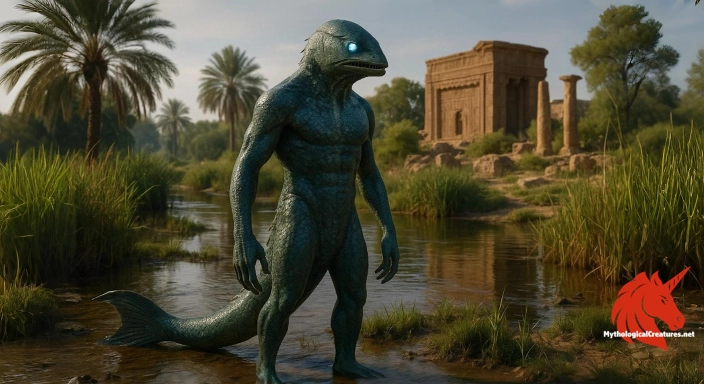
Kulullû
Kulullû - Kulullü represents the integration of aquatic symbolism into Mesopotamian myth and the transmission of divine attributes from Ea to Marduk
Origins & First Encounters
Kulullü emerges from the shadows of ancient Mesopotamia as a striking embodiment of mystical aquatic power and human form. Its origins seem to be intertwined with the early mythic narratives of the region, where the convergence of water and divinity created legendary beings. This creature, often called the 'Fish-Man', is thought to have been inherited by the mighty god Marduk from his legendary father, Ea, suggesting a deep ancestral link within the pantheon. Its earliest attestation is found in ritualistic inscriptions that reveal a complex tapestry of religious beliefs and myth-making. The creature’s creation myth reflects the intricate interplay between nature and the divine, a theme central to many Mesopotamian cultural expressions. Local artistic representations and temple iconography speak to a revered status that transcended mere folklore. Worship and symbolism were interwoven into the creature's depiction, with its aquatic qualities symbolising both fertility and danger. The legacy of Kulullü is firmly situated within a cultural framework that celebrated the mysteries of water as a source of life and cosmic power. Over time, Kulullü came to stand as a testament to the ingenuity of early mythmakers, whose stories continue to inspire awe in modern interpretations.
Source Texts & Tale Variants
Ancient texts and administrative records serve as the primary window into the enigmatic world of Kulullü. Inscriptions found on temple statues at the Nabû temple in Nimrud as well as related cuneiform tablets provide a fragmented but rich account of the creature's existence. These records point to a sophisticated tradition of integrating both masculine and feminine aquatic deities, as seen in the association with kuliltu, the Fish-Woman. Beyond the inscriptions, there are administrative documents that attest to the ritualistic reverence given to these figures. Variations in the narrative appear in different copies of texts, suggesting that the creature’s myth evolved over time. Some texts describe Kulullü in terms that emphasise its protective qualities, while others illuminate its more mysterious, liminal nature. The textual evidence, though limited in volume, offers glimpses into a broader mythological tradition where aquatic beings played a key role in the religious life of ancient Mesopotamia. Artefacts and artistic depictions complement these texts, providing a visual record that enriches our understanding. The multiplicity of sources contributes to an evolving story that highlights the fluid nature of ancient myth-making, where each retelling added new layers of meaning.
Form & Powers
Kulullü is envisioned as a remarkable synthesis of human and piscine elements, merging the familiar with the fantastical. Its body is typically depicted with a human torso that transitions seamlessly into features more reminiscent of aquatic creatures, such as scaled skin and subtle fin-like protuberances along the arms and legs. The face of Kulullü is said to combine expressive, deep-set eyes with a structure that hints at both human intelligence and the unfathomable mystery of the deep. Large, webbed hands and feet suggest an adaptation perfectly suited for navigation in watery realms. Ancient carvings often illustrate a lean, muscular build that is both graceful and formidable, symbolising a creature that commands respect. Fine ornamentation, including intricate patterns reminiscent of water ripples and aquatic flora, adorns its body, reflecting the divine artistry of Mesopotamian craftsmen. The lower extremities may be rendered with a tail or fin-like appendage that emphasises its unique nature as a creature of both land and water. Variations in size are noted, with some depictions showcasing it as a life-sized guardian and others as a colossal monument integrated into temple architecture. Each sculptural detail communicates aspects of a deeper symbolic language where physical form was a mirror to cosmic principles.
Regional Faces
The depiction of Kulullü reflects a regional adaptability that evolved alongside shifting cultural and religious tides across Mesopotamia. In some areas, especially within Assyrian tradition, the figure of Kulullü was interlinked with the concept of kuliltu, or the Fish-Woman, suggesting a duality that blossomed in local narratives. In the temple complexes of Nimrud and Kalhu, the creature's statues were adorned with stylistic elements unique to those regions, integrating local artistic motifs and ritualistic symbols. The emphasis on fluid, water-like detailing varied from site to site, indicating that local environmental and cultural factors influenced its portrayal. In areas where riverine life held particular significance, the aquatic characteristics of Kulullü were amplified to embody the life-giving as well as the perilous nature of water. Regional inscriptions occasionally incorporate local dialects and iconographic adjustments that distinguish the monster’s portrayal from one city to another. Some local variants imbued the creature with an even greater sense of the supernatural, portraying it as a liminal guardian at the threshold of sacred spaces. The interplay of regional aesthetics with a common myth underlines how universally revered symbols could be customised to reflect local values and landscapes. This regional mosaic speaks to an ancient understanding of myth as a dynamic and adaptive narrative form, responsive to the sensibilities of diverse communities.
Cultural Parallels
When examined alongside other mythological hybrids, Kulullü stands in fascinating parallel to aquatic and liminal figures from diverse cultures. Its portrayal as a hybrid of human and fish finds echoes in other traditions, including the Greek depictions of Triton and other sea deities who embody both majesty and menace. Similar narratives appear in Near Eastern and Mediterranean mythologies, where water is revered as a potent symbol of creation and renewal. The dual representation of Kulullü alongside kuliltu resonates with global mythic themes that explore the balance between masculine and feminine cosmic forces. Such aquatic hybrids also manifest in later folklore where mermaids and mermen capture the imagination as symbols of beauty, danger, and otherworldliness. The creature’s unique visual and symbolic attributes invite comparison with other legendary beings who blur the lines between the human and the divine. This cross-cultural comparison reveals a shared recognition that water, with its elusive and transformative properties, often gives rise to beings that challenge conventional boundaries. The myth of Kulullü thus contributes to a broader tradition that integrates natural phenomena into the spiritual lives of societies. Overall, its symbolism reinforces the universal motif that the mysterious forces of nature can be personified in forms that inspire both awe and caution.
Legacy & Modern Evolution
Over the centuries, the image and symbolism of Kulullü have undergone substantial transformation, evolving alongside the dynamic history of the ancient Near East and beyond. Early depictions rooted in the rich cauldron of Mesopotamian myth gradually morphed as political shifts and cultural exchanges introduced new interpretative layers. The later Assyrian tradition, for instance, refined the creature’s association with divine duality by pairing it with its feminine counterpart, kuliltu, thereby reinforcing the archetypes of fertility and cosmic balance. As modern scholarship has revived interest in ancient mythologies, contemporary interpretations often highlight Kulullü as a symbol of transformation and the fluid boundaries of identity. The resurgence of interest in hybrid figures in art and literature today finds a compelling precedent in figures like Kulullü, whose complex synthesis of human and natural elements continues to inspire creative reimaginings. Archaeological discoveries and reinterpretations of cuneiform texts have sparked debates that underscore the creature’s multifaceted role in ancient ritual and myth. Modern museological displays and academic discussions frequently explore its iconography as a reflection of ancient societies’ reverence for water and its enigmatic power. These evolving interpretations serve as a bridge between antiquity and the present, demonstrating how ancient symbols can be recontextualised for contemporary artistic and cultural discussions. In this way, Kulullü has journeyed from an obscure inscription to a potent emblem of resilience, mystery, and the enduring influence of myth.
Interesting Fact
An intriguing aspect of Kulullü is his pairing with kuliltu, the Fish-Woman, which highlights the dualistic representation of gender and natural forces in Mesopotamian mythology.
Partner with Mythological Creatures
Bring your myth-based world into ours
From game settings to narrative worlds, we work with partners who treat myths with care. Share your project for a potential sponsor slot.
Partner with usQuick Creature Info
Origin:
Features:
Associations:
Our Mythic Legendary Rating:

Also Sometimes Known As:
Habitat:
Supernatural Powers:
Physical Attributes:
Abilities:
Behavior:
Lore:
Related Creatures, Tales or Lore
- OOannes
- DDagon
References
Discover Another Mythical Legend You May Not Have Heard Of?
Uncover the mysteries of ancient folklore and expand your knowledge of legendary beings from cultures around the world.
Dare to Meet the Harut and Marut....
Curated by the Mythological Creatures Team
Series editor: Mythological Creatures Directory
Primary desk: Hellenic & Ancient Mediterranean Desk
(rev. November 2025)