
Lai Khutshangbi: Lai Khutshangbi is a fearsome demoness from Meitei mythology, renowned for her unnaturally long hands and sharp, thorn-like fingers.
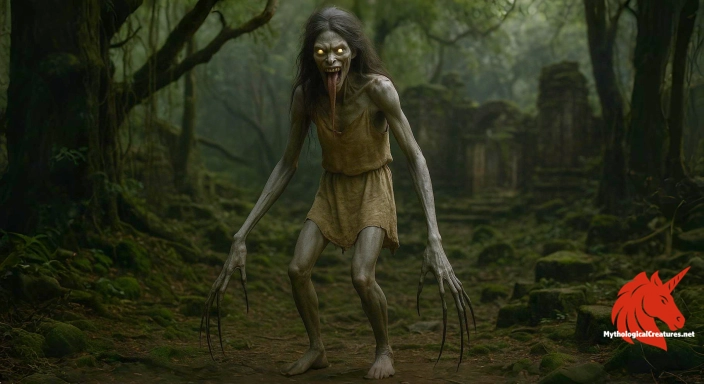
Lai Khutshangbi
Lai Khutshangbi - Embodies the terrifying and supernatural aspects of Meitei folklore, serving as a cautionary figure in local legends.
Origins & First Encounters
Lai Khutshangbi stands as a striking figure in the rich tapestry of Meitei mythology, embodying both divine and demonic qualities in a single fearsome presence. Her origins are steeped in the ancient traditions of Antique Kangleipak, where folklore and spiritual beliefs interweave to form a complex cultural narrative. The very name—combining terms for deity and elongated hand—hints at her dual nature and symbolic power. Tales of her have been handed down through generations, ensuring that her image remains etched in the collective memory of the region. Early narratives depict her as a mysterious force whose presence both protects and terrifies, bridging the realms of the sacred and the profane.
Over time, her legend has evolved into a rich amalgam of symbolism and cautionary lore, serving as a reminder of the universe’s capricious energies. Storytellers have moulded her persona to reflect the shifting values and fears of society, making her as adaptable as she is formidable. Her narrative mirrors the intricate interplay between order and chaos that has long fascinated the people of Manipur. With every retelling, Lai Khutshangbi emerges not only as a monstrous figure but also as one embodying profound lessons about the human condition. Thus, her myth continues to inspire awe and provoke contemplation about the boundaries between light and shadow in existence.
Source Texts & Tale Variants
The myth of Lai Khutshangbi emerges from a tapestry of oral traditions and early textual records that capture the essence of ancient Meitei folklore. Early manuscripts and folklore compilations from Antique Kangleipak offer fragmented yet evocative glimpses of her ominous presence. Storytellers across generations have presented her in various lights, ranging from a ruthless guardian of moral order to a wild embodiment of nature’s untamed force. Her tale finds expression in folk songs, ritual recitations, and dramatic performances that have been integral to communal gatherings. These sources, though diverse in detail, collectively underscore her significance as a figure both feared and revered.
As the narrative transitioned from oral recitation to written form, alternative versions began to surface, each adding layers of nuance to her character. In some accounts, her supernatural attributes are accentuated to emphasise an otherworldly terror, while in others, her role is that of an omen signaling social or natural upheaval. Festival performances and local dramas have also adapted her story to reflect contemporary concerns without losing the core mystique. This multiplicity of versions testifies to the fluidity of folklore, revealing a myth that has continuously adapted to the cultural and historical contexts of its audience. The evolving nature of these accounts highlights the enduring power of Lai Khutshangbi’s legend within the Meitei cultural framework.
Form & Powers
Lai Khutshangbi is most notably characterised by her extraordinarily long hands, a feature that immediately sets her apart from other mythological figures. Her hands are so elongated that they frequently brush the ground with each step, a detail that amplifies her supernatural aura. The name itself, derived from the Manipuri words for deity and long hand, spotlights this exaggerated attribute as integral to her identity. Witnesses in the realm of myth describe her fingers as sharp as thorns, contributing to an overall appearance that is both menacing and otherworldly. This striking detail has been immortalised in art and performance, making her silhouette instantly recognisable in the lore of Manipur.
In addition to her remarkable hands, Lai Khutshangbi’s visage features a large, cavernous mouth and a disproportionately long tongue, elements that heighten the terror she inspires. Some tales also mention intensely piercing eyes, though these are often overshadowed by her more prominent physical traits. Occasional embellishments, such as mysterious body markings and eerie textures, further enhance her enigmatic appearance. These physical attributes are not mere aesthetic flourishes but serve as potent symbols of her connection to forces beyond ordinary human comprehension. Through these vivid descriptions, her image has transcended the realm of myth, becoming a powerful visual metaphor for uncontrollable and enigmatic energies.
Regional Faces
The myth of Lai Khutshangbi exhibits fascinating regional variations across the diverse landscape of Antique Kangleipak. In some local traditions, she is depicted as a fearsome enforcer of social order, while in other accounts she appears as a spectral embodiment of nature’s unpredictability. Communities in remote villages tend to focus on her supernatural attributes, portraying her as an omen whose approach heralds change or disaster. The nuances in her portrayal are often influenced by local customs, environments, and historical experiences, leading to a rich diversity in narrative style and emphasis. This adaptability has allowed her legend to resonate with different audiences, ensuring that her story remains relevant in both rural and urban settings.
Urban retellings sometimes blend traditional iconography with contemporary social commentary, rendering her both a relic of yesteryear and a mirror to modern anxieties. In certain regions, her features are reinterpreted, with some storytellers softening her monstrous aspects to reflect evolving cultural values. Folk performances and ritual celebrations across various locales incorporate distinct regional symbols, thus recontextualising her myth for local audiences. Through these regional adaptations, her portrayal shifts subtly, yet consistently maintains the core elements that have made her a symbol of the mysterious. Ultimately, these local variations not only enrich her legend but also highlight the dynamic interplay between enduring myth and social transformation.
Cultural Parallels
Lai Khutshangbi resonates with mythological figures from diverse cultures, particularly those that embody extremes of form and supernatural might. Her exaggerated physical features are reminiscent of creatures from other traditions whose elongated limbs serve as a visual metaphor for overwhelming power. Similar to figures found in Japanese folklore or even certain chthonic deities in Greek and Mesopotamian myths, her very anatomy challenges the ordinary and incites both awe and fear. Like many hybrid beings in global mythologies, she straddles the line between divinity and malevolence, which is a recurring theme in legends across continents. This interplay of beauty and horror is a compelling narrative device that links her to a wider tradition of monstrous, yet symbolically potent, archetypes.
Further comparative analysis shows that her motif of extended limbs can be seen in various cultural artefacts, symbolising the stretch of cosmic or natural forces in art and literature. Parallels may also be drawn with certain Hindu deities and Native American mythic figures, where non-human proportions are used to illustrate an exceeded form of power and mystery. These cross-cultural echoes reveal that the depiction of altered anatomy to communicate otherworldliness is a near-universal human impulse. In each tradition, exaggerated bodily forms serve as a shorthand for delving into the realms of the supernatural. Ultimately, the comparative study of such figures underscores the shared human fascination with the extraordinary and the unknown.
Legacy & Modern Evolution
The portrayal of Lai Khutshangbi has undergone a significant evolution from the early days of oral tradition to her current status as a multifaceted cultural icon. Initially conveyed through ephemeral storytelling, her terrifying visage captured the imagination of communities seeking to explain and control the forces of nature. Over time, her narrative was enriched by artistic depictions in manuscripts, temple carvings, and performance traditions that celebrated both her dread-inducing features and her symbolic complexity. This gradual transformation reflects broader cultural shifts, as her role transitioned from that of a mere cautionary spectre to an emblematic figure embodying existential dualities. Early artistic representations emphasised the stark horror of her long hands and fearsome mouth, anchoring her in the realm of the supernatural.
Modern reinterpretations have further layered her myth with contemporary themes of identity, transformation, and ambivalence. Today, artists, writers, and performers in Manipur and beyond engage with her story, reimagining her as a symbol of the dynamic interplay between tradition and modernity. The resurgence of interest in ancient folklore has seen her features recontextualised in graphic novels, film, and digital media, ensuring that her terrifying yet fascinating image endures in the public imagination. Through these evolving narratives, Lai Khutshangbi continues to serve as a potent reminder of mythology’s capacity to mirror and shape cultural consciousness. Her enduring legacy offers contemporary audiences a profound look into the timeless dialogue between human vulnerability and the inexhaustible force of the supernatural.
Interesting Fact
One striking aspect of her legend is the etymology of her name, where 'Lai' denotes divinity and 'Khutshangbi' emphasises long hands, creating a paradox that enriches her mythological identity.
Sponsor this space
Tasteful, fixed-fee placements for myth projects
No bidding wars or flashing banners. We offer simple placements for a small set of creators and brands aligned with our readers.
Request further detailsQuick Creature Info
Features:
Associations:
Our Mythic Legendary Rating:

Habitat:
Supernatural Powers:
Physical Attributes:
Abilities:
Behavior:
Lore:
Related Creatures, Tales or Lore
- CChurel
- PPontianak
- RRakshasi
References
Discover Another Mythical Legend You May Not Have Heard Of?
Uncover the mysteries of ancient folklore and expand your knowledge of legendary beings from cultures around the world.
Dare to Meet the Lyngbakr....

Curated by the Mythological Creatures Team
Series editor: Mythological Creatures Directory
Primary desk: Asian & Pacific Myth Cycles Desk
(rev. November 2025)