
Llamhigyn y Dŵr: Llamhigyn y Dŷr, also known as the Water Leaper, is a fearsome creature from Welsh folklore.
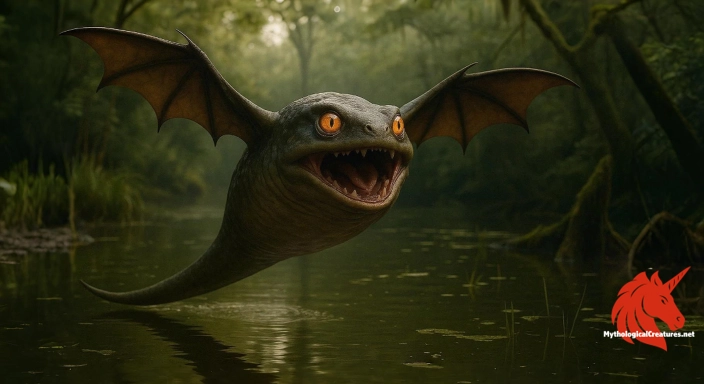
Llamhigyn y Dŵr
Llamhigyn y Dŵr - Feared for snapping fishing lines and preying on livestock and fishermen, the creature embodies the dangers lurking in murky wetland waters.
Origins & First Encounters
Emerging from the storied wetlands of Wales, the Llamhigyn y Dŵr casts a persistent shadow over ancient local lore. Born from the murmurs of rural communities and draped in the mystery of murky swamps, it presents as both a symbol of natural menace and a relic of a by-gone era. Tales recount its early presence in small hamlets, where minstrels and elders wove its image into cautionary narratives that warned against the treacherous waters. Its very existence appears intertwined with the wild and unpredictable forces of nature, drawn from the collective fears of those who lived near the damp, isolated ponds and marshes. Early references, preserved more by oral tradition than by written record, provided the foundation for its enduring reputation. Locals regarded any sighting as an ominous portent, signalling misfortune or the wrath of untamed nature. With every retelling, the creature’s image grew more elaborate, blending elements of beauty and horror into a single, unforgettable entity. The descriptive epithet ‘Water Leaper’ captures both its uncanny method of traversing water and the eerie agility that sets it apart from ordinary beasts. Ultimately, the legend of Llamhigyn y Dŵr remains a potent emblem of Welsh myth, encapsulating the tension between civilization and the wild.
Source Texts & Tale Variants
The earliest vestiges of the Water Leaper’s tale are rooted in the vibrant oral traditions of isolated Welsh communities, where every whispered account added layers to its mythos. Early manuscripts, though sparse in detail, recorded brief mentions that later blossomed into richer folkloric narratives during the 18th and 19th centuries. Local ballads and storytelling sessions further embellished these initial records, painting a picture of a creature both feared and revered. Variations of the story emerged as travellers and local scribes passed the legend from one generation to the next, each adapting the details to suit their own cultural context. Some accounts frame the creature as being controlled by malevolent supernatural forces, while others hint at it being an uncontrollable embodiment of nature. Small collections of rural lore and antiquarian studies have preserved these diverse voices, ensuring that multiple interpretations could survive the passage of time. Personal anecdotes shared by fishermen and farmers lend an intimate air to the myth, recounting uncanny encounters and mysterious disturbances. Although the primary sources are fragmentary by modern academic standards, they collectively offer an engrossing mosaic of tradition and regional colour. Later folklorists have woven these variants into a continuous narrative that not only explains odd incidents, such as snapped fishing lines and livestock losses, but also mirrors the underlying environmental anxieties of rural life.
Form & Powers
The Water Leaper is distinguished by a surreal fusion of anatomical traits that defies the confines of ordinary nature. Its massive, frog-like body is cloaked in a slick, mottled skin that often shimmers with a greenish hue reminiscent of deep, stagnant pools. Strikingly, the creature is outfitted with a pair of broad, bat-like wings that enable it to propel itself in sudden, airborne leaps across water surfaces. In an unusual twist that sets it apart from true amphibians, it is described as lacking any hind legs, relying instead on its extraordinary wings for mobility. A long, sinuous tail, reminiscent of a lizard’s, extends from its body and terminates in a venomous stinger, suggesting both predatory prowess and an inherent danger. The contrasting textures—from the slim, wet skin of its torso to the scaled, rugged tail—create a disquieting visual mosaic that unsettles the mind. Observers in these legends recount that its eyes glisten with an almost supernatural intensity, particularly when illuminated by the moon’s glow. Its overall size is exaggerated in traditional tales, enhancing its status as a formidable presence in the dark wetlands. The intermingling of features drawn from amphibians, bats, and reptiles constructs an image that is at once grotesque and mesmerizing, embodying nature’s unpredictable creativity. Each retelling injects slight nuances into this description, underscoring how myth adapts to highlight both human terror and wonder.
Regional Faces
Although the Llamhigyn y Dŵr is indigenous to Wales, different regional narratives infuse its legend with distinctive local flavours. In some mid-Welsh areas, storytellers accentuate its amphibious heritage by describing intricate skin markings that mimic the mottled reflections of swamp water. Communities in the western valleys often portray it with an almost spectral grace, where the creature’s nocturnal appearances are as much a visual lament as they are warnings. Along the coastal fringes, however, the accounts tend to emphasise its ferocity, framing it as a ruthless predator that prowls the flooded lands under starlit skies. In certain local variants, the creature is even reinterpreted as a guardian spirit, an ambivalent force that both protects and punishes those who disturb its watery realm. Subtle alterations in its described size, colour, or wing structure often reflect the unique geographical and cultural contexts of these regions. Each community adapts the legend to mirror the specific environmental challenges and traditions of its own surroundings. The fluidity of these narratives reveals not only the mutable nature of oral tradition but also the inherent desire to interpret natural phenomena through culturally resonant symbols. In every version, whether fearsome or mystical, the underlying message remains a cautionary tale about respecting the boundaries between civilization and the untamed natural world.
Cultural Parallels
The composite anatomy of the Water Leaper finds intriguing echoes in a broader tradition of hybrid creatures that populate mythologies around the world. Its amalgamation of amphibian, bat, and reptilian elements invites parallels with other chimeric beings found within Celtic narratives and even in disparate European lore. Much like other water-bound creatures in folklore—those that bridge the liminal realms of land and water—it embodies the paradox of fluidity and menace. In some northern traditions, similar sounds of eerie creatures have been recounted, echoing the same dread of what lurks beneath calm surfaces. The merging of seemingly incompatible traits, such as the soft skin of a frog and the hardened scales of a reptile, speaks to a universal fascination with the boundaries of nature. This blend of features has led some modern interpreters to liken the Llamhigyn y Dŵr to fantasy beasts that challenge natural order and spark the imagination. The motif of a creature arising from a fusion of various animal parts is a recurring symbol, one that transcends the confines of a single culture. Comparative studies reveal that such hybrid monsters often serve as metaphors for the unpredictable forces of nature. In drawing these connections, the Water Leaper is placed within a wider tapestry of myth, enabling a dialogue between seemingly distinct cultural traditions. Its enduring appeal lies partly in this universality—a creature that, despite its specific Welsh origins, resonates with broader themes of chaos and metamorphosis in mythic tradition.
Legacy & Modern Evolution
Over the centuries, the myth of the Water Leaper has undergone a dramatic evolution, reflecting shifting cultural attitudes towards nature and the supernatural. In early folklore, it was unequivocally portrayed as a menacing presence, a creature that disrupted lives by snapping fishing lines and threatening livestock with its lethal sting. As time passed, however, artistic reinterpretations began to soften the creature’s purely malevolent image, casting it instead as a complex symbol of the untamed natural world. In contemporary depictions, the Water Leaper commonly emerges as a dual figure—both a warning against environmental overreach and a mysterious embodiment of nature’s unchecked power. Its vivid image has found a new audience in modern fantasy art, literature, and independent film, where the creature’s bizarre anatomy and eerie grace captivate imaginations. Local heritage festivals and cultural events in Wales now celebrate this storied beast, weaving its legend into broader discussions of ecological balance and historical identity. Modern narratives frequently explore the ambiguity of its character, suggesting that what was once seen solely as a curse might also be a misunderstood guardian of ancient waters. This recontextualisation mirrors a wider trend in which mythic creatures are rediscovered through the lens of contemporary environmental and cultural concerns. As such, the legacy of Llamhigyn y Dŵr endures as both a relic of the past and a living, evolving symbol that continues to inspire wonder and caution in equal measure.
Interesting Fact
Some scholars suggest that its bizarre composite appearance may represent a conflation of real animal traits with symbolic elements of ancient Welsh animism.
Sponsor this space
Tasteful, fixed-fee placements for myth projects
No bidding wars or flashing banners. We offer simple placements for a small set of creators and brands aligned with our readers.
Request further detailsQuick Creature Info
Features:
Associations:
Our Mythic Legendary Rating:

Also Sometimes Known As:
Habitat:
Supernatural Powers:
Physical Attributes:
Abilities:
Behavior:
Lore:
References
Discover Another Mythical Legend You May Not Have Heard Of?
Uncover the mysteries of ancient folklore and expand your knowledge of legendary beings from cultures around the world.
Dare to Meet the Nephthys....
Curated by the Mythological Creatures Team
Series editor: Mythological Creatures Directory
Primary desk: Northern & European Folklore Desk
(rev. November 2025)