
Nephthys: Nephthys is an ancient Egyptian goddess and a member of the Great Ennead of Heliopolis.
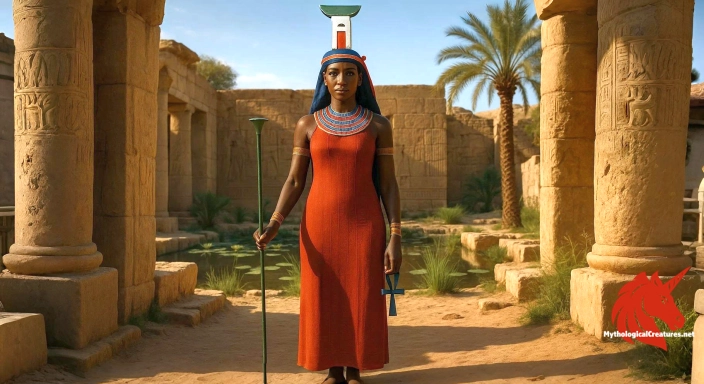
Nephthys
Nephthys - Nephthys is revered for her role in protecting mummies and assisting in the journey of the deceased, as well as her complex family connections within the Egyptian pantheon.
Origins & First Encounters
Nephthys, also rendered as Nebet-Het, emerges as a uniquely compelling figure within the rich tapestry of ancient Egyptian religion. Born into the sacred lineage of the Great Ennead at Heliopolis, she is traditionally understood as a daughter of Nut and Geb, embodying the cosmic interplay of the heavens and the earth. Her association with themes of mourning and the nighttime was central to rituals that navigated the boundaries between life and death. As part of the intricate familial dynamics among the gods, she is frequently paired with her sister Isis, highlighting the dual nature of protection and transformation in funerary rites. Early religious texts and temple inscriptions attest to her role as both guardian and guide in the enigmatic passage to the afterlife. Her presence within these narratives underscores an identity that combines both nurturing care and an undeniable connection to the mysteries of darkness. Over time, Nephthys’s persona came to be linked with diverse aspects of Egyptian life, ranging from embalming to magical practices in service of health and protection. Deeply embedded within the ritualistic and symbolic world of ancient Egypt, her identity provided comfort and continuity in the face of loss and renewal. The goddess’s evolving narrative reflects a broader cultural understanding of the natural cycles governing human existence and has left a lasting imprint on Egyptian cosmology. Her distinct role within myth illustrates the intricate balance between light and darkness, a duality that has fascinated generations since her first attestation.
Source Texts & Tale Variants
Ancient records teem with varying accounts of Nephthys, which reveal a multi-layered persona shaped by state-sponsored religious doctrine and local myth. Textual sources such as the Pyramid Texts, Coffin Texts, and sections of the Book of the Dead present her as an integral figure in the rites that usher souls into the afterlife. Temple reliefs and statuary discovered in Heliopolis and other sacred sites often depict her in a complementary relationship with Isis, underscoring her role in funerary practices. Over time, the goddess’s narrative was recast in numerous papyri and ritual documents, each iteration highlighting differing aspects of her guardianship. Some texts stress her magical abilities and protective functions, while other variants underscore her affiliation with the night and its transformative power. Interpolations from the Greco-Roman period eventually infused her myth with additional layers of symbolism, merging Egyptian motifs with foreign interpretative frameworks. The diversity of these sources illustrates the fluidity of myth-making, where oral tradition and formal liturgical texts together shaped her image. Hidden within the subtleties of these varied accounts are clues to the essential nature of her divine intervention at moments of both mourning and rebirth. The evolving story variants capture the complex interplay of personal, regional, and political influences that sculpted the pantheon. In sum, these rich primary sources continue to offer scholars a dynamic field of inquiry into the multifaceted persona of Nephthys.
Form & Powers
Artistic representations of Nephthys depict her with an elegant poise that reflects both strength and an air of somber mystery. She is usually portrayed as a graceful woman, her countenance marked by soft, thoughtful eyes that hint at the deep sorrow and protection inherent in her nature. Traditional iconography often features her with carefully styled garments that employ earthy and subdued tones, evoking the quiet majesty of twilight. A distinctive headdress, sometimes adorned with lotus motifs or hieroglyphic accents, signals her divine status while also suggesting her link to sacred domestic services. Her physical portrayal eschews excess in favour of a dignified simplicity that aligns with her roles in mourning and magical rites. In many temple reliefs, her stance is both measured and protective, with a subtle openness that speaks to her empathetic nature. The nuances in her depiction—be it the gentle curvature of her figure or the refined detail of her attire—reveal an artist’s conscious effort to balance themes of vulnerability and guardianship. Variations in style across different periods expose layers of interpretative evolution, where each era reinterprets her physicality to resonate with contemporary sensibilities. The use of mineral pigments in her depiction further reinforces the connection between her image and the natural cycles of life and death. Such detailed portrayals cement her image as one imbued with both ethereal mystique and grounded human emotion.
Regional Faces
The character of Nephthys was not monolithic but adapted to the varied religious landscapes of ancient Egypt. In Heliopolis, she was venerated as an essential part of the state pantheon, her iconography and ritual functions tightly interwoven with royal and cosmic symbolism. In contrast, localized cults in regions such as Thebes and Memphis sometimes recast her attributes to better align with regional customs and local deities. This geographic diversity resulted in subtle shifts in her representation—ranging from distinctions in attire to complementary symbols that echoed local religious narratives. In some parts of Egypt, her association with the night was emphasised through additional iconographic elements that underscored her connection to darkness and the mysteries of death. The flexibility of her myth allowed regional priests and communities to blend her identity with indigenous traditions and ancestral spirits. Local inscriptions and reliefs often adapt her role as a protective figure to resonate with the everyday concerns of the populace. Such regional variation highlights the dynamic interface between state-driven theology and grassroots religious practice. Each locale injected its own cultural nuances into her worship, thereby enriching her overall mythos. In essence, the regional adaptations of Nephthys reveal a living tradition that could flex and evolve to meet the shifting spiritual needs of its adherents.
Cultural Parallels
An examination of Nephthys’s attributes reveals striking parallels with other deities who govern transitions between life and death across various mythologies. While her sister Isis often carries the mantle of nurturing and regeneration, Nephthys complements these ideals through her focus on the shadows of mourning and the mystical powers of the night. Certain elements of her myth resonate with the Greek figure of Hecate, whose associations with crossroads, magic, and nocturnal phenomena similarly evoke both protection and transformation. In the realm of Mesopotamian lore, deities overseeing the underworld share with Nephthys the challenging yet essential task of guiding souls through liminal spaces. Her dual roles, straddling vulnerability and authority, reflect a broader cross-cultural trend where divinities embody both the power of rebirth and the sorrow of separation. The interplay between such figures underscores how ancient civilizations wove together seemingly contradictory aspects of existence to form a harmonious cosmic order. Despite varying titles or cultural contexts, these deities commonly serve as mediators between the mortal and the divine. In drawing such comparisons, one observes that while Nephthys is distinctively Egyptian, her thematic essence resonates with universal human inquiries into death and renewal. This comparative analysis illuminates the broader tapestry of mythological archetypes that span different cultures. Ultimately, the connections between Nephthys and her counterparts reveal a shared quest to reconcile the dualities inherent in the human experience.
Legacy & Modern Evolution
The evolution of Nephthys’s image over time reflects a profound dialogue between ancient tradition and modern reinterpretation. Initially embraced as a critical figure in ritual and state mythology, her role underwent significant transformations as the cultural and political landscapes of Egypt shifted. During the Greco-Roman era, elements of her story were recontextualised, blending with wider artistic and religious trends that expanded her mythic resonance. In more recent centuries, the revival of Egyptian motifs during periods of Egyptomania rekindled an interest in her enigmatic qualities. Modern literary and artistic movements have reimagined Nephthys as a symbol of feminine resilience, the deep mysteries of mourning, and the transformative power of darkness. Contemporary spiritual practices and neopagan movements occasionally invoke her name as a guide through life’s transitional phases. Her legacy, therefore, persists not only in the archaeological record but also in popular culture, where she inspires dialogue about the nature of loss, protection, and rebirth. Academic scholarship, too, continues to reassess her complex role within the broader spectrum of mythological figures. Through reinterpretation in film, art, and literature, Nephthys has traversed millennia to find a modern voice. In bridging the ancient and the contemporary, her enduring influence underscores the timeless allure of myth and the universal questions it seeks to answer.
Interesting Fact
A fascinating aspect of Nephthys is her dual role in Egyptian mythology, where she embodies both nurturing qualities and the mysterious, dark aspects of the afterlife, reflecting the complex nature of life and death.
Mythology commerce, done carefully
Align your store with our global myth audience
If you sell myth-inspired jewellery, prints, decks, or collectibles, we can feature your brand without overwhelming the reading experience.
Partner with usQuick Creature Info
Origin:
Associations:
Our Mythic Legendary Rating:

Also Sometimes Known As:
Habitat:
Supernatural Powers:
Physical Attributes:
Abilities:
Behavior:
Lore:
References
Discover Another Mythical Legend You May Not Have Heard Of?
Uncover the mysteries of ancient folklore and expand your knowledge of legendary beings from cultures around the world.
Dare to Meet the Goranchacha....
Curated by the Mythological Creatures Team
Series editor: Mythological Creatures Directory
Primary desk: Hellenic & Ancient Mediterranean Desk
(rev. November 2025)