
Manussiha: Manussiha is a Burmese mythological creature with a human head and torso and lion hindquarters.
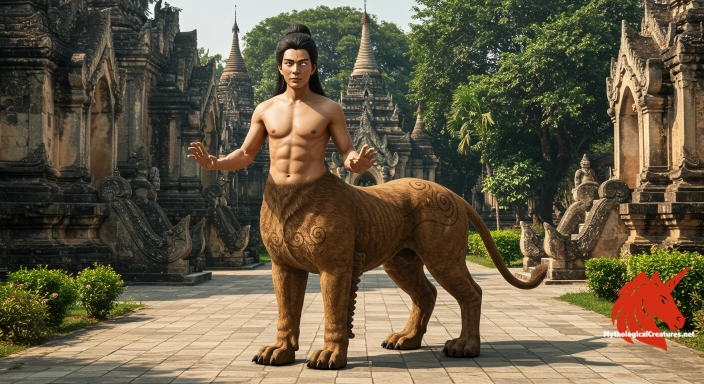
Manussiha
Manussiha - Represents protection and is a key symbol in Burmese pagodas and Buddhist art.
Origins & First Encounters
The Manussiha emerges as a unique guardian figure within Burmese myth, embodying a seamless fusion of human intelligence and leonine strength. Its origin is steeped in the deliberate creation by Buddhist missionary monks, intended to shield a newborn royal heir from the voracious menace of rakshasis emerging from the sea. Its early attestations in Burmese lore highlight a deliberate intertwining of royal protection with spiritual symbolism. The creature’s depiction—half-human, half-lion—illustrates a blend of martial courage and wise guardianship, traits highly esteemed in both royal and religious traditions. Historically, its image has adorned sacred pagodas, symbolising an eternal vigilance at the thresholds of holy spaces. Its presence in these cultural monuments underlines a belief in the protective power of myth and art. As a guardian, it not only serves as a bulwark against malevolent forces but also as a reminder of the moral and spiritual balance cherished by its creators. Thus, the Manussiha has secured its role as a potent emblem of protection and authority in the Burmese cultural and religious landscape.
Source Texts & Tale Variants
The narrative of the Manussiha is preserved in a rich assortment of traditional manuscripts, temple inscriptions, and enduring folklore passed down through generations. Artistic representations in temples and on pagoda facades serve as visual documentation of its storied past. Diverse texts and local oral traditions recount its purpose as a guardian, emphasising its creation by Buddhist missionary monks to counteract the threat of sea-dwelling ogresses. The legends surrounding the creature have been interwoven with the broader tapestry of Burmese religious and royal iconography. Historical records and ritual descriptions attest to its role as both protector and symbol of divine strength in mystical settings. Varied story lines in regional retellings underscore its multi-faceted nature, each version accentuating different aspects of its power and benevolence. The recurring appearance of the Manussiha in the seal of significant religious sites, such as the Shwedagon Pagoda, reinforces its authorized presence in sacred narratives. Overall, the blending of archival sources and vibrant oral history has ensured that the legacy of this mythic protector remains both dynamic and deeply rooted in Burmese tradition.
Form & Powers
The Manussiha is depicted with a captivating duality, exhibiting a human head and torso that merge seamlessly into the potent hindquarters of a lion. This hybrid form is rendered with an attention to anatomical detail, where the human features exude calm wisdom and the lion’s form conveys raw physical power and virility. Intricate carvings reveal subtle textures in both the hair and fur, often enhanced with traditional Burmese ornamental motifs. Its facial expression combines serene intelligence with the inherent fierceness of a predatory animal, a depiction that has both allegorical and protective meanings. Sculptors have often embellished the upper human portion with regal elements, suggesting a noble lineage, while the robust lion’s hindquarters underline the creature’s formidable strength. Variations in its representation can be seen in the meticulous detailing of muscular structure and the flowing mane that gracefully transitions into the body of the beast. The overall scale of statues may vary, with some crafted as modest amulets and others as towering guardians at temple entrances. Such detailed physical portrayals encapsulate the harmonious integration of human consciousness and animal instinct inherent to the Manussiha myth.
Regional Faces
Across Burma and adjacent regions, the Manussiha’s depiction adapts to local artistic styles and cultural nuances, reflecting a rich interplay between indigenous beliefs and external influences. In central Burmese tradition, the creature consistently appears as a solemn and authoritative guardian, often placed at the corners of important religious structures. In contrast, regional adaptations, particularly in areas influenced by the Shan culture, may introduce subtle stylistic variations or alternative phonetic interpretations of its name. These localized representations sometimes feature additional decorative details, such as intricate patterns or unique posture adjustments, that elevate its protective symbolism. Variations in the artistic rendering across regions highlight differing interpretations of strength and vigilance, tailored to the specific cultural and spiritual needs of each locale. While the central narrative remains one of unwavering guardianship, peripheral communities may imbue the creature with further mythological layers, linking it to local legends of bravery and divine intervention. The continuing evolution of its imagery across regions underscores the fluidity of myth, as local artisans and storytellers adapt the Manussiha to contemporary contexts. Collectively, these variations attest to the widespread cultural resonance and enduring appeal of this mythic protector throughout Southeast Asia.
Cultural Parallels
The Manussiha stands in intriguing parallel with hybrid creatures found in other world mythologies, such as the Egyptian and Greek sphinxes known for their enigmatic roles as gatekeepers. Its combination of a human head and lion’s body is reminiscent of the universal archetype of merging intellect with physical might. Similar to the Chinese guardian lions, which are revered as protectors of temples and imperial sites, the Manussiha embodies both aesthetic grace and formidable power. This cross-cultural correspondence serves to highlight common themes in the human psyche, where protective deities are fashioned by synthesising human wisdom with the dominance of the natural world. In both cases, these figures serve as metaphoric bulwarks, ensuring the security of sacred spaces against malevolent forces. While the Egyptian and Greek variants often incorporate elements of mystery and riddle, the Manussiha is deeply embedded in Buddhist symbolism and the traditions of Burmese royal protection. Each tradition, though distinct in its iconography and narrative emphasis, ultimately upholds the vision of a being that transcends ordinary physical forms. Such comparative analysis reveals how disparate cultures converge on the ideal of a guardian figure—a symbol of both protective strength and enlightened authority.
Legacy & Modern Evolution
The evolution of the Manussiha myth mirrors the shifting currents of artistic and cultural expression in Burma over the centuries. Initially depicted as a mystical protector of royal lineage, its imagery has grown to symbolize broader ideals of spiritual guardianship and communal resilience. From its humble beginnings on ancient temple facades to its prominent role in modern emblems such as the seal of Shwedagon Pagoda, the creature has steadily maintained its cultural resonance. Contemporary renditions have embraced both traditional aesthetics and innovative design, ensuring that the Manussiha remains a living symbol within Burmese society. Its image now appears on official badges and in artistic installations, reflecting a seamless blend of heritage and modernity. The narrative surrounding the creature has expanded to address contemporary themes, reinforcing its timeless message of protection and authority. Even as artistic trends evolve, the underlying symbolism of the Manussiha—as a guardian bridging human wisdom and primal strength—continues to captivate new audiences. Ultimately, its enduring legacy testifies to the power of myth to adapt and thrive, serving as a beacon of cultural identity and spiritual continuity in a changing world.
Interesting Fact
Manussiha uniquely bridges human and animal symbolism, serving as both a protective guardian and an enduring cultural emblem in Burmese tradition.
Sponsor this space
Tasteful, fixed-fee placements for myth projects
No bidding wars or flashing banners. We offer simple placements for a small set of creators and brands aligned with our readers.
Request further detailsQuick Creature Info
Origin:
Features:
Associations:
Our Mythic Legendary Rating:

Also Sometimes Known As:
Habitat:
Supernatural Powers:
Physical Attributes:
Abilities:
Behavior:
Lore:
Related Creatures, Tales or Lore
References
Discover Another Mythical Legend You May Not Have Heard Of?
Uncover the mysteries of ancient folklore and expand your knowledge of legendary beings from cultures around the world.
Dare to Meet the Mussie....
Curated by the Mythological Creatures Team
Series editor: Mythological Creatures Directory
Primary desk: Asian & Pacific Myth Cycles Desk
(rev. November 2025)