
Menhit: Menhit is a Nubian lion goddess of war from the Kingdom of Kush.
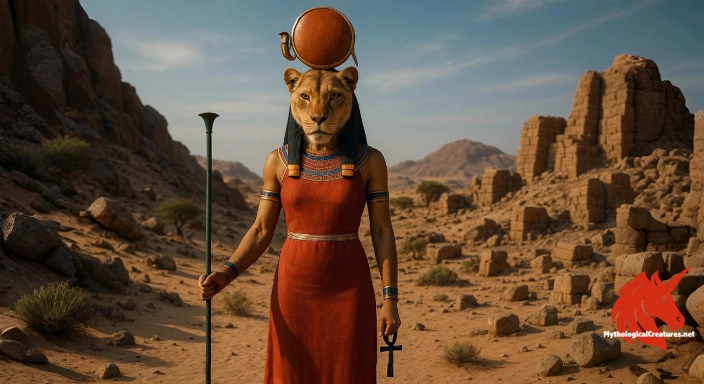
Menhit
Menhit - Represents the martial and sacrificial aspects of ancient Nubian worship, uniting the powers of war and the sun.
Origins & First Encounters
Menhit emerges from the annals of ancient Nubian lore as a formidable lion goddess of war whose legacy intertwines both martial prowess and celestial grandeur. Born from the rich tapestry of Kingdom of Kush spirituality, she embodies a dual nature that fuses the destructive energies of battle with the life-sustaining radiance of the sun. Her early presence in Nubian tradition reflects an era when deities were imbued with lessons of sacrifice and resilience. She is portrayed as a protector of the people, an emblem of divine vigilance in times of turmoil. Her very name, connoting 'she who sacrifices' or 'she who massacres', hints at the severe and uncompromising nature of her divine mandate. The cultural context in which she was worshipped celebrated her not only as a harbinger of war but also as a nurturer of order and cosmic balance. Her mythological attributes served to remind communities of the ever-present forces that underpin both creation and destruction. Over time, Menhit’s iconography became a vital element in rituals and statecraft, reflecting the duality of divine intervention in mortal affairs. Her enduring myth invites reflection on the interplay between ferocity and protection, making her a timeless figure in the study of ancient spirituality. Her historic attestation continues to captivate those who delve into the intricate worlds of Nubian and Egyptian mythology.
Source Texts & Tale Variants
Ancient records and architectural remnants offer glimpses into the veneration of Menhit, painting a picture of a goddess revered for her martial strength and luminous presence. Inscriptions discovered on temple walls and stelae within the Kingdom of Kush reference her with a mixture of awe and trepidation, underscoring her role in both warfare and solar worship. Fragmentary texts hint at rituals and invocations conducted in her honour by both warriors and state elites. Reliefs and carvings, though weathered by time, document her proud stance and fierce countenance in a manner that intimates deep religious sentiment. Variations of her myth occur in both written archives and oral traditions, each version contributing facets to her multifaceted image. Some accounts suggest that her narrative was later absorbed into Egyptian religious practices, where she was seen as a complementary figure to established lioness deities. These varied sources demonstrate a fluidity in myth-making, reflecting the adaptability of her character across cultures. The nuances in each narrative provide fertile ground for interpretative approaches that bridge the gap between material culture and spiritual belief. Despite occasional ambiguities in the surviving texts, the remnants of her veneration speak volumes about her influence and the power of her myth. Ongoing scholarly debate continues to refine our understanding of the ways in which Menhit was celebrated and remembered in antiquity.
Form & Powers
Menhit is traditionally depicted as a majestic lioness whose physical form exudes both grace and formidable power. Her visage is often accentuated by a head crowned with a radiant solar disc, marrying her martial affiliation with the nurturing aspects of the sun. Elaborate artistic renderings capture her muscular build and the sinewy elegance of a wild predator, balancing beauty with the terror of untamed strength. Her intense eyes are frequently rendered with a piercing gaze that seems to encapsulate both ancient wisdom and the ferocity of battle. Sculptures and wall reliefs reveal intricate details such as finely carved whiskers and vibrant mane-like embellishments that enhance her regal appearance. Some portrayals merge human and animal traits, emphasising her dual role as divine guardian and embodiment of raw nature. The interplay of light and shadow in her depictions lends her an almost ethereal quality, as if she were both present in the tangible world and the realm of the gods. Variations in size and proportion across different era artefacts speak to the evolving standards of beauty and divine representation in ancient art. The careful attention to anatomical detail in her imagery symbolises the respect given to power and the natural world. Ultimately, every facet of her physical portrayal is crafted to inspire awe and reverence among her devotees.
Regional Faces
Across the diverse cultural landscapes of ancient Nubia and Egypt, Menhit’s mythos adapted to reflect local traditions and aesthetic values. In the heart of the Kingdom of Kush, she was celebrated with an unyielding emphasis on her raw, lion-like energy and her role in warfare and cosmic order. Egyptian influences merged with the indigenous Nubian reverence to create composite images wherein her attributes blended seamlessly with other renowned lioness deities. Regional artists introduced local iconographic elements, resulting in depictions that varied in style—from stark, rugged portrayals to more refined, elegant images. In some northern renditions, she was adorned with additional solar symbols or hieroglyphic embellishments that tied her further to celestial cycles. The local adaptations often resonated deeply with native spiritual and political narratives, reflecting regional aspirations and the complexities of divine intervention. Her images were sometimes rendered with distinctive tribal motifs, highlighting the interplay between a universal divine archetype and localized cultural aesthetics. As her worship spread, various communities embraced and transformed her legend, ensuring that her legacy was as multi-dimensional as the societies that celebrated her. The dynamism inherent in her myth underscores the remarkable capacity of cultural exchange and reinterpretation over time. These regional variations reaffirm the adaptability of myth and exemplify how sacred figures evolve in response to the needs of different peoples.
Cultural Parallels
Menhit occupies an intriguing position among mythological lioness figures, inviting comparisons with other powerful deities such as the Egyptian Sekhmet and Bastet. Her narrative, marked by the themes of sacrifice and wrath, resonates with Sekhmet’s dual nature as both a bringer of destruction and a healer of wounds. Much like her Egyptian counterparts, Menhit is a potent symbol of the often contradictory forces of aggression and benevolence inherent in the natural world. In a broader cross-cultural context, similar lion-centred deities appear in Mediterranean and Near Eastern mythologies, each sharing motifs of protection and valour. This alignment between varied traditions reflects a shared human tendency to attribute the qualities of lions—nobility, ferocity, and regality—to the divine. Menhit’s narrative is enriched by these parallel mythologies, highlighting universal themes of power, sacrifice, and cosmic order. Comparative analyses reveal a common motif where the lion, as an animal, becomes a conduit for expressing societal values and collective fears. The interplay between her warlike nature and celestial associations further underscores the thematic connectivity among these diverse divine figures. Such cross-cultural resemblances deepen our appreciation of myth as a discipline that transcends geographic and cultural boundaries. Ultimately, her multifaceted portrayal bridges regional mythologies and provides insight into the shared human experience of grappling with the forces of nature and divinity.
Legacy & Modern Evolution
Over the course of millennia, the myth of Menhit has been continually reshaped by the changing tides of history and the evolution of cultural narratives. In her early incarnations, she was revered predominantly as a saviour in times of conflict, embodying the harsh realities of war and the relentless power of the sun. As the religious and political landscapes shifted, her representation expanded to incorporate broader themes of cosmic balance and divine inevitability. Her image was gradually assimilated into a more diverse pantheon, influencing, and being influenced by, the rituals and symbolic languages of neighbouring cultures. Archaeological discoveries in regionally significant sites have revived interest in her as a pivotal figure of ancient Nubian spirituality. In modern times, her fierce yet protective character is celebrated in academic circles and has inspired contemporary artists to reimagine her as both a historical icon and a symbol of female empowerment. The renewed scholarly interest in Menhit reveals a complex dialogue between ancient mythic forms and modern interpretations of identity and power. Her depiction in literature and visual media continues to evolve, reflecting new understandings of strength, sacrifice, and resilience. The enduring legacy of Menhit is a testament not only to her historical worship but also to the timeless appeal of myth that adapts to speak to each generation. Today, her story is a beacon of ancient wisdom, igniting creative reinterpretations that bridge the gap between past and present.
Interesting Fact
Menhit’s dual role as both a war deity and a sun goddess illustrates the paradoxical nature of ancient deities, where forces of both creation and destruction coexist harmoniously.
Reach myth fans
Connect your myth-driven brand with this audience
Our readers are writers, educators, gamers, and collectors who care about mythology. Enquire about a limited sponsor placement on creature pages.
Enquire about sponsorshipQuick Creature Info
Origin:
Associations:
Our Mythic Legendary Rating:

Also Sometimes Known As:
Habitat:
Supernatural Powers:
Physical Attributes:
Abilities:
Behavior:
Lore:
References
Discover Another Mythical Legend You May Not Have Heard Of?
Uncover the mysteries of ancient folklore and expand your knowledge of legendary beings from cultures around the world.
Dare to Meet the Cambion....
Curated by the Mythological Creatures Team
Series editor: Mythological Creatures Directory
Primary desk: Hellenic & Ancient Mediterranean Desk
(rev. November 2025)