
Millalobo: Millalobo is a powerful sea deity from Chilote mythology with a golden, sea lion-like appearance.
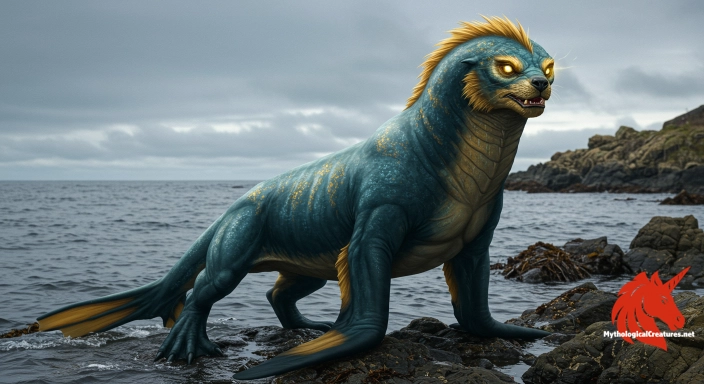
Millalobo
Millalobo - Millalobo is revered for his authority over all sea creatures, second only to the supreme Caicai in Chilote mythos.
Origins & First Encounters
Millalobo emerges as one of the most captivating figures in the rich tapestry of Chilote mythology, embodying a fusion of indigenous and colonial influences that mirror the cultural landscape of the Chiloé Archipelago.
The etymology of his name, which marries the Mapudungun word for gold with the Spanish term for wolf (alluding to the sea lion), reflects a historical blend of languages and traditions.
His origins are deeply rooted in ancient oral narratives that have been carefully passed down through generations, imbuing his story with layers of mystique and reverence.
Chosen by Caicai—the supreme ruler of the sea—to serve as his representative, Millalobo commands a significant role as the administrator of the underwater realm.
This mythic antecedent is not merely a relic of the past but a living symbol that has shaped the identity of coastal communities throughout southern Chile.
The narrative surrounding him is interwoven with themes of natural power, moral authority, and the eternal balance between order and chaos in the marine world.
His tale illuminates the intrinsic relationship between the people and the forces of nature, offering insight into a culture where the sea is revered as both nurturer and sovereign.
Through this legendary figure, communities have long sought to understand the complexities of life along the unpredictable and bountiful ocean.
Millalobo stands today as an emblem of the enduring legacy and transformative power of myth in the human experience.
Source Texts & Tale Variants
The primary accounts of Millalobo are preserved predominantly through a robust tradition of oral storytelling, passed down from elders in the coastal villages of Chiloé.
Although written records remain limited, fragments of his epic tale appear in early colonial chronicles and local manuscripts that hint at his immense power and authority.
Local storytellers have enriched his legend with vivid details, ensuring that his image as the appointed governor of the sea endures in communal memory.
Distinct narrative variants present him both as a benevolent guardian and as a fearsome adjudicator of marine justice, reflecting the multifaceted nature of the ocean itself.
The dispersed nature of these sources adds a dynamic quality to his myth, allowing for interpretations that shift with time and context.
Community rituals, festive performances, and maritime songs also serve as unofficial archives that document the continuous evolution of Millalobo’s persona.
His deep connection with the sea is reiterated in celebrations and parables that have woven his presence into the everyday life of the Chiloé people.
The enduring diversity of these accounts underscores the flexibility of oral tradition in preserving and reinventing myth.
Thus, even in the absence of extensive textual documentation, the vivid recollections of his deeds and characteristics keep his legacy vibrantly alive.
Form & Powers
Millalobo is frequently depicted as a majestic hybrid creature that seamlessly blends human, lupine, and aquatic traits, a reflection of his complex nature.
His form is often illuminated by a golden effulgence that pays homage to the 'milla' in his name, evoking the radiant shimmer of the sun over the sea.
Iconography frequently describes him with a sleek, muscular build that emphasises both the strength required to master the turbulent ocean and the grace of its inhabitants.
His eyes, sharp and penetrating, are said to mirror the deep, ever-changing moods of the waters, combining both wisdom and raw ferocity.
Subtle lupine features, such as a delicate mane or tapered ears, enhance the impression of his being as more than human, lending him a mystical aura that straddles the worlds of land and sea.
His skin is sometimes portrayed as having an iridescent quality, reminiscent of the reflective scales seen in many marine creatures, shifting hues with the movement of the tide.
Artists and storytellers alike have drawn attention to the balance between refined human contours and the rugged textural elements of sea life in his depictions.
Every aspect of his physical appearance is laden with symbolism, suggesting an inherent mastery over the fickle forces of nature.
This richly detailed portrayal continues to inspire awe and a sense of wonder among those who explore the depths of Chilote mythology.
Regional Faces
The interpretation of Millalobo varies considerably across the diverse cultural landscapes of southern Chile, reflecting the region’s multifaceted identity.
In coastal villages within the Chiloé Archipelago, local legends often portray him as a nurturing protector who bestows blessings on fishermen and seafarers.
Conversely, in other communities, his character is imbued with an air of stern authority, representing the unpredictable might of the ocean.
This diversity in portrayal is influenced by varying regional experiences of the sea, where some see it as a source of sustenance and others as a force demanding respect and caution.
Local celebrations, rituals, and even artistic expressions have, over time, adapted his image to resonate with the unique environmental and cultural challenges faced by each community.
Artisans in these regions have integrated distinctive local motifs into depictions of Millalobo, enhancing his dual nature as both benefactor and enforcer.
Such regional adaptations ensure that his myth retains relevance and continues to speak to the local experience of nature’s bounty and peril.
The variations in his narrative not only underscore the diversity of Chilote cultural expressions but also highlight a universal human desire to personify and negotiate with the elemental forces of the world.
These localized tales contribute to a richer, more nuanced collective understanding of Millalobo’s enduring power and significance.
Cultural Parallels
When examined alongside other maritime deities from diverse cultures, Millalobo’s myth resonates with universal themes of authority, transformation, and the sacred power of the sea.
His commanding presence finds echoes in figures like the Greek god Poseidon, who also reigns over the watery expanse with both benevolence and severity.
The hybrid nature of his form, blending human features with those of beast and aquatic creature, is reminiscent of selkie legends from Celtic lore, where beings transition between human and animal states.
This cross-cultural parallel reinforces the idea that communities around the world have long sought to fathom the mysteries of the water through myth.
The dual linguistic roots of his name reflect a syncretism that is also found in other mythological figures shaped by cultural convergence, underscoring the universality of hybrid identities in folklore.
Much like other sea deities in global mythologies, Millalobo embodies the complex balance between creation and destruction, order and chaos.
His role as the appointed emissary of a greater sea power mirrors hierarchical structures seen in other mythic pantheons, where subordinate deities administer the day-to-day workings of nature.
Comparative analysis of his legend with those of deities such as Japan’s Ryujin or India’s Varuna reveals striking similarities in ritualistic worship and symbolic representation of the ocean’s capricious temperament.
This interconnection of myth and environment across cultures highlights a shared human endeavour to understand and venerate the profound forces governing the natural world.
Legacy & Modern Evolution
Over the centuries, the figure of Millalobo has evolved from a shadowy mythic presence into a celebrated emblem of both regional identity and environmental reverence.
Originally passed down through oral traditions and subtle community rituals, his imagery has now found expression in modern literature, art, and public celebrations.
This evolution reflects a broader cultural transformation, where ancient myth is continually reimagined to resonate with contemporary perspectives and ecological concerns.
His legacy now stretches beyond mere folklore, serving as a potent symbol of the interconnectedness between humanity and the natural world.
Modern interpretations have cast him as a guardian of marine ecosystems, highlighting the necessity of respecting and protecting the delicate balance of the ocean.
Festivals, public art installations, and cultural exhibitions throughout the region have embraced his image as an icon of resilience, power, and wonder.
Scholars and creatives alike continue to explore his myth, finding in it themes that speak to both historical heritage and modern environmental challenges.
This dynamic adaptation ensures that Millalobo remains a vibrant and evolving part of Chile’s cultural narrative.
In every reinterpretation, he stands as a reminder of the timeless dialogue between tradition and modernity, a conversation as fluid and enduring as the sea itself.
Interesting Fact
The fusion of Mapudungun and Spanish in his name not only signifies his golden attributes but also reflects the cultural synthesis inherent in Chilote mythology.
For myth educators and toolmakers
Built a resource for mythology learners?
If you offer courses, teaching tools, or research platforms focused on myth and folklore, consider a discrete placement on our reference pages.
Introduce your resourceQuick Creature Info
Origin:
Features:
Associations:
Our Mythic Legendary Rating:

Habitat:
Supernatural Powers:
Physical Attributes:
Abilities:
Behavior:
Lore:
Related Creatures, Tales or Lore
- CCaicai
- CCaleuche
- PPoseidon
References
Discover Another Mythical Legend You May Not Have Heard Of?
Uncover the mysteries of ancient folklore and expand your knowledge of legendary beings from cultures around the world.
Dare to Meet the Orphne....
Curated by the Mythological Creatures Team
Series editor: Mythological Creatures Directory
Primary desk: Americas & Indigenous Traditions Desk
(rev. November 2025)