
Mnevis: Mnevis is an ancient Egyptian bull god revered as the physical manifestation of Atum-Ra and regarded as the ba of Ra.
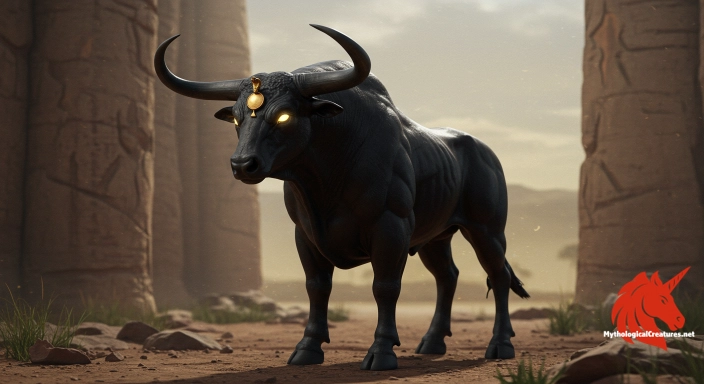
Mnevis
Mnevis - Played a pivotal role in the solar cult and was revered as a divine oracle, second only to the Apis bull.
Origins & First Encounters
Mnevis is an ancient Egyptian bull deity whose cult was intimately woven into the religious fabric of Heliopolis. His origins lie in a tradition that celebrated the bull as a potent symbol of fertility and solar power. Initially revered as a distinct entity under the names Mer-wer or Nem-wer, his identity was later merged with the syncretic aspects of Atum-Ra. This assimilation reflected the dynamic evolution of Egyptian theology, where celestial power and earthly existence intertwined. The deity was seen as embodying the ba, an essential aspect of Ra's soul, thereby linking him directly to the solar cycle. The rituals and ceremonies that accompanied his worship underscored the belief that his movements were dictated by divine will. His presence was so significant that even when another bull (the Apis) held comparable status, Mnevis was revered with equal devotion. The enduring allure of his myth is a testament to the sophisticated interplay between natural forces and divine manifestation in ancient Egyptian spirituality. His story continues to evoke the mysterious connection between the earthly realm and the celestial energies the Egyptians revered.
Source Texts & Tale Variants
Ancient texts and inscriptions from the temples of Heliopolis provide a rich tapestry of narratives surrounding Mnevis. Greek historians such as Plutarch recount his divine presence, highlighting his role in oracular practices and ritual ceremonies. Ritual documents and papyri from the necropolises reveal meticulous accounts of his embalming and burial rites, demonstrating the profundity of his cult. Various temple reliefs and inscriptions mention his association with two sacred cows, embodiments of Hathor and Iusaaset, which further embellish his mythic profile. Story variants sometimes position him as a precursor or even the progenitor of the more famous Apis bull, reflecting flexible interpretations of divine lineage. Certain accounts underscore the role of his physical manifestation in the governance of cosmic order. The legacy of scholarly and priestly records illustrates how his myth adapted through periods of religious transformation such as the Amarna period. Local folklore, interwoven with official doctrine, shows a complex layering of tradition that highlights both regional variations and pan-Egyptian themes. These multiple narratives ensure that Mnevis remains a focal point in the study of ancient Egyptian religiosity.
Form & Powers
Depictions of Mnevis characteristically show a powerful, entirely black bull, a choice that symbolises regeneration and mystery. His body is rendered with an imposing musculature that conveys both strength and divine vitality. A prominent solar disk is often portrayed resting atop his head, signifying his close association with the sun. The uraeus, a rearing cobra emblem, adorns his forehead, imbuing the deity with an aura of royal authority and protection. Artistic representations capture his sleek hide with meticulous detail, emphasising the elegance and austerity of his form. At times, hieroglyphic elements are integrated into these depictions, linking his visual identity directly to written sacred lore. Variations in his portrayal occur, yet the essential motifs of the solar emblem and serpentine adornment remain steadfast. Each depiction, whether in temple reliefs or ritual artefacts, underscores the duality of Mnevis as both a living bull and a divine avatar. The careful attention to his physical details reflects the ancient Egyptians’ belief in the profound symbolism embedded in every natural form.
Regional Faces
Although Heliopolis served as the heartland of Mnevis’s worship, his influence extended well into other regions of ancient Egypt. Local cult centres occasionally adapted his iconography to suit indigenous tastes and theological emphases. In areas away from the capital, decorative elements in depictions of the bull sometimes incorporated motifs unique to the regional landscape. These adaptations allowed local communities to integrate Mnevis into their own spiritual narratives, merging central doctrine with regional tradition. For instance, in certain parts of the Delta, the bull’s attributes were interwoven with existing local symbols of fertility and pastoral strength. Despite these regional variations, the core elements of his representation—the solar disk and uraeus—remained consistent. Such flexibility in portrayal exemplifies the Egyptians’ capacity to maintain a cohesive cultural identity while honouring local distinctiveness. The blend of centralised religious practices with regional adaptations is indicative of a broader pattern where myth and local tradition coalesce. This melding of ideas underscores the complexity and versatility of ancient Egyptian religious expression.
Cultural Parallels
Mnevis occupies a unique niche in Egyptian mythology yet shares notable similarities with other bull deities, particularly the renowned Apis bull. His dual role as an independent divine presence and as an embodiment of Ra reflects a common motif in ancient cultures where power is both individualised and shared. Comparative mythology reveals that the symbolism of the sacred bull extends far beyond Egypt, featuring in Near Eastern and Mediterranean traditions as a signifier of strength, fertility, and cosmic order. His iconography, with a radiant solar disk and protective cobra, resonates with similar depictions found in Greek and Roman art. The syncretic evolution of his persona parallels other deities who bridge the gap between localized worship and broader cultural mythos. This shared imagery has allowed for cross-cultural exchanges, where attributes of Mnevis find echo in other ancient bull cults. The narrative of his transformation—from an independent deity to a solar manifestation—provides a rich field for comparative analysis. Such interconnections highlight the universal appeal of the bull as a symbol across civilizations. Through these parallels, Mnevis exemplifies how shared mythological motifs can traverse cultural boundaries while retaining unique local flavours.
Legacy & Modern Evolution
The evolution of Mnevis from a distinct local bull deity to a symbol deeply enmeshed in solar theology reflects broader shifts in Egyptian religious thought. His early worship, characterised by elaborate ritualistic practices, set a precedent for the integration of animal cults within the framework of state religion. Over subsequent centuries, his assimilation with Atum-Ra mirrored the dynamic reconfigurations of the Egyptian pantheon. The meticulous rituals surrounding his life and ceremonial death contributed to a legacy that influenced both funerary practices and cosmic symbolism. Even during periods of significant religious reform, such as the Amarna heresy, his cult endured due to its intrinsic connection with the sun’s eternal cycle. Modern archaeological investigations continue to reveal insights into his ritual burial sites, thereby reviving interest in his ancient cult. Contemporary interpretations have seen Mnevis emerge in discussions of sacred animal symbolism and esoteric traditions. Literature and visual arts in modern culture often invoke his image as a timeless emblem of divine strength and continuity. Thus, the enduring legacy of Mnevis serves as a bridge between ancient religious practice and modern spiritual exploration.
Interesting Fact
An intriguing aspect of Mnevis is that despite his eventual assimilation with Atum-Ra, his distinct cult practices and dedicated necropolises highlight the unique and enduring reverence for the bull in ancient Egyptian spirituality.
Curated sponsor space
One subtle banner. Thousands of myth lovers.
We offer a small number of curated sponsor spots for relevant books, courses, games, and art. No clutter, just well-matched partners.
Partner with usQuick Creature Info
Origin:
Associations:
Our Mythic Legendary Rating:

Also Sometimes Known As:
Habitat:
Supernatural Powers:
Physical Attributes:
Abilities:
Behavior:
Lore:
Related Creatures, Tales or Lore
- AApis (Egyptian bull deity)
- BBull of Heaven (Mesopotamian mythology)
- CCretan Bull (Greek mythology)
References
Discover Another Mythical Legend You May Not Have Heard Of?
Uncover the mysteries of ancient folklore and expand your knowledge of legendary beings from cultures around the world.
Dare to Meet the Telete....
Curated by the Mythological Creatures Team
Series editor: Mythological Creatures Directory
Primary desk: Hellenic & Ancient Mediterranean Desk
(rev. November 2025)