
Mögþrasir: Mögérasir is a jötunn from Norse mythology, known from a single attestation in the Vafþrúðnismál.
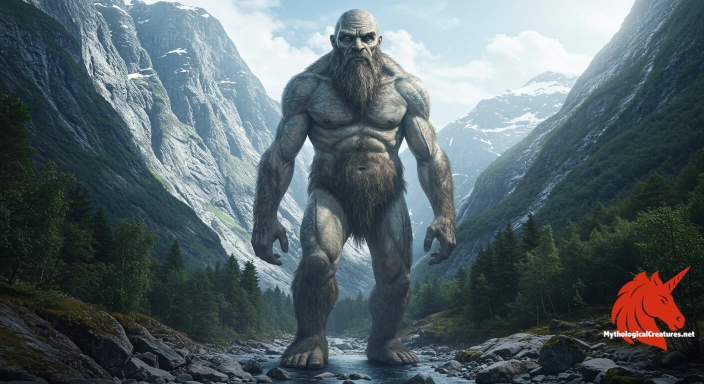
Mögþrasir
Mögþrasir - Noted solely in Vafþrúðnismál, his name implies a role in siring offspring among the jötnar, highlighting a generative aspect within a mythos rich in giant lore.
Origins & First Encounters
Mögferasir emerges in the intricate world of Norse myth, embodying the enigmatic qualities of the jötnar, whose presence is both formidable and fertile. His name, possibly meaning 'the one who is striving for sons', implies an underlying power of procreation and creation amid turbulent cosmic forces. The earliest and sole mention of him is found in a single stanza of the Poetic Edda, specifically within the verses of Vafþrúðnismál, making his narrative as elusive as it is intriguing. His appearance in this seminal work places him within a mythic tapestry where gods and giants engage in perpetual dialogue and conflict. This brief attestation hints at a character who stands at the intersection of chaos and fertility, a recurring theme in Norse mythology. Although details of his deeds remain scant, the evocative nature of his name suggests a being of great ambition and elemental strength. The sparse reference invites ongoing scholarly and artistic exploration, encouraging modern interpreters to imagine his role within a broader mythological context. Ultimately, Mögferasir’s fleeting mention attests to the richness of Norse myth, where even the most obscure figures can embody profound archetypal energies.
Source Texts & Tale Variants
The primary legacy of Mögferasir rests in the singular appearance within the Poetic Edda, a text that has long served as a window into the archaic Norse worldview. The brief mention in stanza 49 of Vafþrúðnismál has led to a surge of curiosity among scholars who seek to unravel the layers of meaning behind his enigmatic title. His inclusion in this pivotal exchange among mythic beings underlines the complex interplay between the divine and the chaotically fertile jötnar. Despite the lack of extended narrative, the isolated reference opens a gateway to wider interpretative possibilities within the corpus of Norse literature. Some early medieval commentators speculated that his role, however minor in the text, might hint at deeper cosmological and genealogical functions. Later folkloric traditions have sometimes alluded to the generative qualities suggested by his name, thereby enriching the sparse narrative with additional layers of symbolic significance. The oscillation between literal and allegorical readings of his mention underscores the interpretative challenges inherent in ancient myth. As a result, Mögferasir has become a focal point for imaginative reconstructions, linking the fragmentary evidence of old texts with the broader mythic tradition.
Form & Powers
Even though the original texts provide no detailed physical description of Mögferasir, one can infer that his appearance would align with the imposing characteristics commonly attributed to the jötnar. He is likely to have been envisioned as a towering figure, embodying raw, elemental power and the untamed spirit of nature. His visage might be imagined with rugged, time-worn features and a wild, unkempt beard or hair that echoes the feral aspects of the natural world. The ambiguity surrounding his physical traits allows for a vision of a being both beautiful and fearsome, straddling the line between the sublime and the grotesque. Artists and later literary interpretations often depict similar giants with a blend of muscular intensity and an almost primordial, otherworldly presence. In this light, Mögferasir may be seen as possessing eyes that burn with an inner light, hinting at wisdom born of ancient struggle. Variations in his depiction could also reflect a dual nature—one side embodying the creative force of nature, the other its relentless, chaotic energy. The lack of explicit detail in the primary source has, therefore, spurred creative freedom, inspiring a range of depictions that continue to evolve in modern retellings.
Regional Faces
Within the diverse realms of Scandinavian and Norse tradition, Mögferasir’s narrative is primarily rooted in the Icelandic poetic tradition, yet his sparse mention has permitted a host of local reinterpretations over time. In various regional narratives, the themes of fertility and generative struggle encapsulated by his name are adapted to mirror local customs and the seasonal cycles of nature. Some regional variants have portrayed him as a potent symbol of natural fertility, entwining his myth with those of earth deities and ancestral spirits. In contrast, other retellings emphasise his profound otherness and chaotic nature, reflecting the local tension between organised society and the wild forces of nature. These adaptations often colour his story with local colour, infusing regional landscapes and climatic elements into his characterisation. Such variations highlight the flexibility of myth as it passes through different cultural filters and geographical settings. The regional reinterpretations help to cement his status not merely as an isolated giant but as a figure whose attributes resonate with broad, cross-cultural themes. In this manner, the legacy of Mögferasir continues to transform, absorbing local ethos and reinforcing his mythic presence in the collective narrative of the Norse world.
Cultural Parallels
Across the global spectrum of myth, Mögferasir stands alongside figures who embody the elemental forces of creation and chaos. Comparable to the Greek Titans—primordial beings whose very existence was tied to the act of creation—Mögferasir reflects universal themes of generative struggle and the relentless drive to propagate life. The evocative meaning of his name, 'the one who is striving for sons', resonates with mythic motifs found in other Indo-European traditions, where the battle for progeny is a recurrent story. Similar parallels can be drawn to legendary ancestors or giant figures in Celtic and Slavic lore, whose narratives also intertwine fertility with elemental might. This shared focus on procreation, continuity, and the inherent tension between order and chaos links Mögferasir to a broader, cross-cultural archetype. The synthesis of these attributes across diverse mythic traditions underscores the common human preoccupation with the origins of life and the forces that sustain it. These comparative insights serve not only to enrich the understanding of Mögferasir himself but also to illuminate the interconnectedness of ancient mythologies. Through this lens, his sparse mention transforms into a subtle nod to a global tradition of cosmic generative power.
Legacy & Modern Evolution
The legacy of Mögferasir has evolved significantly from his brief mention in medieval Norse poetry to a subject of modern mythological fascination. Over the centuries, his name has inspired reinterpretations that stretch beyond the confines of the original text, inviting fresh narrative explorations in literature and visual art. Early scholars pondered his potential role as a symbol of procreative force and tumultuous creation, a theme that later resonated in the romantic and nationalist revivals of Norse myth. In contemporary fantasy and speculative fiction, characters inspired by his legacy often embody the raw, unpredictable forces of nature that continue to captivate modern audiences. Modern reimaginings tend to portray him as embodying the eternal tension between creation and destruction, often as a tragic or enigmatic figure whose legacy is as complex as it is mysterious. Artistic depictions, whether in graphic novels or digital media, frequently draw on his inherent associations with the wild and the untamed, thus reaffirming his relevance in modern cultural discourse. Academic discussions have also revisited his sparse portrayal as a window into the broader understanding of Norse myth, encouraging a reexamination of the dynamics between gods and giants. Ultimately, Mögferasir represents the enduring power of myth to transcend time, evolving from an obscure mention in an ancient poem to a multifaceted symbol in modern storytelling.
Interesting Fact
His epithet, drawn from his name’s meaning, hints at an inherent drive to sire offspring, an unusual trait that sparks curiosity about generative forces among the jötnar.
For indie creators
Give your myth project a permanent home
Indie authors, artists, small studios, and makers can secure an annual, non-intrusive sponsor slot that meets readers where they explore.
Obtain more informationQuick Creature Info
Origin:
Features:
Our Mythic Legendary Rating:

Habitat:
Supernatural Powers:
Abilities:
Behavior:
Lore:
References
Discover Another Mythical Legend You May Not Have Heard Of?
Uncover the mysteries of ancient folklore and expand your knowledge of legendary beings from cultures around the world.
Dare to Meet the Hestia....
Curated by the Mythological Creatures Team
Series editor: Mythological Creatures Directory
Primary desk: Northern & European Folklore Desk
(rev. November 2025)