
Mungoon-Gali: Mungoon-Gali, also known as Mungoongarlee, is a giant, legendary goanna from Yuwaalaraay folklore.
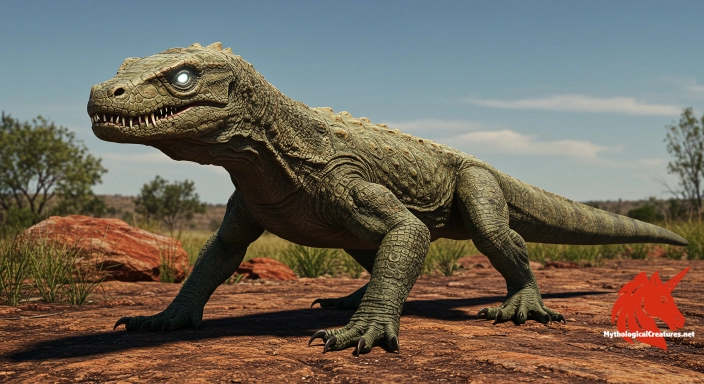
Mungoon-Gali
Mungoon-Gali - His legend explains why lizards lost their venom while snakes became dangerous and connects to the origin of the Murrumbidgee River, ending a great drought.
Origins & First Encounters
Mungoon-Gali is a storied giant goanna deeply woven into the rich tapestry of Yuwaalaraay folklore. His legend is anchored in a time when the forces of nature and the spiritual realm were intimately connected to everyday life. Described as a formidable reptilian being with a venomous bite and voracious appetite, he has long been both feared and revered by local communities. Tales recount him as a colossal figure whose very presence dictated the balance between menace and mysticism. Early narratives present him as a harbinger of natural forces, capable of both destruction and transformation. The uniqueness of his myth lies in the way his character intertwines with crucial moral and environmental lessons. His alternate name, Mungoongarlee, reveals the linguistic and cultural evolutions that have accompanied his tale over generations. The mythology surrounding him is not only a record of ancient beliefs but also a commentary on the delicate interplay between man and nature. His story, emerging from oral traditions, stands as a testament to the resilience and resourcefulness of the Yuwaalaraay people. Ultimately, Mungoon-Gali embodies the enigmatic spirit of a landscape both harsh and awe-inspiring.
Source Texts & Tale Variants
The primary accounts of Mungoon-Gali originate from long-held oral traditions passed down through the generations of the Yuwaalaraay people. These narratives have been conveyed at communal gatherings, ensuring that the creature’s legend survival through the ages. One well-known tale chronicles how his venomous bite instilled terror in local tribes until a cunning black snake, Ouyouboolooey, intervened on behalf of both man and nature. A distinct version recounts the extraordinary era of drought in the Riverina, where Mungoon-Gali and his tribe guarded a secret water source that sustained them when all other life withered. In this recount, his youngest wife, Kubbitha the black duck, becomes instrumental in unearthing the hidden water, an act that eventually gave rise to the Murrumbidgee River. The dual narrative versions illustrate a complex mythology that incorporates both cautionary elements and themes of renewal. Despite variations in the details, each version is rich in symbolism and reflects the cultural priorities of different local communities. The enduring nature of these stories demonstrates the importance of oral literature in preserving the history and beliefs of indigenous peoples. Elements of trickery, betrayal, and the transformative power of nature are consistently present across the variants. Each narrative, though distinct, contributes to a multifaceted picture of a mythic creature whose impact transcends time.
Form & Powers
The depiction of Mungoon-Gali is as striking as it is formidable, with every detail accentuating his mythical status. His enormous form is often portrayed with rippling musculature that underscores his strength and the innate power of the wild. Richly textured scales, reminiscent of ancient armour, shimmer in deep earthly browns and forest greens, echoing the colours of the natural landscape. His long, sinuous tail is said to sweep with a grace that belies its destructive capability, creating a visual image of both elegance and danger. The creature’s eyes are described as piercing and soulful, hinting at an intelligence that belies his beastly nature. Intricate details such as subtle crests along his head or ridges along his back further enhance his regal yet intimidating presence. Local legends speak of a distinctive venom pouch tucked within his jaw—a feature that has since become a central motif in his tale. The texture of his skin, rugged and timeworn, is symbolic of the harsh environments he inhabits. Variations in size are noted across different recitations, with some portraying him as the archetypal giant that overshadows all other creatures. In every rendition, the physical traits of Mungoon-Gali serve not only to awe but also to reinforce his role as an agent of both chaos and order in the natural world.
Regional Faces
The myth of Mungoon-Gali takes on diverse nuances as it travels across different regions, each community adapting the legend to reflect local realities. In the Yuwaalaraay tradition, he is closely identified with the lace monitor, his image evolving alongside the indigenous understanding of native fauna. Certain versions focus on his venomous traits that instilled fear, while others highlight his part in the explanation of natural phenomena, such as the origin of a vital river under extreme drought. In the Riverina, the narrative of his secret water source and the subsequent role of his wife Kubbitha is particularly emphasised, underlining a regional response to harsh climatic events. The creature’s portrayal can vary from a monstrous terror to a reluctant guardian whose actions prompt significant ecological transformation. Communities in different parts of Australia have used his legend to mirror the challenges posed by their unique environmental conditions. The emphasis on regional details—be it the specific tone of his physical description or the intricacies of his actions—reveals a dynamic interchange between mythology and local ecological wisdom. This regional adaptation enriches the overall myth, tying Mungoon-Gali’s legend to the lived experiences of each distinct community. Local narratives not only celebrate his fearsome abilities but also acknowledge the lessons embedded within his story. Through these varied retellings, the myth becomes a collective cultural asset that unites diverse perspectives on nature and survival.
Cultural Parallels
When compared with other mythic figures around the world, Mungoon-Gali stands as a distinctive example of a reptilian force of nature. His portrayal resonates with the archetype of the great beast found in many indigenous cultures, where colossal reptiles symbolise both creation and destruction. Parallels can be drawn with other Indo-Pacific and Aboriginal creatures, where the blend of danger and sacred power is a recurring theme. Similar in some respects to the revered Rainbow Serpent, his narrative also emphasises the role of water and renewal, albeit from a different perspective. Beyond Australia, mythical reptiles and dragons in Eastern and European traditions share the motif of formidable guardianship over natural elements. The interplay of betrayal and cunning within his tales, such as the encounter with the black snake Ouyouboolooey, mirrors similar narrative techniques found in global mythology. Such comparisons reveal how legends transform natural elements into symbols of cultural and moral lessons. These cross-cultural connections highlight a universal human desire to understand and personify the unpredictable forces of nature. Despite the variance in form and cultural context, common threads such as metamorphosis and balance unite these mythic entities. In this way, Mungoon-Gali not only stands on his own but also joins a broader tradition of myth-making that spans across continents.
Legacy & Modern Evolution
The evolving legacy of Mungoon-Gali is a testament to the enduring power of myth in adapting to changing cultural landscapes. Historically, his image was one of raw, untamed might, a reflection of nature’s often unpredictable fury. Over time, his tale has been reframed by successive generations, shifting from a narrative of pure terror to one symbolising the delicate balance between destruction and regeneration. Modern interpretations have added layers of ecological and ethical significance, presenting him as a reminder of the intricate ties between people and the environment. Contemporary storytellers and artists have reimagined his legend to speak to issues of sustainability, environmental disruption, and the consequences of human intervention. Exhibitions, literary works, and community festivals now sometimes feature his image as a call to honour traditional wisdom while engaging with modern ecological challenges. The creature’s journey from a fearsome giant to a cultural emblem encapsulates the transformation of myth in a changing world. His story, replete with themes of betrayal, resilience, and natural retribution, continues to inspire both local communities and a broader audience intrigued by indigenous narratives. Mungoon-Gali now stands as an icon bridging ancestral lore and present-day conversations about the care of the land. In this manner, the modern legacy of the giant goanna remains as dynamic and multifaceted as the environment it once so fiercely dominated.
Interesting Fact
It is particularly intriguing that the myth of Mungoon-Gali not only accounts for the loss of venom in lizards but also connects his story to the creation of one of Australia’s major rivers, highlighting the deep interplay between natural features and cultural narratives.
Support the directory
Promote your myth project and fund more research
Sponsor placements help keep this directory growing and free to use while giving your work a focused, relevant audience.
Learn how sponsorship worksQuick Creature Info
Origin:
Associations:
Our Mythic Legendary Rating:

Also Sometimes Known As:
Habitat:
Supernatural Powers:
Physical Attributes:
Abilities:
Behavior:
Weaknesses:
Lore:
Related Creatures, Tales or Lore
References
Discover Another Mythical Legend You May Not Have Heard Of?
Uncover the mysteries of ancient folklore and expand your knowledge of legendary beings from cultures around the world.
Dare to Meet the Abcán....
Curated by the Mythological Creatures Team
Series editor: Mythological Creatures Directory
Primary desk: Asian & Pacific Myth Cycles Desk
(rev. November 2025)