
Polemos: Polemos is an abstract daemon from Greek mythology representing the embodiment of war.
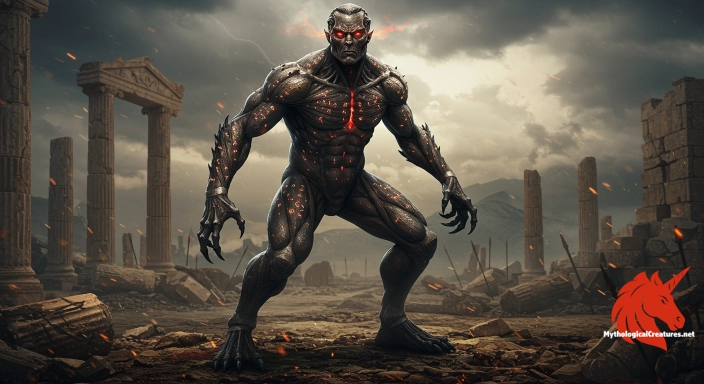
Polemos
Polemos - Represents the inevitable and chaotic nature of war, often invoked in allegorical and philosophical discussions rather than in cult practices
When was Polemos first written about?
Polemos emerges in the ancient Greek mythological landscape as a distinctive representation of the tumult and violence inherent in war. Distinguished as a daemon rather than a conventional god, he captures the lesser-seen aspects of conflict that transcend mortal heroics. His origins remain enigmatic, with early literary currents conceiving his essence during eras of profound societal introspection. Rather than inspiring heroic sagas, his persona was principally utilised in allegorical and philosophical discourse to probe the nature of strife. Unlike deities celebrated in epic narratives, Polemos symbolises the abstract, often chaotic, flow of conflict that pervades human existence. His presence reflects an intellectual tradition in which intangible forces are personified to elucidate the moral complexities of battle. The ancient Greeks, grappling with the cyclical nature of war, imbued his character with a sense of inevitability and transformative power. His role underscores that war is not only a physical confrontation but also a profound existential trial. Despite the absence of formal cult practices or elaborate myths, Polemos endures as an emblem of the perpetual and transformative nature of warfare.
Polemos: From Oral Tale to Written Record
Ancient texts offer only sparse glimpses of Polemos, with references appearing primarily in philosophical explorations rather than in detailed mythic narratives. Unlike the richly documented exploits of Olympian deities, his mentions are confined to subtle allegorical allusions in scattered literary fragments. Early philosophical writings hinted at his nature as the embodiment of the disruptive elements of war, rather than as a subject of dedicated cult worship. The limited primary sources provide a mosaic of impressions that merge abstract thought with the stark realities of conflict. His character was often sketched in brief mentions that serve to illuminate deeper meditations on the nature of strife. Literary sources occasionally conflate his persona with more tangible representations of martial violence, further blurring the lines between idea and icon. Some variants, though rare, suggest that local storytellers appropriated his imagery to express the unrefined chaos of battle. Over time, these fragments contributed to an evolving conceptual understanding that merged intellectual allegory with the palpable harshness of war. Even in the absence of comprehensive mythic cycles, the enduring subtlety of his portrayal testifies to the power of abstraction in capturing war's essence.
What abilities did Polemos have?
Artistic and literary depictions of Polemos are inherently ambiguous due to his status as an abstract daemon. He is frequently imagined as a shadowy, spectral figure whose form defies the clarity of conventional deities. In some imaginative renderings, his eyes burn with a fierce inner fire that symbolises the relentless intensity of battle. His visage is at times skeletal and gaunt, evoking the decay and desolation left in the wake of warfare. Tattered robes that billow like the remnants of shattered armour often accompany his form, reinforcing the transient beauty of destruction. The absence of a fixed iconography means that he can be portrayed as both towering and overwhelming or, alternately, as an ephemeral presence barely discernible in the chaos of conflict. Visual representations sometimes incorporate elements such as shattered shields or diffused, ominous light to capture the fragmented nature of war. This mutable physicality serves as a constant reminder that Polemos is not a concrete entity but a personification of the ever-changing and elusive character of conflict. His depictions invite viewers to confront the inherent duality of war—the tangible manifestations of violence and the abstract forces that drive it.
Where is the legend of Polemos strongest?
Although rooted in Greek mythology, the conceptual form of Polemos has resonated across various regions, adapting its nuances to distinct local experiences of conflict. In areas burdened by prolonged strife, his abstract persona was sometimes interwoven with the tangible horrors of battle, reflecting the regional memory of warfare. Certain Greek city-states, deeply scarred by internecine struggles, reinterpreted his image to echo their collective experiences of loss and upheaval. During the Hellenistic era, local artistic expressions began to infuse his representation with culturally specific elements, including unique stylistic motifs and symbolic regalia. In regions where war was a recurring reality, the figure of Polemos became a subtle emblem of both the tragedy and catharsis inherent in conflict. His abstraction allowed communities to meld his identity with other local deities of strife, producing syncretic figures that conveyed both destruction and eventual renewal. The Roman adoption of his conceptual qualities into the figure of Bellum further illustrates how adaptable his symbolism was across differing cultural milieus. Through these regional adaptations, the abstract nature of Polemos transformed to meet local sensibilities, making his presence a silent testament to the universal impact of war. This flexibility underscores the enduring allure of his character as a vessel through which varied societies have explored the nature of conflict.
Which other cultures tell a story like that of Polemos?
Comparative analysis reveals that Polemos occupies a unique niche among mythological representations of war. Unlike Ares, whose narrative is steeped in the vigour of battle and heroic exploits, Polemos personifies the intangible and chaotic essence of conflict. His abstract nature finds a direct parallel in the Roman conceptual figure of Bellum, where the focus remains on war’s elemental force rather than on illustrative mythic adventures. Across different mythological traditions, similar figures emerge, offering allegorical interpretations of strife without the detailed mythos afforded to their more anthropomorphic counterparts. In some Northern and Eastern narratives, there exist shadows of this same idea—entities that encapsulate the relentless power and inevitable destructiveness of war without being tied to a fixed story. The contrast between the vivid, personal mythology of deities like Mars and the ungraspable spectre of Polemos highlights a cross-cultural distinction in how war is envisioned. This divergence underscores a broader cultural tendency to either mythologise war with personalised heroes or to understand it as a faceless, pervasive force. Such comparisons invite reflection on the multifaceted ways societies understand and articulate the phenomenon of conflict, making Polemos a timeless symbol of war’s abstract and transformative character.
Polemos: From Folklore to Pop Culture
Over the centuries, the interpretation of Polemos has evolved in tandem with shifting societal views on conflict. In early Greek thought, he emerged primarily as a philosophical symbol, encapsulating the inescapable and often destructive nature of war. As the cultural landscape transformed through the Hellenistic and Roman periods, his abstract identity began to influence broader artistic and intellectual discourses. During the Renaissance, a renewed interest in classical mythology led artists and writers to reinterpret his qualities as emblematic of both the chaotic brutality and the paradoxical creativity of warfare. Although he never inspired a dedicated cult or ritual, the legacy of Polemos persisted in the realm of allegory, influencing political thought and literary expression. Modern interpretations continue to draw on his spectral nature when exploring the interplay between destruction and rebirth in times of conflict. Contemporary literature and film frequently echo his attributes, using abstract depictions of war to underscore themes of human vulnerability and resilience. His lasting legacy lies in his ability to encapsulate the profound duality of war—a force that is as destructive as it is transformative. In reimagining Polemos for a modern audience, creators harness his timeless symbolism to comment on the enduring and complex nature of conflict in human society.
Interesting Fact
Polemos is one of the few mythological figures who is more symbolic than narrative, reflecting the ancient Greeks' philosophical exploration of abstract concepts like war and conflict.
Sponsor this space
Tasteful, fixed-fee placements for myth projects
No bidding wars or flashing banners. We offer simple placements for a small set of creators and brands aligned with our readers.
Request further detailsQuick Creature Info
Origin:
Associations:
Our Mythic Legendary Rating:

Also Sometimes Known As:
Habitat:
Supernatural Powers:
Physical Attributes:
Abilities:
Behavior:
Weaknesses:
Lore:
Related Creatures, Tales or Lore
- BBellum
- AAres
- PPhobos
References
Discover Another Mythical Legend You May Not Have Heard Of?
Uncover the mysteries of ancient folklore and expand your knowledge of legendary beings from cultures around the world.
Dare to Meet the Minawara and Multultu....
Curated by the Mythological Creatures Team
Series editor: Mythological Creatures Directory
Primary desk: Hellenic & Ancient Mediterranean Desk
(rev. November 2025)