
Rán: Rán is the Norse sea goddess who personifies the ocean and its ever-changing, perilous nature.
Rán
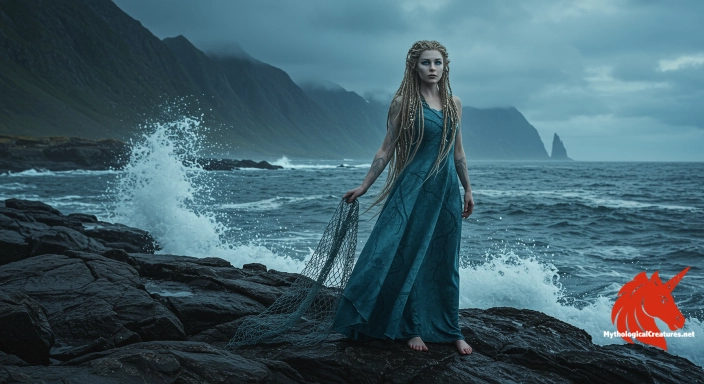
Rán - Rán embodies the unpredictable might of the sea, capturing seafarers with her net and symbolising both its beauty and danger.
the legend in five swipes.
the legend in five swipes.
The Origin Story of Rán
Rán emerges in the mystic tapestry of Norse mythology as an enigmatic sea goddess who embodies the untamed spirit of the ocean. Her origin is interwoven with the elemental forces of nature, reflecting a deep connection to the brine and salt of the deep waters. She manifests with a regal yet mercurial presence that is as alluring as it is daunting—a force that both protects and punishes those who journey across the seas. Rooted deeply in ancient tradition, she symbolises the ocean’s capricious moods and its capacity to both nurture and devastate. Rán is intrinsically linked to her husband Ægir, a formidable jötunn who personifies the vast and unpredictable sea. Together they have nine daughters, each representing the dynamic and varied expressions of the ocean’s waves. Her myth is further coloured by the famous image of her wielding a net to capture unwary seafarers, an emblem of the peril that lies beneath the tranquil surface. For the Norse and other seafaring cultures, she has long been revered and feared as a guardian of the deep whose mysteries continue to inspire wonder and respect.
Rán: How the Tale Was Told and Retold
Primary accounts of Rán’s character are embedded within some of the most revered sources of Norse literature. The Poetic Edda, a treasure trove of ancient oral lore, presents her as a potent embodiment of the sea with stories passed down through generations. Snorri Sturluson’s Prose Edda further refines her narrative, integrating her interactions with Ægir and the enchanting symbolism of their nine wave-daughter figures. Her presence is also woven into narrative sagas such as the Völsunga saga and Friðþjófs saga hins frœkna, where her role in the cosmic drama of nature is delicately balanced. The rich imagery found in skaldic poetry—exemplified by Egill Skallagrímsson’s Sonatorrek—offers an evocative glimpse into her multifaceted character, blending beauty with an underlying menace. Each source contributes unique details and nuances, from the lending of her net to the interplay of divine forces, enriching our understanding of the goddess. Diverse accounts have led to multiple versions of her myth, each highlighting different facets of her power and compassion. Through these textual variations, Rán’s legend has been continually reinterpreted, underscoring her enduring significance in the Norse mythological tradition.
Rán: Physical Form and Supernatural Powers
Visual depictions of Rán often evoke an image that is both striking and enigmatic, infused with the eternal depths of the ocean. Artists and storytellers imagine her with long, flowing hair that cascades like seaweed in turbulent waters, reflecting hues of deep blue and stormy grey. Her eyes are portrayed as mirrors of the sea, capturing the ever-shifting colours and moods of the tides. There is a sense of ethereal luminescence to her visage, as if moonlight itself has been woven into her features. In many renditions, she is seen adorned in garments that resemble billowing waves, their folds imbued with the mystery of hidden underwater realms. The unmistakable net in her hands is rendered with intricate detail, symbolic of her dominion over maritime fate and the elusive nature of the deep. Variations across artistic traditions sometimes reveal hints of seafoam and coral textures in her attire, further anchoring her identity to the marine world. Overall, Rán’s physical portrayals blend elements of beauty, awe, and foreboding, mirroring the very nature of the ocean she personifies.
Rán: One Legend, Many Local Versions
Rán’s legend has travelled across the varied landscapes of the Norse world, adapting to reflect local interpretations of the mighty sea. In Icelandic tradition, she is frequently entwined with the treacherous coastal waters, where the blend of beauty and danger is a daily reality for seafarers. In Norway, local lore casts her as a spectral guardian amid stormy fjords and mist-shrouded inlets, enhancing her image as both protector and potential threat. Scandinavian regional tales often enrich her myth by incorporating elements of ritual and folklore, such as the symbolic recasting of her net in local ceremonies. In some areas, she is portrayed with an added layer of benevolence, a nurturing spirit whose dominion over the sea affords blessings to those who earn her favour. Other traditions emphasise her more ominous aspects, where the net she wields becomes a harbinger of fate for those who defy the might of the ocean. These regional variations underscore a shared cultural acknowledgement of nature’s dual capacity for life and destruction. Consequently, whether revered for her generosity or feared for her wild unpredictability, Rán’s myth adapts gracefully to the distinctive sentiments of each locale within the Norse world.
What figures resemble Rán?
Rán’s multifaceted persona finds intriguing parallels with water deities from various mythological traditions around the globe. In her dual role as both nurturer and destroyer, she evokes comparisons with Mediterranean deities such as the Greek Amphitrite and the Roman goddess Salacia, each reflecting a respectful ambivalence toward the sea’s gifts and perils. Similar to these figures, Rán embodies the intricate balance between beauty and danger, a theme that resonates throughout coastal cultures. Her characteristic net, used to ensnare both fish and human souls, mirrors the motifs found in other mythic narratives where natural elements both provide sustenance and exact retribution. Cross-cultural comparisons extend to Celtic and Slavic water spirits, who like Rán, straddle the boundary of benevolence and ferocity in their stewardship of aquatic realms. This interconnection between myths highlights a universal human grappling with the unpredictable forces of nature, rendered in the form of divine entities. Rán’s story, therefore, contributes to a broader tapestry of water lore that celebrates the awe-inspiring mystery of the sea. In comparing her to similar figures, it becomes apparent that her legend serves as a cultural touchstone for understanding the complex relationships humans have with the oceanic environment.
How has the image of Rán evolved?
The myth of Rán has evolved remarkably from its early oral and written forms into a symbol rich with contemporary resonance. Over the centuries, her character has been reshaped through the reinterpretations of medieval scribes, later visual artists, and modern storytellers, all of whom have added layers of complexity to her tale. In more recent cultural expressions, she is often portrayed not merely as a capricious goddess but as a tragic figure whose sorrow mirrors the eternal ebb and flow of the tides. Modern literature and art have reimagined her as a guardian of nature, an emblem of the mystery and majesty inherent in the sea. Her enduring motif—the net—has come to signify the inescapable pull of fate and the delicate balance between life and death that defines human interaction with nature. Contemporary media, including films, graphic novels, and video games, have tapped into her potent symbolism to explore themes of isolation, environmental change, and the inexorable power of the natural world. As discussions about climate change and conservation grow, Rán’s legacy as a personification of the sea’s beauty and menace continues to inspire renewed artistic and cultural reflections. Her myth remains a timeless reminder of the intricate bond between humanity and the untamed forces that govern our world.
Interesting Fact
An intriguing aspect of Rán is how her seemingly perilous act of capturing seafarers with her net simultaneously underscores the life-affirming, mysterious beauty of the sea, reflecting the duality of nature itself.
Mythological Treasures
Norse Sagas: A field guide to the beasts of the Viking world
Drawn from the saga accounts themselves, with the powers, weaknesses and doom of each being set out.
Egyptian Legends: A field guide to the gods and monsters of ancient Egypt
Guardians of the living and devourers of the dead, with the role each played in judgement.
Chinese Beasts: A field guide to the dragons and demon kings of Chinese myth
From river dragons to demon kings, with the legends that shaped five thousand years of storytelling.
the legend in five swipes.
For serious mythcraft
Your project belongs among the legends
If your work deepens how people understand, play with, or teach mythology, a sponsor placement here keeps it in front of the right readers all year.
Submit a sponsorship enquiryQuick Creature Info
Origin:
Features:
Associations:
Our Mythic Legendary Rating:

Habitat:
Supernatural Powers:
Physical Attributes:
Abilities:
Behavior:
Lore:
Related Creatures, Tales or Lore
- AAmphitrite
- TThalassa
- SSalacia
References
Discover Another Mythical Legend You May Not Have Heard Of?
Uncover the mysteries of ancient folklore and expand your knowledge of legendary beings from cultures around the world.
Dare to Meet the Haymon....

The Mythological Creatures Book Series
Yokai, Greek, Norse, Egyptian & Chinese. Five illustrated field guides to the creatures the old stories either warned or told you about.

Curated by the Mythological Creatures Team
Series editor: Mythological Creatures Directory
Primary desk: Northern & European Folklore Desk
(rev. November 2025)