
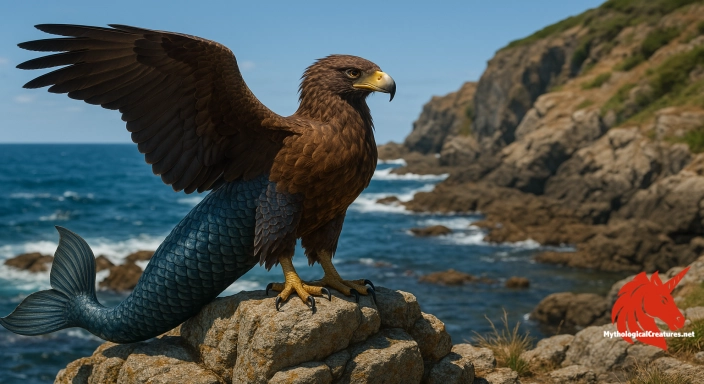
Sea-griffin: The sea-griffin is a heraldic creature that merges the features of an eagle and a fish.
Sea-griffin
Sea-griffin - Symbolises the union of aerial prowess and maritime strength, often used to denote noble heritage and power in heraldry.
Origins & First Encounters
The sea-griffin is a majestic heraldic emblem that seamlessly marries the valor of the eagle with the fluid grace of a fish. Its origins can be traced to the rich traditions of medieval Europe, where emblematic creatures were crafted to embody dual realms of power. Emerging predominantly in German and Polish heraldry, this mythical creature is fashioned with the head, upper body, wings, and talons of an eagle, coupled with the sleek lower half of a fish. This striking combination symbolises the mastery of both sky and sea, a theme that resonated deeply in eras when maritime prowess and aerial vigilance were equally paramount. Often seen on crests, shields, and banners, the sea-griffin served as an auspicious sign for families and cities, communicating qualities of nobility and protective strength. Its image was not only a mark of martial vigour but also a talisman believed to safeguard commerce and seafaring endeavours. Over time, artists and chroniclers expanded on its symbolism, integrating local myths and naturalistic details that elevated it beyond a mere decorative motif. The enduring allure of the sea-griffin lies in its ability to encapsulate the mystical blend of earthly and aquatic forces in a single, captivating form.
Source Texts & Tale Variants
Early attestations of the sea-griffin appear in a variety of medieval heraldic manuscripts and armorial rolls, where its image is entwined with the storied traditions of European nobility. Illustrative heraldic texts from the 13th and 14th centuries frequently catalogue this aquatic hybrid alongside other emblematic creatures, underscoring its importance in historical symbolism. While it lacks a singular, cohesive narrative like some mythic figures, its recurring depiction in regal emblems points to a deep cultural reverence for its dual characteristics. Some accounts in lesser-known folklore hint at an origin story that blends the mythical powers of the eagle with the enchanting mystery of the deep sea. Alternative story variants have portrayed the sea-griffin as a divine guardian of submerged treasures, imbuing it with an almost otherworldly aura. These diverse narratives, though fragmentary, collectively reveal how the creature’s symbolism was moulded by both martial and maritime influences. Occasional references in renaissance heraldic manuals further solidify its place in the mythological lexicon, even as its artistic rendering varied with time and region. Modern compilations of heraldic symbols have revived these historical variants, ensuring that the legend of the sea-griffin continues to evolve and inspire new interpretations.
Form & Powers
The sea-griffin is delineated with a remarkable fusion of anatomical features that reflect both aerial majesty and aquatic elegance. Its head, complete with piercing eyes and a sharply curved beak, mirrors the regality and acute perceptiveness of the eagle. The upper body and expansive wings are rendered with robust detail, showcasing feather patterns that suggest both strength and swift movement. In a dramatic departure from traditional griffin imagery, the lower half transitions seamlessly into the scaled form of a fish, complete with a streamlined tail designed for agile navigation through water. This melding of textures—from the soft plumage of the eagle to the glistening, ribbed scales of the fish—creates a vivid contrast that is both aesthetically appealing and symbolically potent. The talons, sharp and formidable, further enhance the creature’s impression of lethal precision in flight. Artists in various heraldic traditions have experimented with colour schemes, often employing deep blues, vibrant greens, and regal golds to underscore its maritime and martial attributes. Whether depicted in a detailed, realistic style or as a more abstract, stylised charge, the sea-griffin remains a testament to the creative ingenuity of heraldic art. Its physical presence, a blend of contrasting natural elements, continues to captivate imaginations across generations.
Regional Faces
Across Europe, the sea-griffin has been adapted in myriad ways to reflect local cultural ideals and natural landscapes. In German heraldry, where it is known as the Fischgreif, its design is often adorned with elaborate ornamental details that echo the artistic sensibilities of the region’s medieval courts. In Poland, referred to as rybogryf or gryf morski, the creature is frequently depicted with a particular emphasis on its aquatic attributes, mirroring the nation’s deep connections with rivers, lakes, and maritime trade. Eastern European renditions sometimes infuse the sea-griffin with folkloric elements reminiscent of local water spirits, transforming it into a symbol of both protection and mysterious natural forces. Meanwhile, in Northern Europe, more minimalist interpretations prevail, with stark, bold lines that accentuate its dynamic form against the backdrop of rugged landscapes. Mediterranean and coastal regions have also contributed their own nuanced takes, often incorporating vibrant colours and flowing lines that celebrate the beauty of the sea. These regional differences are not mere artistic variations; they reveal how communities have interwoven the creature’s image with their unique historical narratives and environmental inspirations. Despite these diverse portrayals, the core symbolism of the sea-griffin—as an emblem of dual mastery over sky and sea—remains a unifying theme. This cross-cultural appeal has helped the sea-griffin persist as a potent symbol throughout various regional traditions.
Cultural Parallels
The sea-griffin stands as a fascinating counterpart to the more archetypal griffin of myth, which itself combines features of the eagle and the lion to denote supreme power and vigilance. Its distinctive substitution of the lion’s body with that of a fish creates a unique narrative that emphasises the dominion of water alongside the dominion of the skies. This change invites comparison with other mythological hybrids, such as the hippocampus, which similarly marries terrestrial and aquatic qualities to encapsulate the mystery of the sea. Beyond the realm of heraldry, creatures that straddle the boundaries of different natural elements are found in diverse cultural mythologies, where they often represent the reconciliation of opposites. In many traditions, the duality embodied by such hybrids—mirroring the balance between light and dark or the seen and unseen—serves as a powerful metaphor for unity in diversity. The sea-griffin’s imagery, merging the freedom of flight with the fluidity of water, resonates with broader themes of transformation and adaptability. Its layered symbolism is echoed in the icons of other cultures, from water dragons in Eastern lore to hybrid birds in indigenous narratives. This comparative perspective underscores not only a shared human fascination with the natural world’s extremes but also the enduring appeal of mythic creatures that bridge disparate realms.
Legacy & Modern Evolution
Over the centuries, the sea-griffin has transitioned from a specialised heraldic charge to a broader cultural symbol that continues to inspire artistic and literary endeavours. Initially celebrated in the medieval period for its embodiment of martial prowess and maritime command, the creature has maintained its allure through a variety of historical epochs. As the language of heraldry evolved, so too did the visual representations of the sea-griffin, increasingly blending tradition with innovative artistic flourishes. In contemporary times, its image is frequently encountered in fantasy literature, video games, and modern graphic design, where it is reinterpreted to capture the imagination of a new generation. Organisations, sports teams, and maritime communities have adopted the sea-griffin as an emblem of resilience, adaptability, and the bridging of elemental forces. Its revival in digital media and popular culture has afforded it a renewed relevance, positioning it as a symbol of both heritage and modern creativity. This evolution speaks to the creature’s inherent versatility, capable of embodying enduring values while adapting to new symbolic contexts. The legacy of the sea-griffin is a testament to the power of myth to transcend time, continually redefining itself to reflect the aspirations and challenges of each era. Today, it remains a potent icon, bridging the gap between ancient heraldic tradition and the dynamic expressions of modern myth-making.
Interesting Fact
An intriguing aspect of the sea-griffin is its rare portrayal as an aquatic variant of a typically terrestrial griffin, highlighting the inventive symbolism of medieval heraldry.
For myth educators and toolmakers
Built a resource for mythology learners?
If you offer courses, teaching tools, or research platforms focused on myth and folklore, consider a discrete placement on our reference pages.
Introduce your resourceQuick Creature Info
Features:
Associations:
Our Mythic Legendary Rating:

Also Sometimes Known As:
Habitat:
Supernatural Powers:
Physical Attributes:
Abilities:
Lore:
References
Discover Another Mythical Legend You May Not Have Heard Of?
Uncover the mysteries of ancient folklore and expand your knowledge of legendary beings from cultures around the world.
Dare to Meet the Minokawa....
Curated by the Mythological Creatures Team
Series editor: Mythological Creatures Directory
Primary desk: Northern & European Folklore Desk
(rev. November 2025)