
Silvanae: The Silvanae are Roman woodland nymphs associated with the god Silvanus.
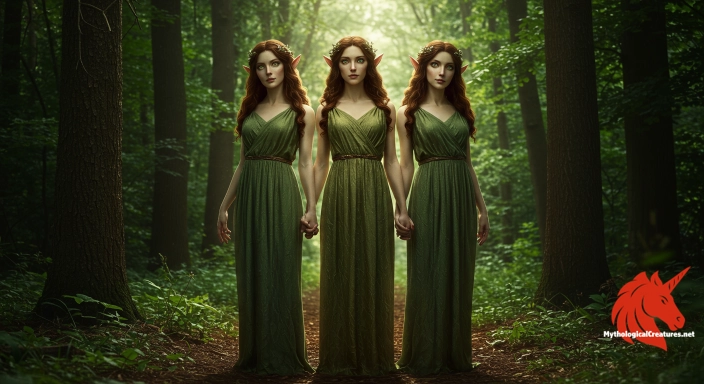
Silvanae
Silvanae - Represent the syncretism between Roman and Celtic religious traditions, highlighting the integration of indigenous nature worship with Imperial cults
the legend in five swipes.
the legend in five swipes.
How old is the legend of the Silvanae?
The Silvanae are intriguing figures from the Roman religious landscape, embodying the spirit of woodland deities in a multifaceted role within the Empire. Originating as nymphs or goddesses linked to Silvanus, they first emerge in inscriptional evidence primarily from the Pannonian region. Their early appearance points to a deep-rooted association with rural and natural cults that celebrated the abundance of the forest. This group of deities reflects a unique synthesis between indigenous nature worship and the organised structure of Roman religious practice. Their presence, often depicted as a female complement to the male form of Silvanus, underscores the Roman penchant for balanced divine dualities. The cultural context in which they thrived was one of regional adaptation, where local traditions merged with the expansive influence of Roman imperial ideology. The inscriptions and artistic representations suggest that the Silvanae were revered by both civilians and military personnel, indicating an inclusive appeal. Over time, they came to symbolise not only the vitality of the forest but also the fertility and protection of rural life. Their enduring legacy within the Roman pantheon highlights the adaptability of religious practice in the face of ever-changing cultural landscapes. Ultimately, the Silvanae serve as a testament to the dynamic interplay between local myth and imperial power.
Which texts first mention the Silvanae?
Primary evidence for the Silvanae is found in a variety of inscriptional sources, most notably within the Danubian provinces such as Pannonia. These dedications, made by free citizens, legionaries, and military officials, provide a rich tapestry of how these deities were integrated into public and private cultic practices. Inscriptions often mention the Silvanae alongside Silvanus, reinforcing the idea of a complementary divine pairing. Variants in their cultic titles, including terms like augustae, silvestres, and Campestres, help trace their geographic and cultural diffusion. Beyond epigraphic attestations, artistic depictions in reliefs and statues further corroborate their significance in the Roman world. Some sources indicate that these goddesses shared attributes with other nature deities, suggesting a fluid and adaptive mythology that welcomed regional variations. In certain inscriptions from locations like Lugdunum, the Silvanae are identified with the Matres, linking them to broader Celtic traditions. Although literary sources are comparatively sparse, mentions of Silvani in plural form in writings by figures such as St. Augustine hint at an underlying narrative complexity. The multiplicity of available sources offers insights into both the localised cults and the broader ideological usage of nature deities within the Empire. Over time, these texts have contributed significantly to modern scholarly reconstructions of Roman polytheistic practices.
What were the Silvanae believed to be capable of?
Artistic depictions of the Silvanae offer a vivid glimpse into their iconographic character and physical representation. Typically portrayed as groups, most often in triads, they are shown standing in a frontal alignment with intertwined arms or hands, symbolising unity and interconnectedness. In some examples, they appear individually or in larger groups extending to nine figures, highlighting the flexibility of their cultic imagery. Often, these deities are depicted holding tree branches, flower pots, conch shells, or wreaths, all of which underscore their connection to the natural world. While they are generally clothed, there is at least one notable instance where a Silvana is shown nude from the waist up, offering a contrasting insight into their symbolic traits. The delicate balance between modesty and an inherent naturalism is evident in the way their garments are rendered, punctuating their role as guardians of the woodland realm. Their facial expressions and refined postures reveal a sense of serenity and a timeless association with nature’s rhythms. Sculptural details, including the careful rendering of foliage and decorative motifs, further enhance the impression of graceful, organic beauty. The variability in size and grouping in different regions suggests that local traditions may have influenced subtle changes in their physical portrayals. Overall, the artistic legacy of the Silvanae encapsulates a harmony between the cultivated aspects of Roman religious art and the untamed essence of nature.
Silvanae: One Legend, Many Local Versions
The iconography and cultic prominence of the Silvanae display notable regional variations across the Roman Empire. In the Danubian provinces, particularly in Pannonia and Dacia, inscriptions and dedications consistently underscore their importance, sometimes under the epithet Campestres, which intimates a connection to the countryside and fields. In these regions, military and civilian worship converged in ways that emphasised both the protective and nurturing aspects of their character. In Latin literary tradition, they are often mentioned as companions of Silvanus, yet some areas preferred the label Silvanae to denote their distinct local attributes. Celtic influences are evident where the Silvanae are associated with the Matres or Matronae, suggesting a harmonious blending of local mythologies with Imperial cult practice. Variations in terms such as augustae and silvestres further highlight regional nuances in their veneration. There is also evidence of their connection with crossroads deities like Quadruviae, Triviae, or Biviae in Celtic areas, illustrating the adaptive nature of their worship. Artistic renditions from various provinces reflect differing stylistic elements, likely influenced by regional cultural and aesthetic preferences. Such regional diversity reinforces the idea that the Silvanae were not a homogeneous group but a flexible symbol embracing multiple local traditions. Their ability to traverse cultural boundaries remains a testament to the syncretic quality of ancient Roman religion.
Which myths echo the story of the Silvanae?
The Silvanae invite rich comparative analysis with similar nature deities across various cultural traditions. Their role as woodland nymphs often draws parallels with figures such as the Celtic Matres, or Matronae, who similarly symbolise fertility, protection, and the nurturing aspects of nature. In both the Roman and Celtic contexts, depictions of triadic groupings underscore a common motif of balance and completeness. Like the Greek hamadryads, the Silvanae are closely associated with trees and the life force of the forest, further cementing their role as guardians of the natural world. Their iconography, replete with tree branches and floral symbols, resonates with multiple Indo-European traditions that celebrate the sanctity of nature. The complementary relationship with Silvanus mirrors other mythological pairings where a masculine and feminine duality work in tandem to maintain cosmic order. Comparative studies also reveal that while the Silvanae are structured within the formalised framework of Roman religion, their inherent attributes align them with broader, cross-cultural archetypes of nature deities. This synthesis not only underscores shared mythological themes across different cultures but also highlights the adaptability of ancient religious concepts. By embracing elements from both indigenous and imported traditions, the Silvanae illustrate the fluid boundaries that often define ancient mythologies. Their enduring motifs continue to capture the imagination of scholars and enthusiasts of comparative mythology alike.
Why do the Silvanae still matter?
Over time, the depiction and interpretation of the Silvanae have evolved significantly, reflecting broader shifts in cultural and religious values. During the Roman era, their association with nature and the imperial cult allowed them to adapt to local tastes and practises, thereby ensuring their widespread veneration. As the Roman polytheistic system declined, echoes of these woodland deities survived in medieval folklore and rural traditions throughout Europe. Their images, resurrected in the modern era by neo-pagan movements and artistic reimaginings, continue to symbolise the enduring power of nature worship. Contemporary interpretations often cast the Silvanae as emblems of environmental balance and the enduring beauty of untouched wilderness. The transformation in their portrayals—from solemn figures in sacred rituals to inspirational icons in modern art and literature—underscores a dynamic cultural legacy. Their journey from the inscriptions of ancient fortresses to the canvases of modern artists encapsulates the rich interplay between tradition and innovation. Modern scholarship has also re-evaluated their role, situating them within a broader narrative of cultural syncretism in antiquity. The adaptability of their iconography serves as a reminder of the interconnectedness of human belief systems, both past and present. In this way, the Silvanae continue to inspire a renewed appreciation for ancient mythologies and the timeless allure of nature.
Interesting Fact
An intriguing aspect of the Silvanae is their frequent depiction as a triad, mirroring the tripartite nature of Silvanus, which underscores the Roman appreciation for dualities and complements in their deities.
Mythological Treasures
Chinese Beasts: A field guide to the dragons and demon kings of Chinese myth
From river dragons to demon kings, with the legends that shaped five thousand years of storytelling.
Japanese Yokai: A field guide to the spirits and demons of Japanese folklore
Fifteen spirits, with the signs to watch for and what the old tales say to do if you meet one.
Greek Myths: A field guide to the monsters of ancient Greece
Every monster here earned its place in legend, and each gets a full page of artwork and the story behind it.
the legend in five swipes.
Advertising opportunity
Showcase your mythology project
We offer limited sponsor placements for books, courses, games, and creators aligned with our audience.
View partnership optionsQuick Creature Info
Origin:
Associations:
Our Mythic Legendary Rating:

Also Sometimes Known As:
Habitat:
Supernatural Powers:
Physical Attributes:
Abilities:
Behavior:
Lore:
Related Creatures, Tales or Lore
- HHamadryads
- MMatres
- RRoman Nymphs
References
Discover Another Mythical Legend You May Not Have Heard Of?
Uncover the mysteries of ancient folklore and expand your knowledge of legendary beings from cultures around the world.
Dare to Meet the Vetala....
The Mythological Creatures Book Series
Yokai, Greek, Norse, Egyptian & Chinese. Five illustrated field guides to the creatures the old stories either warned or told you about.



Curated by the Mythological Creatures Team
Series editor: Mythological Creatures Directory
Primary desk: Hellenic & Ancient Mediterranean Desk
(rev. November 2025)