
Stallo: The Stallo is a large, man-eating humanoid from Sámi folklore renowned for its brute strength and clumsiness.
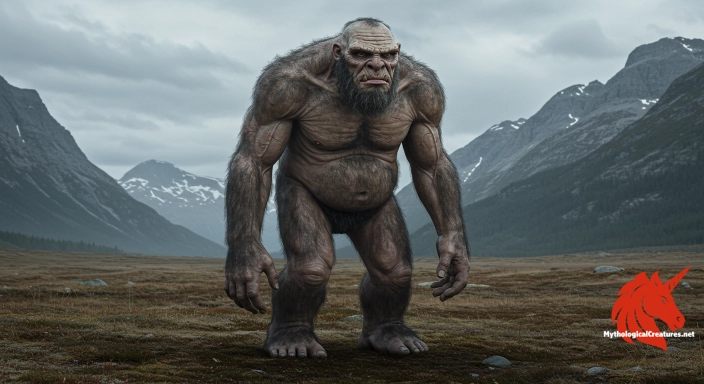
Stallo
Stallo - Serves as a cautionary figure and embodies the brutal aspects of nature in Sámi mythology.
Origins & First Encounters
The Stallo is a striking figure in Sámi folklore, a hulking, human-like creature whose legend has been passed down through generations, captivating audiences with its paradoxical blend of menace and clumsiness. Born of a time when the natural world was seen as both a living force and a mysterious adversary, the Stallo has become emblematic of the wild, untamed aspects of the Arctic landscape. Tales of its origin hint at ancient encounters, where the creature emerged from a deep connection with the land and the ruins left behind by long-forgotten cultures. Early narratives detail its formidable size and the threat it poses to humans, a dangerous reminder of nature's unpredictable power. It has long occupied a space in the collective imagination, acting as both a boogeyman and a symbol of the primal forces that underlie human existence. The duality of its character—both stupid and clumsy, yet possessing almost supernatural strength—adds complexity to its mythos. Regional storytellers often embellish its exploits, linking it with physical landmarks and mysterious structures in the landscape. The enduring allure of the Stallo lies in its representation of the boundary between civilisation and wilderness, a timeless reminder of the mysteries beyond human control.
This creature’s myth continues to thrive, its narrative evolving in tandem with shifting cultural attitudes toward nature and heritage.
Source Texts & Tale Variants
Accounts of the Stallo can be traced back to a rich tapestry of oral traditions maintained by the Sámi, where elders recounted stories that blended historical memory with mythic symbolism. Various folkloric compilations from the Nordic region capture vivid episodes of encounters with this creature, highlighting a legacy that has persisted for centuries. Some traditional narratives describe the Stallo as a being of chaotic strength, often involved in dramatic contests with humans that end in a blend of humour and tragedy. Written records collected in the 19th and early 20th centuries helped to solidify its place in Sámi folklore, even as local storytellers continued to adapt the myth in diverse settings. Multiple versions of the tale exist, each emphasizing different elements—from its fierce appetite and brutish behaviour to its inadvertent clumsiness that allows humans to overcome its threat. Alongside these accounts, landmarks like the remains of ancient building foundations and the renowned Stallo stone have incited further storytelling, intertwining physical geography with legend. Variants in the narrative underscore regional differences, with some versions portraying the creature in a slightly more sympathetic light as a relic of a bygone natural order. These diverse sources collectively weave a multifaceted picture, anchoring the myth of the Stallo firmly in both historical records and popular imagination.
The evolving nature of these stories highlights the dynamic interplay between oral tradition and recorded folklore over the centuries.
Form & Powers
Descriptions of the Stallo consistently depict it as a giant among men, its enormous stature setting it apart from any ordinary being. Its body, often portrayed as thick and robust, appears to be forged from the very rock and soil of the northern landscapes it inhabits. The creature is said to bear an uneven, rough-hewn visage, with a dishevelled mane of hair and a face marked by exaggerated, almost caricatured features. Its limbs are described as powerful yet ungainly, reinforcing the recurrent theme of brute strength paired with a lack of finesse. Some depictions suggest that its skin might bear a texture akin to weathered stone, hinting at a supernatural resilience against the elements. The Stallo’s eyes, in many accounts, shimmer with a wild intensity, reflecting both a primitive intelligence and an inherent clumsiness that frequently undermines its formidable appearance. Adornments of the creature, if any are mentioned at all, are rudimentary—perhaps simple garments made from animal hides or natural fibres, further grounding it in the earth. Overall, the physical portrayal of the Stallo serves to enhance its status as a creature both fearsome in might and comically inept in its interactions with the world around it.
This vivid physicality brings the creature to life, inviting comparisons with nature’s own unpolished and rugged forms.
Regional Faces
The portrayal of the Stallo exhibits notable regional variations that reflect the diverse cultural landscapes of the Sámi and neighbouring communities. In the northern reaches of Scandinavia, where the cold and desolate terrain leaves an indelible mark on the local psyche, the creature is often depicted with even greater physical exaggeration and ferocity. Some localities emphasise the Stallo’s connection to ancient stone structures and eerie natural formations, linking its legend to real, monumental landscapes that have survived through the ages. In contrast, other regional narratives soften its portrayal, sometimes imbuing it with traits that border on the comical rather than purely menacing. These regional adaptations are influenced by the distinct environmental challenges and social conditions of each area, resulting in a spectrum of interpretations—from a terrifying predator to a bumbling giant. The regional lore is frequently interspersed with mystical elements, suggesting that the Stallo may once have been a guardian of certain natural sites or a remnant of a prehistoric era. Even when the underlying danger of the creature is acknowledged, the narratives often highlight its clumsiness, which allows clever humans to subdue it. Such local adaptations underscore how the myth of the Stallo is as much a product of its environment as it is a testament to the creativity of the storytellers who have kept its legend alive.
This regional diversity enriches its myth, ensuring that the Stallo remains a flexible symbol adaptable to various cultural and environmental contexts.
Cultural Parallels
When examining the Stallo alongside similar figures in European folklore, one notices a striking resemblance to the archetypal giants and trolls that populate Norse and Celtic myths. Much like the giants of Norse lore, the Stallo embodies a raw, almost elemental fury tempered by a lack of cunning, creating a contrast that harks back to the duality of nature itself. Comparisons are often made with ogres and other large creatures, where physical might is both celebrated and ridiculed, reflecting a universal theme of formidable power undermined by inherent foolishness. In several comparative myths, such figures serve as a metaphor for the untamed forces of nature, standing in opposition to the order and innovation of human civilisation. The Stallo, in its multifaceted portrayal, mirrors these universal mythic traits while maintaining a unique link to the geographic and cultural specifics of the Sámi people. Cross-cultural echoes are found in stories of beings whose sheer physical size belies a clumsy incapacity, thus serving as cautionary symbols about the limits of brute force. The thematic parallels with other mythological creatures underscore a shared human fascination with monstrosity that is both fearsome and strikingly relatable. Such comparisons illuminate the ways in which folklore across different cultures negotiates the boundaries between human vulnerability and the overwhelming power of the natural world.
This comparative insight deepens our understanding of the Stallo, positioning it within a broader framework of mythological giants and supernatural entities.
Legacy & Modern Evolution
The evolution of the Stallo legend over time mirrors shifts in both cultural identity and the ways in which folklore is preserved and reinterpreted. Once feared as a dangerous, man-eating giant, the Stallo has morphed into a symbol that encapsulates the clash between the ancient, wild forces of nature and the encroaching modern world. In more recent times, the creature has found a new place in popular culture, surfacing in literature, art, and even film as a figure embodying both historical dread and a nostalgic fascination with archaic myth. This modern reinterpretation often casts the Stallo in a dual light—simultaneously a relic of a forgotten era and a cautionary tale about the consequences of human encroachment on nature. Contemporary artists and storytellers frequently draw on the rich, vivid imagery of the Stallo to evoke the mystique of the Arctic and its storied past, using the creature as a metaphor for indigenous resilience and natural power. Museums and cultural festivals sometimes highlight the myth of the Stallo as a critical component of Sámi heritage, helping to bridge the gap between ancient tradition and modern identity. Yet, despite its evolution, the core elements of the myth remain intact, serving as a reminder of the enduring power of oral tradition. Today, the Stallo continues to inspire creative reinterpretation, ensuring that its legacy endures as both a cultural touchstone and a source of timeless narrative intrigue.
This ongoing legacy not only honours traditional beliefs but also invites future generations to explore the rich tapestry of mythological heritage with fresh eyes.
Interesting Fact
The Stallo stone near Lake Giengeljaure is a direct link to the legend, believed to have been set by the creature itself to prove its immense strength.
Advertising opportunity
Showcase your mythology project
We offer limited sponsor placements for books, courses, games, and creators aligned with our audience.
View partnership optionsQuick Creature Info
Origin:
Features:
Associations:
Our Mythic Legendary Rating:

Also Sometimes Known As:
Habitat:
Supernatural Powers:
Physical Attributes:
Abilities:
Behavior:
Weaknesses:
Lore:
References
Discover Another Mythical Legend You May Not Have Heard Of?
Uncover the mysteries of ancient folklore and expand your knowledge of legendary beings from cultures around the world.
Dare to Meet the Eudora....
-a1f11b94-3340-4c8f-9030-dbe8c93cd970_small.webp "Depiction of Eudora")
Curated by the Mythological Creatures Team
Series editor: Mythological Creatures Directory
Primary desk: Northern & European Folklore Desk
(rev. November 2025)