
Śuri: Śauri is an ancient Etruscan deity revered as the infernal, volcanic, and solar fire god.
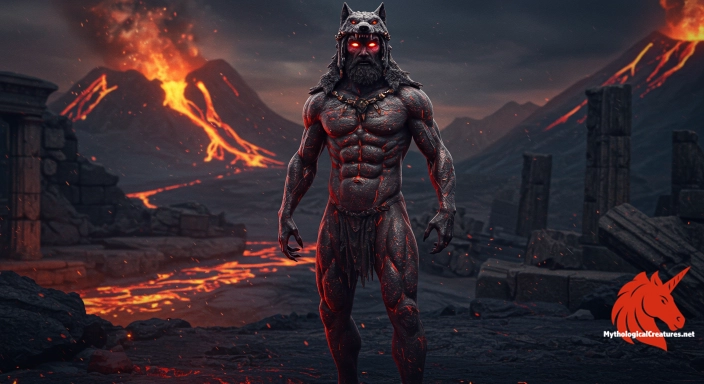
Śuri
Śuri - Śauri was revered as an embodiment of the powerful and transformative force of fire, influencing various Italic cultures and later integrated into the Roman religious framework.
Origins & First Encounters
Šauri emerges from the ancient tapestry of Etruscan belief as a potent deity whose dominion encompasses the volatile yet life-affirming forces of fire. His very name, meaning 'black', evokes the dark hues of volcanic rock and hints at the mysteries of the infernal realm. The earliest attestations of his cult lie in Etruscan inscriptions and sacred iconography, where fire symbolised both destruction and eventual renewal. He is a figure of dual nature, interweaving aspects of the blazing, radiant sun with the smouldering embers of the underworld. Various Italic peoples, including the Latins, Sabines, Capenates, and Faliscans, revered him, each contributing their cultural nuances to his mythos. His assimilation into the Roman pantheon as Soranus reflects a transformative process that spanned centuries and diverse traditions. The layered complexity of his character mirrors a broader ancient understanding of nature’s capricious interplay between creation and devastation. His myth encapsulates a balance between cosmic chaos and order, which resonated deeply with communities facing both natural calamities and agricultural rebirth. Even today, his enigmatic legacy continues to inspire those who seek to understand the elemental forces of the natural world.
Source Texts & Tale Variants
Ancient inscriptions and dedications from Etruscan sanctuaries provide some of the earliest evidence of Šauri’s veneration, illuminating his role as a conduit of elemental power. Archaeological discoveries, including votive offerings and terracotta figurines, have contributed to our understanding of his diverse mythic attributes. With time, Roman writers began to reference him under the Latinised name Soranus, incorporating his character into a broader religious framework. Diverse narrative strands emerged, with some traditions portraying him as a youthful warrior and others as a venerable, dark-bearded sovereign. Rural folklore across Italic regions enriched his myth by emphasising his role as a guardian of both celestial and infernal realms. Iconographic sources reveal a deity who was equally capable of unleashing fiery devastation and fostering renewal. This amalgamation of narratives reflects the dynamic interplay between ritual practice and literary tradition. Localised legends speak of a figure who bridges the gap between the mortal and the divine, imbuing his myth with an enduring mystery. Thus, a variety of sources—both textual and material—attest to Šauri’s multifaceted legacy and his evolving significance over time.
Form & Powers
Šauri’s iconography is as diverse as it is striking, revealing multiple facets of his divine persona. In one common portrayal, he appears as a crowned young man whose poised expression and athletic form exude both nobility and martial vigour. This youthful representation is typically shown wielding a spear or a bow and arrows, emphasising his role as a dynamic force of nature. In contrast, other depictions present him as an enthroned, black-bearded figure adorned with a wolf-skin cap, which accentuates a raw, untamed ferocity. His dark complexion, reminiscent of smouldering volcanic rock, reinforces his connection to the element of fire. Some artistic renditions further evoke his mysterious nature by portraying him with penetrating, flame-like eyes that seem to flicker with inner luminescence. Additional images feature a winged humanoid form, often brandishing a sledgehammer or sword, thus underscoring his capacity to forge and dismantle. Variations in scale and detail across different artworks highlight local interpretative preferences. Each physical portrayal captures an intentional interplay between human attributes and elemental might, embodying the eternal paradox of creation and destruction.
Regional Faces
Across ancient Italy, Šauri’s worship adopted distinct characteristics that reflected local traditions and environmental influences. In the core regions of Etruria, his depictions emphasise volcanic intensity and infernal power, aligning his image with the dramatic forces of nature. In Capenate and Faliscan contexts, however, his solar attributes are foregrounded, casting him as a beacon of light and seasonal regeneration. Latin sources offer yet another perspective by blending his ominous, fiery temperament with themes of rejuvenation and communal well-being. Sabine interpretations often rendered him with a protective mien, where his darker aspects were balanced by an aura of guardianship. Artistic media in different regions—from carved stone to terracotta figures—further reveal these local idiosyncrasies. Rituals and festivals provided additional layers of interpretation, enabling communities to integrate his myth into everyday life. The contrasting portrayals, whether as a youthful warrior or an aged, mystical sovereign, mirror the diverse cultural landscapes that revered him. Ultimately, these regional adaptations enriched his myth, transforming Šauri into a symbol that could be both a harbinger of destruction and a promoter of renewal.
Cultural Parallels
The multifaceted nature of Šauri finds intriguing parallels in deities from various mythological traditions, underscoring a universal engagement with the symbol of fire. His dual association with the radiant sun and the brooding depths of the underworld invites comparisons with Greek figures like Hephaestus, whose mastery of fire played a central role in creation and transformation. Elements of his narrative resonate with Near Eastern storm-gods, where the interplay of lightning and flame symbolises both peril and the promise of rebirth. In a similar vein, the Hindu deity Agni, revered as a mediator between divine and earthly realms, offers further insight into the symbolic power of fire. Šauri’s portrayal also echoes aspects of Mesoamerican deities, reflecting a blend of youthful vigour and ancient wisdom. Norse myth, with its depictions of elemental giants and catastrophic fire events, similarly captures the transformative qualities embodied by Šauri. This cross-cultural dialogue underscores the shared human fascination with the paradoxical nature of fire as both destructive and regenerative. The recurring motif of elemental energy illustrates how different cultures articulate similar existential themes through their mythic narratives. Ultimately, Šauri stands as a universal archetype whose imagery bridges diverse myth-making traditions in the celebration and caution of nature’s raw power.
Legacy & Modern Evolution
Over the centuries, the figure of Šauri has undergone a profound transformation, mirroring shifts in religious thought and cultural attitudes. In early Etruscan worship, he was closely tied to the awe-inspiring forces of volcanic activity and the celestial fire of the sun. As Roman influence expanded, his myth was gradually absorbed into the imperial pantheon, where his identity was reinterpreted under the name Soranus. The initially stark and infernal qualities of his character softened over time, evolving to encompass themes of regeneration and renewal. During the medieval period, vestiges of his legacy echoed in allegorical art and literature, even as his myth became intertwined with more sinister interpretations. The Renaissance sparked a renewed scholarly and artistic interest in ancient mythologies, prompting a revival of Šauri’s imagery and symbolism. In modern times, his depiction has been reimagined in literature, visual arts, and even in contemporary neopagan practices, reflecting a rich tapestry of reinterpretation. Today, Šauri is celebrated as a complex emblem of transformation, embodying the eternal dance between creative energy and destructive force. Through ongoing cultural production and reinterpretation, his enduring legacy continues to inspire reflections on the interplay between nature, time, and human experience.
Interesting Fact
Śauri’s multifaceted depictions highlight his embodiment of both the creative and destructive aspects of fire, reflecting the ancient understanding of this elemental force as a dualistic power.
Support the directory
Promote your myth project and fund more research
Sponsor placements help keep this directory growing and free to use while giving your work a focused, relevant audience.
Learn how sponsorship worksQuick Creature Info
Associations:
Our Mythic Legendary Rating:

Also Sometimes Known As:
Habitat:
Supernatural Powers:
Physical Attributes:
Abilities:
Behavior:
Lore:
References
Discover Another Mythical Legend You May Not Have Heard Of?
Uncover the mysteries of ancient folklore and expand your knowledge of legendary beings from cultures around the world.
Dare to Meet the Chrysaor....
Curated by the Mythological Creatures Team
Series editor: Mythological Creatures Directory
Primary desk: Hellenic & Ancient Mediterranean Desk
(rev. November 2025)