
Tabinshwehti: Tabinshwehti was the King of Burma from 1530 to 1550 and the founder of the First Toungoo Empire.
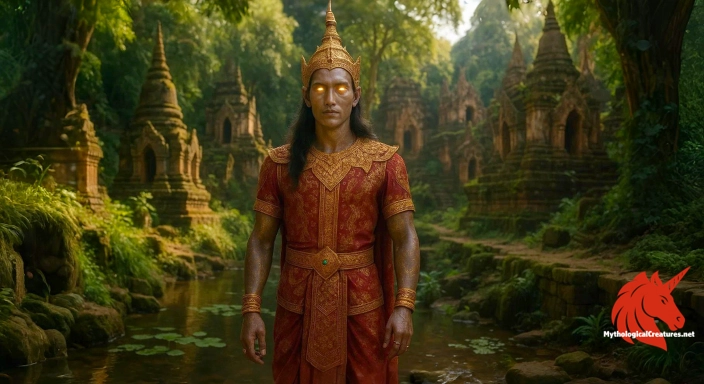
Tabinshwehti
Tabinshwehti - His reign is seen as a turning point in Southeast Asian history, and his deification as a nat reflects his enduring legacy in Burmese culture.
Origins & First Encounters
Tabinshwehti emerged as a seminal figure in Burmese history during a period of profound political and cultural transformation. Born in 1516, his ascendance to power marked the beginning of a vigorous era that reshaped the contours of Southeast Asian polity. His reign, commencing in 1530, was characterised by a bold vision to unify disparate principalities under a single banner of Burmese identity. Operating from his landlocked principality in the Sittaung valley, he advanced a series of military campaigns that would eventually reclaim lost territories and reinvigorate ancient capitals such as Pagan. His forward-thinking strategies included the innovative integration of Portuguese mercenaries and firearms, a move that underscored his tactical adaptability. Tabinshwehti also nurtured alliances with diverse ethnic groups, notably the Mons, whose cultural influence permeated his administration and military. Although his empire was administratively fragile, his achievements laid crucial foundations for the later reunification of the country by Bayinnaung. His life and exploits have transcended mere historical record, inspiring veneration as a nat, a spirit that continues to imbue Burmese cultural memory with spiritual significance. This blend of martial prowess, diplomatic acumen, and mystical elevation encapsulates a legacy that has resonated through the ages.
Source Texts & Tale Variants
The primary accounts of Tabinshwehti’s reign are preserved in a range of royal chronicles and official texts that have shaped Burmese historiography. Official records such as the Hmannan Yazawin and Maha Yazawin provide detailed narratives of his military conquests and statecraft. Stone inscriptions, royal decrees, and court records also contribute valuable insights into the administrative and diplomatic innovations of his rule. In addition to these written records, enduring oral traditions have enriched his narrative, blending historical events with layers of myth and folklore. These sources often extend beyond mere chronicle, imbuing his exploits with allegorical and moral dimensions. Distinct story variants portray him variously as a visionary unifier or a formidable conqueror whose actions straddled the realms of the mortal and the sacred. The diversity among these sources highlights both converging themes and regional differences in the way his life is remembered and celebrated. As narratives were passed down through generations, artistic renderings and theatrical recountings further amplified the legendary aspects of his reign. Such interwoven historical and mythological accounts provide a multifaceted portrait of Tabinshwehti that continues to fuel scholarly debate and popular imagination. Ultimately, the rich tapestry of sources attests to his enduring impact on the cultural and political identity of Burma.
Form & Powers
The physical portrayal of Tabinshwehti has been transmitted largely through artistic representation and later chronicled depictions rather than detailed contemporary descriptions. Portraits from Burmese temple murals and royal artefacts often illustrate him as a figure of refined elegance and dignified poise. His royal regalia, complete with intricately embroidered attire and a distinctive Burmese headdress, underscores a visual language of sovereignty and divine right. Artistic depictions typically render his facial features as noble and resolute, capturing an intensity that resonates with the spirit of a warrior-king. Although detailed contemporary descriptions are sparse, these visual traditions suggest a man of robust bearing and measured grace. His posture and expression in various representations convey both the authority of a seasoned military leader and the contemplative demeanour of a statesman. Later reinterpretations in art have often enhanced his image through symbolic embellishments such as a radiant aura or halo, reinforcing his semi-divine status in popular memory. Such portrayals, while not strictly factual, have cemented an iconic body image that bridges historical fact with the realm of legend. In this way, the physical legacy of Tabinshwehti continues to be as much a work of cultural imagination as it is a reflection of historical reality.
Regional Faces
Across different regions of Burma and its neighbouring territories, the narrative of Tabinshwehti has been adapted to reflect local cultural values and historical experiences. In Lower Burma, his rule is often celebrated as a unifying force that reconciled diverse ethnic groups, particularly highlighting his deep associations with the Mons. Local folklore in these areas integrates his image with that of protective spirit figures, reinforcing his role as both a conqueror and a benevolent guardian. In regions such as Arakan and parts of Siam, accounts of his military ventures present a blend of admiration for his strategic daring and a critical reflection on the costs of imperial ambition. Oral traditions in these areas have transformed his exploits into epic tales that serve as both a warning and a celebration of the transient nature of power. The regional adaptations frequently emphasise his diplomatic engagements and the cultural exchanges that his rule facilitated. Local heroes and guardian figures are sometimes juxtaposed with his legend, reinforcing a pan-regional narrative of unity through diversity. Public commemorations and artistic renditions in various provinces reflect a shared reverence that transcends provincial boundaries. These regional narratives, while varied in detail, collectively contribute to a broader, interconnected portrayal of his legacy in Southeast Asia.
Cultural Parallels
Tabinshwehti’s story invites comparisons with other legendary and historical figures who have straddled the boundaries between myth and reality. His ambitious efforts to unify a fractured land draw parallels with earlier Burmese monarchs such as Anawrahta, whose legacies are equally interwoven with both military might and spiritual reverence. Similar to other celebrated warriors in Southeast Asia, his tactical innovations and strategic alliances, including the adoption of foreign mercenaries, establish him as a forward-thinking leader in a rapidly evolving historical landscape. Comparative narratives in regional folklore often elevate his status to that of a demi-god, much like the celebrated rulers whose lives have been mythologised through centuries of retelling. His fusion of martial prowess with an inherent mystical aura mirrors the archetypal hero found in diverse mythological traditions, from the semi-divine emperors of East Asia to the chivalric legends of medieval Europe. Artistic depictions and literary accounts frequently cast him alongside figures who have transcended the mere temporal limits of their reigns to become enduring symbols of national spirit. The interweaving of his human failings with his grand achievements exemplifies a universal motif of tragic heroism found across cultures. Such cross-cultural comparisons not only enrich our understanding of Tabinshwehti’s persona but also highlight a common human yearning to celebrate leaders who bridge the mortal and the divine. In this way, his legacy resonates as both a historical milestone and a mythic emblem, aligning him with other luminaries of world history.
Legacy & Modern Evolution
The historical evolution of Tabinshwehti’s legacy reflects a dynamic interplay between fact, myth, and modern national identity. His reign, initially marked by audacious military campaigns and bold diplomatic manoeuvres, has come to symbolize the unification of Burma during a critical juncture in its history. Over the centuries, his achievements have taken on a mythic quality, especially evident in his deification as one of the revered nats in Burmese spirituality. Modern artistic and cultural interpretations frequently draw on his life story to evoke themes of unity, resilience, and the cyclical nature of power. In literature, theatre, and even cinema, his character is portrayed as both a visionary leader and a tragic hero, whose premature death underscores the inherent vulnerability of even the greatest empires. His influence persists in the way contemporary Burmese society commemorates historical milestones, often using his legacy as a touchstone for national pride and cultural resurgence. Political discourse and public celebrations regularly invoke his memory to inspire visions of a strong and unified future. The transformation of his narrative from historical chronicling to a living myth exemplifies how historical figures can be continually reinterpreted and repurposed to meet the evolving aspirations of a nation. Today, Tabinshwehti stands not only as a cornerstone of Burmese history but also as a symbol of the enduring power of myth in shaping both cultural identity and collective memory.
Interesting Fact
Tabinshwehti's transformation from a mortal king to a revered nat highlights the unique interplay between history and spirituality in Burmese culture.
Partner with us
Sponsor this space
Reach thousands of mythology enthusiasts with a curated placement on our creature pages.
Learn about sponsorshipQuick Creature Info
Origin:
Our Mythic Legendary Rating:

Also Sometimes Known As:
Habitat:
Supernatural Powers:
Physical Attributes:
Abilities:
Behavior:
Weaknesses:
Lore:
Related Creatures, Tales or Lore
- BBayinnaung
- AAnawrahta
References
Discover Another Mythical Legend You May Not Have Heard Of?
Uncover the mysteries of ancient folklore and expand your knowledge of legendary beings from cultures around the world.
Dare to Meet the Galipote....
-5715625a-5eeb-455a-a4cd-bc073402cb98_small.webp "Depiction of Galipote")
Curated by the Mythological Creatures Team
Series editor: Mythological Creatures Directory
Primary desk: Asian & Pacific Myth Cycles Desk
(rev. November 2025)