
Talos: Talos was a giant bronze automaton from Greek mythology, created to protect the island of Crete from pirates and invaders.
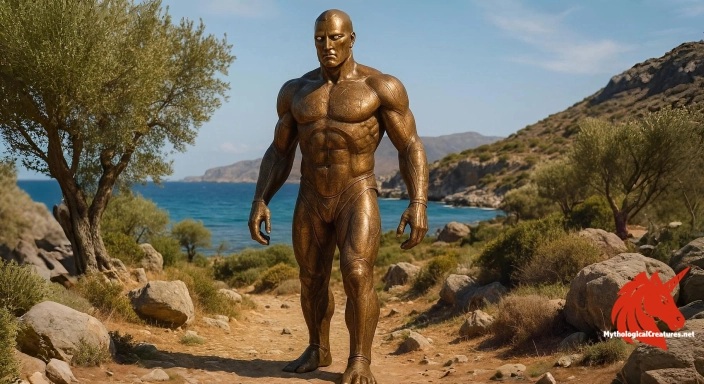
Talos
Talos - Talos is celebrated as one of the earliest mythological automatons, symbolizing the ingenuity of divine craftsmanship and the defensive might of Crete.
Origins & First Encounters
Talos emerges as one of Greek mythology’s most intriguing guardians, a colossal man of bronze whose legend has captivated imaginations for centuries. His origins are steeped in a fusion of divine craftsmanship and heroic myth, believed to be crafted either by the hand of the gods or by ingenious mortal artisans. Early attestations of Talos date back to the classical period of Greek literature, where he was celebrated not only as a protector of Crete but also as a symbol of the innovative spirit of his age. The bronze guardian was renowned for patrolling the island’s shores, standing as a bulwark against pirates and marauders at a time of frequent strife. His role encapsulated the ancient cultural ethos that valued both divine intervention and the protective power of artful man-made creations. The myth of Talos provided a tangible representation of Crete’s resilience and technological prowess, resonating with local communities facing external threats. His presence in countless tales contributed to a legacy that mingled both human ingenuity and the sublime mysteries of the divine. Talos, therefore, stands as a testament to the intertwined destinies of myth, technology, and the timeless allure of protective sentinels.
Source Texts & Tale Variants
The narrative of Talos is preserved in a variety of ancient texts and artistic portrayals that offer multiple versions of his story. Some of these early sources hint at his creation as part of divine artistry, while others present him as the result of complex human craftsmanship infused with supernatural power. Texts from the classical era provide fragmented accounts that describe his unwavering duty to safeguard the island of Crete. Various literary sources expand his legend further by incorporating details of his metal composition and his unique mechanism, such as the singular life-sustaining vein. Alternate storylines introduce the possibility of an inherent vulnerability, which later writers embellished with dramatic flair. These diverse sources from both poetry and prose illustrate that Talos was not merely a static figure but a dynamic character whose myth evolved over time. Local folklore also played a significant role in reinterpreting his story, adding layers of cultural nuance and regional colour. In sum, the multifaceted narrative of Talos draws from an array of historical references that underscore his enduring place in myth and folklore.
Form & Powers
Talos was depicted as an imposing figure with a body entirely fashioned from gleaming bronze, exuding an aura of both strength and otherworldly design. His form was masterfully engineered, with every muscle and limb carefully crafted to reflect the robust power of metal while retaining a striking human resemblance. The intricate interlocking plates that composed his exterior shone under the Mediterranean sun, conferring upon him a radiant and almost impervious quality. Mythical portrayals often emphasise his gigantic stature, suggesting that he towered over ordinary mortals and adversaries alike, making his presence both awe-inspiring and intimidating. His physical construction included meticulously designed joints and moving parts, which lent him an uncanny lifelikeness despite his inanimate material. Some accounts note the existence of a single, vital vein coursing through his body, a detail that not only bestowed him with a semblance of life but also hinted at a fatal vulnerability. The harmonious blend of artistry and functional design in his depiction highlighted the advanced metalworking skills admired by the ancients. Through his striking appearance, Talos encapsulated the dual nature of myth as both a celebration of human ingenuity and a cautionary emblem of the limits of mechanical perfection.
Regional Faces
Talos’s legend underwent various reinterpretations as it passed through different regional and cultural lenses, each adding its own distinctive flavour to his myth. In Crete, he was venerated as the ultimate protector, his tale woven deeply into the island’s identity and found in local artistic and literary traditions. Mainland Greek narratives sometimes portrayed him with an emphasis on his marvelous, almost supernatural, mechanical attributes, thereby elevating his status to that of a living enigma. As his legend travelled into the Roman world, his story was adapted further to align with prevailing tastes and the growing fascination with engineered wonders. Some regions accentuated his role as a relentless sentinel, while others introduced the notion of a singular weakness that could be exploited by cunning adversaries. Local adaptations often incorporated regional symbolism, reflecting the collective values, fears, and aspirations of the communities that preserved his tale. Artifacts and ancient reliefs from different parts of the Mediterranean reveal slight variations in his depiction, from ornate detailing on his head to streamlined depictions of his robust limbs. This regional diversity enriches Talos’s myth, offering a mosaic of interpretations that underscore his universal appeal as both a symbol of divine innovation and heroic protection.
Cultural Parallels
When set beside other mythological guardians, Talos occupies a unique niche as a mythic precursor to later depictions of automata and man-made protectors. He shares conceptual similarities with early legends of golems and other animated constructs, which symbolise the merging of human innovation with the supernatural. His mechanistic form and singular vulnerability evoke themes common to many myths where seemingly invincible beings harbour a hidden flaw, much like other heroes and monsters of old. The bronze guardian can also be juxtaposed with figures like the all-seeing Argus or even modern robotic sentries, bridging the gap between ancient myth and contemporary notions of technology. Similar narratives in other cultures celebrate the idea of constructed protectors that are imbued with life through mysterious means, reflecting mankind’s longstanding fascination with creating artificial life. This cross-cultural exchange of ideas enriches our understanding of Talos, suggesting that his myth taps into a universal desire to encase human ambition in the guise of impregnable guardians. His legacy continues to resonate alongside other mythic entities that explore the boundaries between nature, art, and the divine. In this way, Talos’s myth underscores a timeless dialogue between the promise of technological mastery and the ever-present peril of overreaching—an enduring motif that transcends geographical boundaries.
Legacy & Modern Evolution
Over the centuries, the tale of Talos has evolved from a strictly mythological account into a rich symbol of technological wonder and human ingenuity. His image, once rooted solely in the oral and written traditions of ancient Greece, has undergone continuous reinterpretation across various epochs, from Renaissance art to modern science fiction. This evolution reflects society’s shifting perceptions of technology, where Talos is now often viewed as a precursor to modern robotics and artificial intelligence. His narrative has been repurposed in contemporary literature and media, which frequently explore the paradox of a creation that is both powerful and inherently flawed. Modern portrayals sometimes focus on his vulnerably, drawing parallels with current debates surrounding the ethical implications of technology. Artists and filmmakers have been particularly drawn to the dramatic possibilities inherent in his story, portraying him as an enigmatic bridge between myth and machine. The enduring fascination with Talos is evident in the continued academic and popular discussions that seek to uncover the symbolic dimensions of his existence. As his myth adapts to the concerns and creative impulses of each new generation, Talos remains an emblematic figure—a timeless reminder of the delicate balance between genius and hubris.
Interesting Fact
Talos is often cited as one of the earliest mythological examples of an automaton, foreshadowing modern concepts of robots and artificial intelligence.
Reach myth fans
Connect your myth-driven brand with this audience
Our readers are writers, educators, gamers, and collectors who care about mythology. Enquire about a limited sponsor placement on creature pages.
Enquire about sponsorshipQuick Creature Info
Origin:
Features:
Associations:
Our Mythic Legendary Rating:

Also Sometimes Known As:
Habitat:
Supernatural Powers:
Physical Attributes:
Abilities:
Behavior:
Weaknesses:
Lore:
Related Creatures, Tales or Lore
- HHephaestus' Bronze Automatons
- IIron Golem
- GGolem
References
Discover Another Mythical Legend You May Not Have Heard Of?
Uncover the mysteries of ancient folklore and expand your knowledge of legendary beings from cultures around the world.
Dare to Meet the Nuckelavee....
Curated by the Mythological Creatures Team
Series editor: Mythological Creatures Directory
Primary desk: Hellenic & Ancient Mediterranean Desk
(rev. November 2025)