
Nuckelavee: The Nuckelavee is a fearsome horse-like demon from Orcadian folklore, blending equine and human traits into a grotesque form.
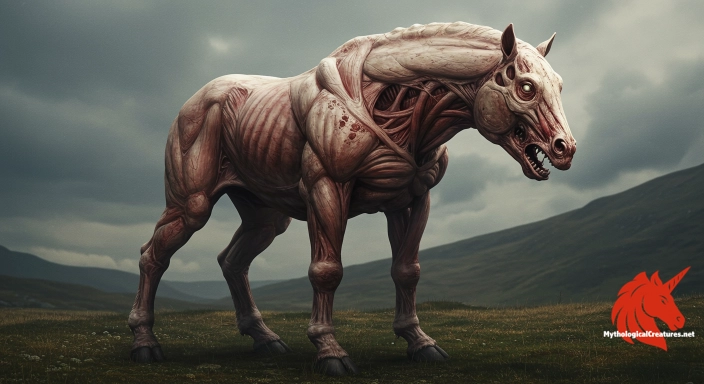
Nuckelavee
Nuckelavee - Serves as an explanation for unexplained natural disasters such as droughts and epidemics, and is a central figure in the mythos of Scotland's Northern Isles
Origins & First Encounters
The Nuckelavee emerges from Orcadian folklore as a fearsome demon, blending equine strength with unsettling human features in a singular, monstrous form. Its origins are steeped in the mists of ancient island tales, where the creature was invoked to explain the inexplicable calamities that befell isolated communities. It is portrayed as a horse-like entity whose very presence provokes terror and awe among those who dwell near the sea. Local traditions accentuate its malevolence, attributing to it a toxic breath capable of wilting crops and sapping the vitality of livestock. The creature is primarily seen as a sea-dweller, yet it sometimes makes a dreadfully ominous appearance on land. Folk narratives often recall its swift and unpredictable movements, emblematic of nature’s untamable fury. Early attestations of the Nuckelavee are interwoven with the environmental challenges of the Northern Isles, a reflection of the islanders’ struggle to understand natural disasters. Its narrative is a rich tapestry of myth and mystery, an enduring symbol of the fine line between the natural and the supernatural. The enduring fear and fascination it inspires continue to provide insight into the ancient mindset of the island communities.
Source Texts & Tale Variants
The records of the Nuckelavee are primarily preserved through oral tradition and the fragments of folklore handed down by generations of islanders. Unique and often chilling narratives recount encounters that attest to the creature’s dreadful presence, even if no systematic documentation exists. One particularly memorable account describes a direct confrontation on land, offering graphic details that have become central to its mythic character. British folklorist Katharine Briggs was among those who recorded these tales, noting that the Nuckelavee was regarded as one of the most terrifying demons of Scotland’s Northern Isles. Variations in the story reflect the fluid, evolving nature of myth, with different island communities highlighting distinct aspects of its powers. While some accounts emphasise the creature’s ability to wreak havoc on both agriculture and human health, others focus on its association with the broader natural elements, particularly the sea. The diverse versions of its legend serve as vivid snapshots of cultural anxieties, merging environmental phenomena with metaphysical terror. Over time, these narratives have been collected, compared, and reinterpreted, ensuring that the Nuckelavee remains a potent symbol within regional folklore.
Form & Powers
In descriptions that have survived through the centuries, the Nuckelavee is depicted as a blend of equine and human features that create a visage both formidable and grotesque. Its body is often described as muscular and sinewy, invoking the image of a wild, untamed stallion with a scarred, otherworldly twist. Some accounts suggest that its skin is curiously absent or rendered in a pallid, decaying state, revealing the raw, underlying structure of its form. The creature’s head is a disturbing amalgamation, bearing both the elongated snout of a horse and disconcertingly human facial elements. Vivid tales speak of eyes that burn with an intense malice, casting a penetrating gaze that seems to stir primal fear. Its mane, when mentioned, is frequently portrayed as wild and unruly, as if it barely clings to any semblance of order. The toxic breath that it exhales is not only metaphorical but is often described as emanating visibly, a noxious cloud that forewarns of its impending approach. Despite certain inconsistencies across various retellings, the size and overall presentation of the Nuckelavee are invariably imposing, making it a creature that looms large in both myth and memory.
Regional Faces
The portrayal of the Nuckelavee varies significantly across different regions, with each local community imprinting its own cultural and environmental nuances onto the myth. In Orcadian tradition, the creature is equally at home in the roiling sea as on the rugged land, a duality that intensifies its fearful reputation. Some versions of the tale focus on its ferocity on land, where its toxic influence brings about droughts and epidemics, while others reinforce its dominion over the sea. The creature’s well-known vulnerability to fresh water is a detail that recurs in multiple traditions and serves as a key element in local strategies for evasion. Norse influences can be detected in the layers of its myth, where elements of Scandinavian folklore intermingle with earlier Celtic motifs. In some narratives, the Nuckelavee is controlled by mystical forces such as the Mither o’ the Sea, an association that underscores its connection to maritime lore. The adaptation of its characteristics to include regional environmental dangers reflects the communities’ attempts to use myth as a means of understanding natural disasters. This array of interpretations ensures that, while its essence remains terrifying, the Nuckelavee also adapts seamlessly to the local cultural landscape, reinforcing its status as a truly multifaceted mythological figure.
Cultural Parallels
When viewed in the broader context of mythological creatures, the Nuckelavee occupies a unique position as a hybrid entity, rich with both human and animal attributes. Its fearsome, toxic presence and dominion over land and sea evoke comparisons to legendary water horses and keltic entities like the kelpie, which similarly blend nature with the supernatural. Despite these similarities, the Nuckelavee distinguishes itself with an added layer of malevolence and unpredictability, a nuance that sets it apart in comparative folklore. Analogous figures in Norse mythology also make appearances across the island narratives, highlighting a broader, cross-cultural tendency to attribute disastrous natural events to supernatural forces. This intermingling of mythic elements speaks to a common human need to reconcile and explain the mysteries of the natural world through vivid, often terrifying, personifications. The creature’s dual nature blurs the line between protector and destroyer, mirroring the ambivalence found in many mythic traditions. Intriguingly, while its appearance is unique, its underlying symbolism—of decay, environmental disruption, and unchecked power—is a recurring theme across many cultures. Examining these parallels provides insight into the shared mythological psyche that spans regions and epochs, further enriching the lore that surrounds the Nuckelavee.
Legacy & Modern Evolution
The evolution of the Nuckelavee myth from a deeply rooted element of Orcadian folklore to a modern cultural icon illustrates its enduring appeal and adaptability. Over centuries, early depictions of this ghastly creature, once solely a symbol of agrarian and environmental misfortune, have been reimagined to reflect contemporary concerns about nature’s uncontrollable and destructive forces. Today, its menacing visage often appears in literature, film, and art, where its portrayal is expanded to comment on ecological imbalance and human vulnerability. The creature has transitioned from a strictly cautionary tale into a complex, multifaceted symbol, representing both the dark facets of nature and the timeless allure of ancient myth. Modern reinterpretations tend to emphasise its ambiguity, positioning it as both a harbinger of doom and a reminder of nature’s intrinsic, sometimes brutal, beauty. Heritage festivals and local art in the Northern Isles often celebrate the Nuckelavee, securing its place in the evolving landscape of regional identity. This metamorphosis from local terror to a figure in modern myth-making illustrates the fluidity of folklore as it assimilates contemporary themes. In a world increasingly grappling with environmental and existential uncertainties, the Nuckelavee continues to serve as a potent emblem of myth, mystery, and the enduring power of storytelling.
Interesting Fact
One of the most fascinating aspects of the Nuckelavee is its critical weakness to fresh water, which has provided a simple, natural defence against its otherwise overwhelming malevolence.
For serious myth projects
Feature your work alongside the legends
From academic works to story-rich games, we highlight projects that respect world mythologies. Talk to us about a measured, long-term placement.
Start a conversationQuick Creature Info
Associations:
Our Mythic Legendary Rating:

Also Sometimes Known As:
Habitat:
Supernatural Powers:
Physical Attributes:
Abilities:
Behavior:
Weaknesses:
Lore:
Related Creatures, Tales or Lore
- KKelpie
- EEach-Uisge
- NNøkk
References
Discover Another Mythical Legend You May Not Have Heard Of?
Uncover the mysteries of ancient folklore and expand your knowledge of legendary beings from cultures around the world.
Dare to Meet the Hábrók....
Curated by the Mythological Creatures Team
Series editor: Mythological Creatures Directory
Primary desk: Northern & European Folklore Desk
(rev. November 2025)