
Tanin'iver: Tanin'iver is an evil cosmic entity known as the 'blind dragon' in Kabbalistic literature.
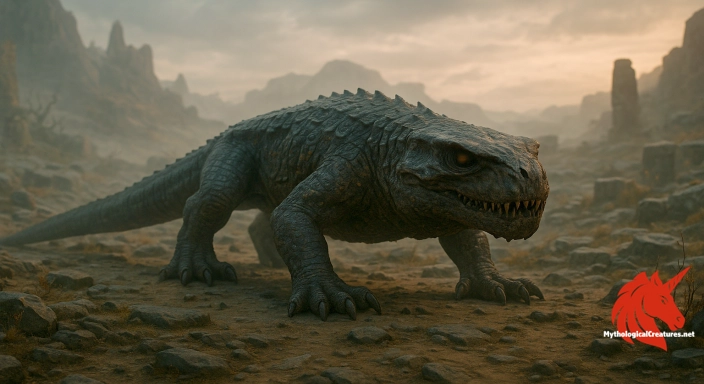
Tanin'iver
Tanin'iver - Represents the activation of evil forces and the propagation of pestilence in the world.
Origins & First Encounters
Tanin'iver emerges as a formidable and enigmatic figure within the rich tapestry of Kabbalistic mysticism. His origins are steeped in ancient interpretations where cosmic forces of darkness and order are interwoven, reflecting deep allegorical themes central to Jewish thought. Appearing in seminal texts such as the Zohar and the Treatise on the Left Emanation, his early attestations highlight the mystic quest to understand the interplay of divine and infernal energies. The very name, translating to the 'blind dragon', evokes an image of a creature that perceives the world in a realm beyond ordinary sight, thus symbolising hidden and arcane wisdom. Linked inextricably with Lilith, his role as her steed imbues him with a potent charge, channeling the activation of evil and cosmic imbalance. His myth is a complex counterpoint to the traditional forces of light, marking the boundaries between sanctity and profaneness. The narrative of Tanin'iver is often rendered in allegory to illustrate the struggle between creation and annihilation, a theme common in mystical literature. Over time, his depiction has been refined and reinterpreted in various cultural contexts, ensuring his legacy as both a harbinger of pestilence and an emblem of ineffable darkness endures.
Source Texts & Tale Variants
The principal accounts of Tanin'iver are found in the esoteric corridors of Kabbalistic writings, where texts like the Zohar and the Treatise on the Left Emanation provide the foundational mythos. Early mystical literature presents him not only as a literal entity but also as a complex symbol of destructive power. Variations in his narrative can be traced through the layers of commentaries that gradually developed an intricate lore around his characteristics. Some texts detail his role as the catalyst for the union between Lilith and Samael, a coupling that ushered in the era of pestilence. The disparate manuscript traditions reveal a spectrum of symbolic interpretations, each emphasising different elements of his nature. In certain variants of the story, his castration is foregrounded as an emblematic act, reflecting tensions around generative power and its derangements. Diverse mystics have adapted his mythology over time, integrating local folklore and regional spiritual ideals. These strands of narrative converge to form a multifaceted picture of an entity that has inspired both awe and fear in equal measure.
Form & Powers
Visually, Tanin'iver is depicted as a colossal creature that melds serpentine grace with draconic ferocity. His skin is imagined to be covered in dark, iridescent scales that capture the murmur of a twilight mystique, evoking the very essence of night and cosmic shadow. Despite being termed the 'blind dragon', there is a powerful suggestion that his perception extends beyond the physical, compensating for the absence of literal sight with a profound insight into the metaphysical realm. The void where his eyes should be is often rendered as deep, enigmatic hollows, contributing to his aura of otherworldliness. His form is further distinguished by sharply curved horns and sinuous, shifting contours, which together evoke both elegance and menace. Some depictions even introduce a subtle luminescence that seems to pulse along his body, hinting at the celestial origin of his dark energy. The narrative of his castrated nature underscores a deliberate abandonment of conventional generative power, imbuing his physical features with a distinct symbolic resonance. Artists and mystics alike have portrayed him with slight variations—at times a towering, almost amorphous shadow, at others a defined and monstrous dragon—each interpretation enhancing his reputation as an archetype of cosmic enigma.
Regional Faces
The myth of Tanin'iver has traversed geographical boundaries, acquiring unique features within various cultural milieus. In Eastern European traditions, he is often interwoven with local folklore that casts him as both a dark omen and a spectral guardian of nocturnal secrets. In Middle Eastern mysticism, his attributes resonate with older legends of primordial chaos and intertwine with narratives reminiscent of the ancient Leviathan. Mediterranean interpretations may lend him a more anthropomorphic presence, where his draconic form merges with the chiaroscuro of shadow and light to evoke the dual nature of the human soul. In each region, the symbolic imagery adapts to local artistic sensibilities, whether through iconographic motifs in illuminated manuscripts or subtle variations in oral storytelling traditions. His portrayal reflects the broader cultural context in which communities have sought to understand and externalise the forces of evil. Through these varied lenses, the dark energies he embodies are both universal and uniquely local, underscoring the adaptability of myth. The regional variants, while largely consistent in spirit, highlight an evolving appreciation of chaos, resistance, and the mysteries that lie beyond mortal comprehension.
Cultural Parallels
Tanin'iver shares intriguing parallels with other draconic figures that populate the mythological canon across continents. His embodiment of destructive cosmic power finds a counterpart in the ancient Babylonian monster Tiamat, whose chaotic form similarly bridged the realms of creation and oblivion. Unlike many dragons that are portrayed as custodians of treasure or bearers of wisdom, his role is more aligned with the activation of malevolent forces and the inevitable spread of corruption. Similar mythic motifs can also be discerned in parts of Eastern lore, where serpentine dragons sometimes symbolise the precarious balance between order and chaos. His association with figures like Lilith and Samael creates an intricate network of relationships reminiscent of other mythological couples whose unions birth calamity. The motif of blindness, used to denote a transcendence beyond conventional sight or an absence of moral vision, recurs in other cultures' portrayals of demonic entities. These parallels illuminate how disparate societies have employed the dragon archetype to express their deepest fears and cosmic dilemmas. In drawing comparisons, it becomes evident that Tanin'iver is both distinct and part of a wider mythological dialogue—a dialogue in which the symbolism of the beast serves as a mirror to humanity's struggles between light and dark.
Legacy & Modern Evolution
Over successive centuries, the figure of Tanin'iver has evolved from a niche element of mystical Judaic thought into a broader cultural symbol of darkness and cosmic disruption. Early Kabbalistic texts portrayed him as an almost abstract force, yet as the influence of myth spread, his narrative became more detailed and symbolically loaded. During medieval eras, his association with Lilith and his role as a harbinger of pestilence provided a stark metaphor for the erratic forces believed to undermine social and spiritual order. In modern times, his image has experienced a renaissance through literature, art, and even popular occult traditions, each reimagining his story to resonate with contemporary concerns. His blindness, once a literal attribute, has come to be viewed as a potent emblem for modernity’s occasional failure to perceive underlying truths. Contemporary authors and visual artists have drawn on his myth to explore themes of alienation, fragmentation, and the struggle against unseen malevolent energies. The layered symbolism of Tanin'iver allows him to function as both cautionary tale and profound metaphor, inviting ongoing reinterpretation. Today, his legacy endures in the form of artistic expressions, scholarly debates, and even in niche counter-cultural movements where ancient symbols continue to challenge and inspire new generations.
Interesting Fact
Its castration is a potent symbolic act, reflecting the paradox of diminished physical attributes alongside an undiminished capacity to channel cosmic evil.
Partner with us
Sponsor this space
Reach thousands of mythology enthusiasts with a curated placement on our creature pages.
Learn about sponsorshipQuick Creature Info
Associations:
Our Mythic Legendary Rating:

Also Sometimes Known As:
Habitat:
Supernatural Powers:
Physical Attributes:
Abilities:
Behavior:
Weaknesses:
Lore:
Related Creatures, Tales or Lore
- LLeviathan
- JJörmungandr
- TTannin (Biblical dragon)
References
Discover Another Mythical Legend You May Not Have Heard Of?
Uncover the mysteries of ancient folklore and expand your knowledge of legendary beings from cultures around the world.
Dare to Meet the Asut Malkia....
Curated by the Mythological Creatures Team
Series editor: Mythological Creatures Directory
Primary desk: Hellenic & Ancient Mediterranean Desk
(rev. November 2025)