
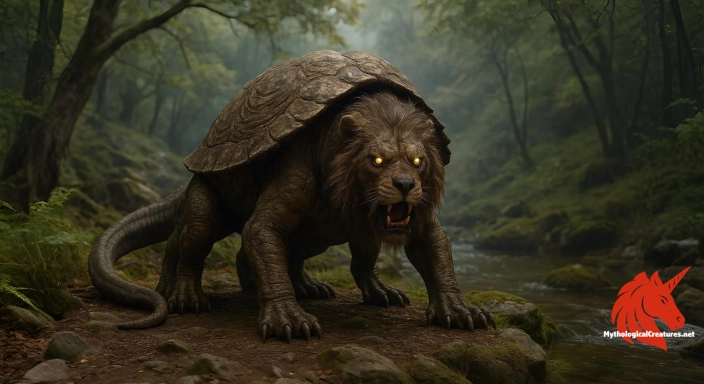
Tarasque: The Tarasque is a fearsome, hybrid creature from French mythology, featuring a lion-like head, turtle-protected body, bear-like claws, and a serpent's tail.
Tarasque
Tarasque - A potent cultural symbol in Provence, the Tarasque has been immortalised in art, local legends, and festive processions.
Origins & First Encounters
The Tarasque is a captivating figure from French mythology, emerging from a milieu where the boundaries between the natural and the supernatural blur. Its origins can be traced back to medieval narratives, with early attestations found in hagiographical texts such as the Golden Legend. The creature has long held a significant cultural role in regions like Provence, where folklore intertwines with religious celebration. Legends surrounding the beast have been passed down through generations, often symbolising the struggle between untamed nature and the civilising influence of faith. Its composite nature – blending elements of a lion, turtle, bear, and serpent – has made it a unique emblem of both terror and wonder. The myth of the Tarasque also serves as a canvas for moral and spiritual stories, particularly tales of redemption and the triumph of good over chaos. Celebrated festivals and processions honour its memory, keeping its legend vivid in local cultural identity. Over time, the Tarasque has grown beyond a mere monster into a symbol of historical tradition and communal pride.
Source Texts & Tale Variants
Medieval manuscripts and ecclesiastical texts have long chronicled the story of the Tarasque, with the Golden Legend providing a particularly influential narrative. The earliest accounts detail a beast of extraordinary design, whose portrayal in written sources set the stage for centuries of artistic interpretation. Diverse hagiographies highlight its dramatic encounter with saintly figures, most notably the narrative involving St. Martha. Local chronicles and folklore further enriched these accounts with regional embellishments and moral allegories. The story has circulated widely in church sculptures and illuminated manuscripts, each version adapting the creature’s features to the artistic conventions of its time. Variants of the tale underscore the Tarasque’s dual role as both a ferocious monster and an instrument of divine intervention. In several texts, its imagery is paired with acts of miraculous transformation, reinforcing the power of faith. These primary sources and narrative variations have played a pivotal role in cementing the Tarasque as a perennial icon of myth and legend.
Form & Powers
The physicality of the Tarasque is a montage of the animal kingdom’s most formidable traits, resulting in a creature that defies conventional description. Its head, often likened to that of a lion, embodies a fierce and majestic aspect with penetrating eyes and a powerful mien. The body is encased in a rugged, turtle-like carapace, offering a semblance of both impenetrability and ancient resilience. Six robust legs, equipped with bear-like claws, are said to lend the creature its formidable strength and unexpected agility. A long, sinuous tail reminiscent of a serpent not only completes its bizarre anatomy but also hints at its potential for sudden, lethal strikes. Some depictions even attribute to it the ability to expel poisonous breath, adding a further layer of menace to its already fearsome visage. Artists have rendered the creature with a dynamic interplay of scales, fur, and armour-like plating, emphasising its composite nature. This varied and evolving portrayal in art and literature highlights how its physical characteristics have been adapted over time to reflect the changing tastes and symbolic needs of different eras.
Regional Faces
Regional interpretations of the Tarasque reveal a fascinating adaptability that spans both spatial and cultural boundaries. In Tarascon, the creature has been embraced as a central emblem of local identity, becoming a fixture in annual festivals and municipal iconography. Local artists and storytellers often infuse the Tarasque with additional motifs drawn from the surrounding natural landscape, sometimes smoothing its fearsome aspects to portray a more benevolent guardian. In Provence and neighboring French regions, the legend is interwoven with local customs and topographical landmarks, creating a rich tapestry of myth that reflects the local community’s values. Distinct artistic renderings from different periods show variations in the creature’s size, posture, and ornamentation, mirroring regional artistic trends and interpretive priorities. Some local versions present the Tarasque as less a terror and more an expression of nature’s chaotic beauty and transformative power. Even beyond the borders of France, in parts of neighbouring Belgium, echoes of the Tarasque myth have been adapted to local folklore, particularly in the context of processional giants and dragons. These regional variations underscore the enduring flexibility of the myth, allowing the Tarasque to resonate in diverse cultural landscapes while retaining its core identity.
Cultural Parallels
The Tarasque shares intriguing parallels with other composite creatures found throughout European and Mediterranean mythologies. Its amalgamation of disparate animal traits invites comparisons with the Chimera or even the Hydra, where a single monstrous entity embodies multiple aspects of natural terror. Much like the dragon of various European legends, the Tarasque occupies a liminal space between the realms of myth and reality, symbolising the eternal conflict between order and chaos. Comparative analysis reveals that such creatures often serve as metaphors for nature’s uncontrollable forces and mankind’s efforts to tame the untamable. The narrative of a saint subduing a monstrous beast, a recurring motif in many cultures, further aligns the Tarasque with other mythic encounters like that of Saint George and his dragon. These cross-cultural connections emphasise a shared human impulse to personify the wild and unknown through vividly composite beings. While the details differ, the symbolic underpinnings remain consistent, highlighting themes of redemption, conquest, and the transformative power of faith. In this way, the Tarasque stands not only as a unique figure within French lore but also as part of a larger, interconnected mythological tradition that spans continents and eras.
Legacy & Modern Evolution
The historical evolution of the Tarasque is a testament to its enduring allure and the dynamic nature of myth-making. Initially depicted in medieval texts and church sculptures as a terrifying amalgam of beasts, its image gradually evolved into a more standardised form by the Renaissance. The involvement of figures such as René of Anjou further elevated the creature’s profile, integrating it into the fabric of public festivity and religious celebration. Over the centuries, the Tarasque transformed from an emblem of dread into a beloved icon showcased during parades and communal events. Modern interpretations have further softening its monstrous qualities, recasting the beast as a cultural mascot that bridges ancient myth with contemporary revelry. The elaborate floats and effigies used in festivals not only preserve the traditional imagery but also reinterpret it for new audiences. Its inclusion in UNESCO’s listings underscores the Tarasque’s significance as part of the intangible heritage of France and Belgium. Ultimately, the modern legacy of the Tarasque reflects a remarkable journey from mythic terror to a celebrated symbol of local identity and cultural continuity.
Interesting Fact
An intriguing aspect of the Tarasque is that despite its fearsome appearance and reputation as a monster, it is celebrated in lively local festivals, symbolising a unique fusion of horror and communal joy in French cultural heritage.
Mythology-aligned partners
Showcase your myth-friendly brand here
Run a store, studio, or platform that lives in the world of myth and folklore? A curated sponsor panel on these pages may fit.
Explore partnership optionsQuick Creature Info
Features:
Associations:
Our Mythic Legendary Rating:

Habitat:
Supernatural Powers:
Physical Attributes:
Abilities:
Behavior:
Lore:
References
Discover Another Mythical Legend You May Not Have Heard Of?
Uncover the mysteries of ancient folklore and expand your knowledge of legendary beings from cultures around the world.
Dare to Meet the Alan....
-765cbf17-c9ee-4ee8-8f30-4371af3f40cc_small.webp "Depiction of Alan")
Curated by the Mythological Creatures Team
Series editor: Mythological Creatures Directory
Primary desk: Hellenic & Ancient Mediterranean Desk
(rev. November 2025)