
Taraxippus: Taraxippus is a ghostly presence from Greek mythology known for its eerie role in frightening horses at hippodromes and its association with both hero cults and the sea-god Poseidon.
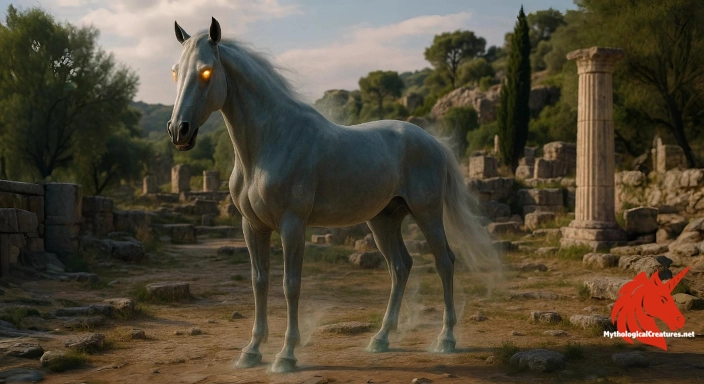
Taraxippus
Taraxippus - Taraxippus served as a mythological explanation for disturbances at hippodromes and the mysterious death of Hippolytus, reflecting ancient attempts to rationalize inexplicable events through divine or supernatural intervention.
Origins & First Encounters
Taraxippus emerges from the ancient Greek mythos as a mysterious and unsettling presence, haunting the very spaces where horses were meant to thrive. Its name, derived from the Greek term for 'horse disturber', hints at its role in unsettling both the animal spirit and human endeavours relying on these noble creatures. The origins of Taraxippus are intertwined with the early heroic cults and sacred rites associated with equine worship in a society that revered horses as symbols of power and mobility. It was first attested in local traditions and inscriptions, where the disturbing influence of this phantom was ascribed to both ghostly apparitions and ominous environmental conditions. Ancient communities perceived the Taraxippus as a force that blurred the boundaries between the divine and the spectral, serving as a harbinger of misfortune during important events like chariot races and battles. The cultural context of ancient Greece, with its rich interplay of ritual, warfare, and mythology, allowed such an enigmatic figure to gain a foothold in public imagination. Over time, the myth of Taraxippus accommodated a variety of interpretations, revealing it to be more of an epithet than a single, fixed entity. The lore surrounding this figure reminds us of the Greeks’ deep connection to nature and their attempt to rationalise the unpredictable forces that could imperil both man and beast.
Source Texts & Tale Variants
The primary sources for the Taraxippus myth are sparse yet intriguing, with Pausanias offering one of the most detailed compilations of its various aspects. His accounts capture the rich tapestry of local oral traditions and fragmentary inscriptions that connected the name Taraxippus with both sacred hero cults and natural phenomena. Ancient texts occasionally provide variant interpretations, indicating that Taraxippus might have been less a proper noun and more an appellation applied to several disruptive presences. Other literary fragments and inscriptions discovered near historic hippodromes contribute to the picture, revealing how the term was used to describe ungovernable forces that disturbed horses. Some of these sources suggest that the phenomenon was not limited to a singular ghostly figure but rather encompassed a range of manifestations linked to dangerous locations or cursed sites. The narrative surrounding Taraxippus was further enriched by its association with Poseidon, particularly in his guise as the deity of horses, and with the tragic myth of Hippolytus. Diverse accounts from different regions indicate that local cults adapted the legend to resonate with their particular religious and social experiences. Despite the challenges inherent in reconciling these fragmented texts, the multiplicity of sources underscores the enduring allure and complexity of this spectral figure.
Form & Powers
While Taraxippus does not conform to a rigid physical description, the various accounts imbue it with an aura of the ethereal that leaves a strong impression on those who witnessed its presence. Descriptions often evoke images of a shadow-like entity, cloaked in eerie mists and accompanied by an intangible yet palpable sense of dread. Some traditions hint at a form that shimmers with the pallor of moonlight, as if the spirit itself were composed of the very essence of night and chill. There are suggestions that, when manifest, it might resemble a spectral equine outline or a distorted silhouette that blurs the line between animal and apparition. Its appearance was said to be transient, emerging suddenly to disturb the calm before vanishing into the surrounding darkness or natural elements. The visual impression of Taraxippus was further accentuated by the unsettling sounds said to accompany its appearance, such as the distant echo of a restless neigh or the whisper of the wind in a desolate arena. In some local traditions, peculiar marks on the ground or inexplicable natural formations were taken as physical traces of its passage. Thus, while no definitive physical form can be ascribed, the amalgam of these descriptions contributes to a formidable and enduring image in the collective memory.
Regional Faces
Across different regions of ancient Greece, the interpretation of Taraxippus underwent subtle yet significant transformations. In some city-states, the figure was represented primarily as a ghostly presence associated with particular contests and sacred sites, especially those linked to equestrian events. On the mainland, where the emphasis was placed on the functional role of horses in warfare and sport, Taraxippus was seen as a bad omen that could disrupt carefully orchestrated events. In contrast, communities in coastal and island regions sometimes merged the myth with local deity worship, attributing its power to the influence of Poseidon in his equine aspect. These variations allowed local traditions to incorporate the legend into their unique ritual practices, ultimately leading to differences in how the spectre was commemorated or appeased. Some locales even recorded specific geographical markers believed to be imbued with its disruptive essence. The myth’s adaptability to regional customs is indicative of a broader tendency in Greek religion to personalise and localise divine and supernatural influences. These regional nuances continue to underline the cultural pliability of the Taraxippus myth within a diverse ancient Greek landscape.
Cultural Parallels
The legend of Taraxippus finds interesting parallels in the myths and superstitions of other cultures, resonating with themes of supernatural disruption and the mystique of the unseen world. Similar to the Taraxippus, numerous traditions across Europe feature spectral entities that disturb animals, a motif that speaks to ancient societies’ anxieties about the uncontrollable forces of nature. In Roman literature, for example, the equivalent term 'equorum conturbator' is used in a manner echoing the Greek conception, hinting at a shared mythological vocabulary regarding the moods and fates of horses. Beyond the classical world, folklore in regions such as Ireland and Scandinavia also recounts tales of ghostly figures affecting the behaviour of livestock, aligning Taraxippus with a wider tradition of nature spirits. These cross-cultural connections demonstrate that the fear of unexplained disruptions—especially those affecting animals of significant economic and cultural value—was a near-universal concern. Comparative analysis reveals that while the names and specific characteristics vary, the underlying theme of a supernatural force capable of disturbing order is common across many mythologies. The spectral, almost transient nature of Taraxippus is mirrored in Western traditions of poltergeists and in other cultural depictions of liminal entities. In each case, these figures serve as metaphors for the struggle to understand and manage the unpredictable forces of the world.
Legacy & Modern Evolution
Throughout the centuries, the myth of Taraxippus has evolved from a local explanatory narrative into a symbol rich with cultural and psychological significance. In the classical era, its presence was often cited as a divine retribution for hubris or as a warning of impending calamity, particularly in contexts where horses played a central role. As the ancient world transitioned into later historical eras, the tale of the Taraxippus gradually absorbed additional layers of interpretation within the broader tapestry of ghostly lore and supernatural omens. Modern reinterpretations in literature, art, and popular culture have occasionally resurrected the figure as a spectral embodiment of chaos and uncontrollable natural forces. Contemporary adaptations often blend the ancient myth with inventive narrative twists, portraying Taraxippus as both a relic of bygone superstitions and a timeless metaphor for the disruption of natural order. This evolution illustrates the enduring appeal of classical myths and their capacity to be reimagined in new contexts. In academic circles, Taraxippus continues to be a subject of fascination, offering insights into the Greeks' complex relationship with nature and the divine. Ultimately, its modern legacy lies in the way it symbolises the eternal human fascination with the mysterious and the unexplainable, bridging the ancient past with today’s cultural narratives.
Interesting Fact
Taraxippus exemplifies the ancient tendency to personify unexplained phenomena as supernatural forces, specifically linking the terror induced in horses to divine retribution and the enigmatic workings of fate.
For serious myth projects
Feature your work alongside the legends
From academic works to story-rich games, we highlight projects that respect world mythologies. Talk to us about a measured, long-term placement.
Start a conversationQuick Creature Info
Origin:
Our Mythic Legendary Rating:

Also Sometimes Known As:
Habitat:
Supernatural Powers:
Physical Attributes:
Abilities:
Behavior:
Lore:
References
Discover Another Mythical Legend You May Not Have Heard Of?
Uncover the mysteries of ancient folklore and expand your knowledge of legendary beings from cultures around the world.
Dare to Meet the Poubi Lai....
Curated by the Mythological Creatures Team
Series editor: Mythological Creatures Directory
Primary desk: Hellenic & Ancient Mediterranean Desk
(rev. November 2025)