
Triteia: Triteia is a minor deity in Greek mythology, celebrated as the daughter of Triton and the mother of Melanippus.
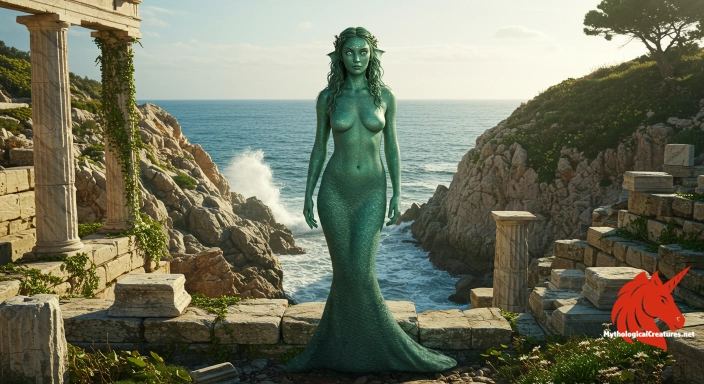
Triteia
Triteia - She is remembered as the figure after whom the town Tritaea was named, linking divine ancestry with local cult practices.
Origins & First Encounters
Triteia emerges from the depths of ancient myth as a captivating figure whose origins straddle the volatile forces of the sea and the resolute spirit of war. Born of Triton, the commanding sea-god, her ancestry immediately situates her within the realm of powerful ocean deities, while her connection to Ares, the god of battle, infuses her myth with martial intensity. Her life is interwoven with the sacred traditions of ancient Achaea, where a town proudly bears her name, reaffirming her importance in local identity and ritual practice. This mythic narrative is not merely a genealogical account but a testament to the way divine lineages shaped civic pride and religious observance in early Greek culture. The ancient inhabitants saw in her a living symbol of nature’s fluidity and the fierce energy of combat, bridging domains that were typically seen as opposites. With her legacy celebrated through dedicated worship and ceremonial sacrifices, Triteia became an emblem that resonated with both seafaring communities and warlike societies. Each retelling of her story enriched the local lore and provided a framework for understanding the complexities of divine intervention. The melding of aquatic beauty with the indomitable will of a warrior serves to remind us how myth could encapsulate the virtues prized by ancient civilisation. Her enduring myth continues to echo the cultural and religious practices that once defined a vibrant part of Greece.
Source Texts & Tale Variants
Triteia’s tale is preserved through a sparse yet intriguing body of ancient texts and temple inscriptions that provide glimpses into her revered status. Records from the sanctuary of Athena in Achaea indicate that rituals and sacrifices were performed in her honour alongside those devoted to Ares. These early inscriptions capture the essence of a myth that was both local and deeply significant, though surviving fragments leave much to the imagination. Variations in her story appear across different local narratives, suggesting that her myth was once more elaborate and multifaceted. Some accounts focus on her role as the divine mother of Melanippus, emphasising the heroic nature of her progeny and the martial qualities inherited from Ares. Over time, oral traditions and regional cult practices added layers to her character, contributing alternative perspectives within the ancient Greek mythos. In various temple records, the dual aspects of her heritage—from the sea and the battlefield—are celebrated in ritualistic acts that connect worshippers to both divine and earthly realms. The evolving accounts, though occasionally contradictory, collectively highlight her importance in local identity and religious observance. These primary sources and story variants serve as a testament to the flexibility and depth of myth-making in ancient Greek society.
Form & Powers
Visual portrayals of Triteia, though limited, convey a striking blend of ethereal beauty and formidable presence that underscores her dual heritage. Artistic depictions on pottery fragments and temple reliefs suggest that she possessed flowing, wavy hair reminiscent of the roiling sea, with strands that shimmer in hues of blue and green. Her eyes, often described in poetic terms, are said to capture the deep, mysterious essence of the ocean, reflecting a vitality that belies her divine origin. Sculptural and mosaic renditions hint at an athletic yet graceful form, which combines the softness of a goddess with the steely resolve characteristic of a warrior’s bloodline. In several local artworks, her attire is decorated with motifs of seashells and marine flora, further emphasising her connection to the underwater realm. The overall iconography reveals subtle shifts in her presentation, where certain portrayals emphasize delicate femininity while others project a more imposing, statuesque quality. Adornments of gold and intricate jewellery in these images symbolise both her noble lineage and the prosperity of her worshippers. Despite the scarcity of comprehensive descriptions, these fragmented artistic records provide a vivid glimpse into how ancient societies visualised her divine attributes. Such varied depictions collectively suggest that Triteia was envisioned as a harmonious fusion of nature’s beauty and the inexorable might of the divine.
Regional Faces
Regional adaptations of Triteia’s myth reveal a rich tapestry of local traditions and community values, particularly in ancient Achaea where her name was immortalised in a town. In this locality, she was more than a distant myth; she was a figure central to civic identity, celebrated through public rituals and sacred sacrifices. Coastal and inland communities alike tailored their worship of Triteia, often blending her maritime origin with attributes of a nurturing yet fierce guardian. Some local traditions elevated her role as a patroness of both seafaring and battlefield endeavours, thereby resonating with the dual interests of these ancient societies. In certain depictions, the goddess was represented emerging from the ocean’s foam, which symbolised not only creation but also the perpetual renewal of life and protection. The distinct regional practices underscore diverse interpretations, from elaborate ceremonies at temple sites to more intimate, family-centred veneration. Local inscriptions and artefacts reveal how communities used her legacy to assert both their historical continuity and their connection to the divine. Variations in ritual practices and iconography across regions demonstrate the adaptability of her myth to local customs and environmental influences. Thus, Triteia’s regional portrayals serve as a mirror to ancient Greek society’s ability to blend shared mythology with distinct cultural identities.
Cultural Parallels
The narrative of Triteia invites comparisons with other mythological figures who embody the convergence of natural forces and martial spirit. Like Amphitrite, whose mythic depictions celebrate a union between the sea’s mystery and the divine realities of power, Triteia similarly bridges the aqueous and the aggressive. Her story, anchored in the legacy of powerful gods, echoes the broader theme found among deities whose divine lineage legitimises heroic achievements. Analogous to local goddesses who lent their names to towns and cities across the Mediterranean, her enduring influence underscores a shared cultural practice of sanctifying local identities through myth. In many ancient traditions, divine figures served as both protectors and progenitors, traits that resonate with Triteia’s role as the mother of a warrior and a symbol of regional vitality. Cross-cultural studies often reveal that such figures, though less prominent, were integral to connecting local myth with panhellenic legends. The blending of water imagery with warlike attributes is a motif that appears in several ancient societies, reinforcing the idea of dual power. In comparative analysis, her myth is akin to other regional deities whose narratives provided a framework for understanding natural phenomena and societal values alike. This synthesis of marine elegance with martial defiance not only enriches her myth but also echoes a universal penchant for hybrid divine figures in world mythology.
Legacy & Modern Evolution
The evolution of Triteia’s myth over the centuries illustrates the dynamic nature of myth-making and the enduring legacy of local deities in ancient religious culture. Initially revered in the modest but fervent circles of Achaean worship, her story gradually absorbed broader layers of artistic and literary reinterpretation. Over time, her image became a symbol of the fusion between nature and battle, increasingly woven into the fabric of regional identity and cultural pride. As ancient texts and local traditions merged, she came to represent not only divine femininity but also the measurable strength and resilience found in both maritime and martial domains. The Renaissance and later periods saw a revived interest in minor mythological figures, leading to reinterpretations that celebrated Triteia as a marker of both aesthetic beauty and heroic legacy. Contemporary artists and scholars frequently draw upon her dual nature to explore themes of transformation and the interplay between human and natural forces. Although she remains relatively obscure compared to major Olympian deities, modern cultural discourse has embraced her as a symbol of the complex identities that local myths can encapsulate. Literary retellings and artistic pieces have reimagined her narrative in ways that resonate with today’s explorations of identity and heritage. In this evolving legacy, Triteia continues to inspire a nuanced appreciation of ancient myth, bridging historical veracity with modern creative expression.
Interesting Fact
Triteia's legacy endures through the town that bears her name, reflecting the deep connections between myth and place in ancient Greek culture.
For indie creators
Give your myth project a permanent home
Indie authors, artists, small studios, and makers can secure an annual, non-intrusive sponsor slot that meets readers where they explore.
Obtain more informationQuick Creature Info
Origin:
Associations:
Our Mythic Legendary Rating:

Also Sometimes Known As:
Habitat:
Supernatural Powers:
Abilities:
Lore:
Related Creatures, Tales or Lore
- RRhode
- GGalatea
- LLeucothea
References
Discover Another Mythical Legend You May Not Have Heard Of?
Uncover the mysteries of ancient folklore and expand your knowledge of legendary beings from cultures around the world.
Dare to Meet the Korbolko....
Curated by the Mythological Creatures Team
Series editor: Mythological Creatures Directory
Primary desk: Hellenic & Ancient Mediterranean Desk
(rev. November 2025)