
Tugarin: Tugarin is a male, dragon-like creature from Eastern European folklore, embodying evil and cruelty.
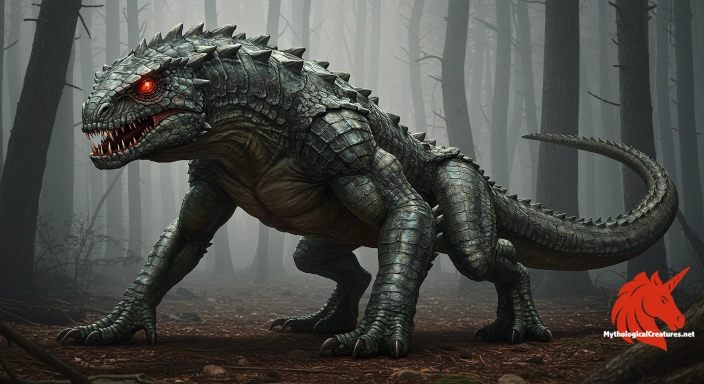
Tugarin
Tugarin - Tugarin personifies evil and cruelty, serving as a fearsome adversary in folklore.
Origins & First Encounters
Tugarin emerges as a formidable figure in Eastern European folklore, embodying dark forces with a chilling presence that has long captivated audiences. His origins are intertwined with the ancient oral traditions of bylinas, where myth and legend merged to create characters that symbolised both the natural and moral order. Early attestations from medieval epic ballads depict him as a personification of cruelty and evil, a beast whose appearance heralds chaos. These narratives, rich in both symbolism and moral lessons, cast him as the antithesis of heroic virtue. The cultural context in which Tugarin was born reflects a period when pagan and emerging Christian worldviews coexisted, blending into complex allegorical figures. His depiction as a dragon-like creature underscores the human attempt to visualise abstract concepts like malice and tyranny. Beyond mere storytelling, his myth served as a powerful metaphor for the dangers of unchecked aggression and corruption. Over centuries, Tugarin’s enduring presence in folklore has come to represent the eternal struggle between light and darkness, making him a timeless emblem of evil.
Source Texts & Tale Variants
Stories of Tugarin have been preserved through an array of bylinas and folk narratives that have travelled through generations in Eastern Europe. His character is documented in epic song cycles where legendary heroes confront his monstrous might, ensuring that his legacy is both feared and revered. Ancient manuscripts and oral recitations provide vivid portrayals that detail his role as a menacing adversary, frequently appearing in dramatic battles with valiant figures. In some traditions, he is referred to as Tugarin Dragoon, emphasising the layered and multifaceted nature of his character. The medieval sources embed him within a rich tapestry of allegorical symbolism, using his dragon-like form to represent the perils of moral decay. Numerous regional variants have emerged over time, with storytellers adapting his narrative to reflect local values and historical contexts. These narrative strands portray him not merely as an embodiment of raw physical force, but also as a cunning and sinister presence whose cruelty knows no bounds. The dynamic nature of these tales has allowed Tugarin to maintain relevance over the centuries, while his legend continues to be told in both scholarly collections and popular retellings. Finally, the persisting popularity of his story attests to a cultural need to confront and personify the darker aspects of existence.
Form & Powers
Tugarin is renowned for his awe-inspiring and fearsome appearance, which merges archetypal draconic features with an unsettling air of malevolence. His massive, sinuous body is sheathed in scales that shimmer with dark, iridescent hues, reflecting a spectrum of twilight colours. Horns, twisted and imposing, crown his head and frame eyes that blaze with an almost supernatural intensity. His limbs, endowed with powerful claws, suggest a capacity for both graceful menace and devastating savagery. In many narratives, additional features such as multiple heads or serpentine extensions are interwoven into his form, symbolising his chaotic essence. Expansive, bat-like wings unfurl from his shoulders, granting him an imposing silhouette against stormy skies. A long, whip-like tail trails behind him, each movement echoing the relentless force of his nature. Intricate details—ranging from spiked ridges to a venomous breath—serve to enhance his depiction as the very embodiment of terror. Variations in his physical portrayal often reflect local artistic traditions, yet each instance reinforces his identity as a creature of mythic proportions.
Regional Faces
While the core aspects of Tugarin’s persona remain constant, regional interpretations embellish his myth with subtle and fascinating variations. In Russian traditions, he is most often depicted in vivid bylinas as a quintessential dragon, with his monstrous form accentuated to evoke profound dread. In neighbouring Belarusian and Ukrainian lore, storytellers sometimes blend more human traits with his classical draconic features, imparting a nuanced quality to his character. Some local legends attribute to him a spectral quality, with eyes that blaze with an eerie, otherworldly light during nocturnal assaults. The fluidity of oral storytelling across regions has allowed adaptations that mirror local natural and historical landscapes. In certain retellings, Tugarin is reimagined to symbolise not only physical danger, but also the broader societal and political threats of the time. Variations in his depiction—whether emphasizing cunning intelligence or raw, untamed power—reveal the unique cultural anxieties of different communities. Despite these differences, his narrative consistently reflects themes of tyranny and the peril of moral corruption. Ultimately, the regional adaptations of Tugarin underscore the plasticity of myth, where a single legendary figure can be reshaped to mirror the values and fears of diverse audiences.
Cultural Parallels
The myth of Tugarin invites comparison with an array of similar creatures from diverse cultural traditions, highlighting a universal fascination with the monstrous embodiment of evil. His role as a personification of malice resonates with figures such as the multi-headed Zmey Gorynych, a fearsome dragon in nearby Slavic lore. Broader comparisons can also be drawn with entities like Typhon from Greek myth or the serpentine Nāga of South Asia, all of whom symbolise the chaotic forces that challenge heroic order. These figures, though arising from distinct mythological traditions, share attributes that underscore humanity’s deep-seated fears of uncontrollable natural and moral forces. Tugarin’s imposing size, venomous mien, and complex symbolism parallel such global archetypes, uniting disparate cultural narratives under a common motif of destructive power. While each culture imbues its beast with unique attributes, their collective purpose is to represent the perennial struggle between order and chaos. Artistic representations across cultures often feature similar iconography—twisting tails, blazing eyes, and formidable claws—that binds them together in the human imagination. This cross-cultural dialogue enriches our understanding of Tugarin by framing him within a broader context of mythic adversaries. Such comparative analysis reveals not only shared fears but also a universal narrative framework where evil is always poised against the forces of goodness.
Legacy & Modern Evolution
The evolution of Tugarin’s depiction reflects a long and storied history that stretches from medieval oral traditions to contemporary popular culture. Initially cast as an almost invincible embodiment of raw, untamed evil, he served as a stark counterpoint to the heroic virtues celebrated in ancient bylinas. Over time, his character has been reinterpreted to encapsulate a wider array of cultural and psychological themes, evolving from a mere monster into a symbol of moral and social decay. Modern adaptations delve into the tragic dimensions of his persona, often casting him in a light that blurs the lines between villainy and a doomed legacy. Present-day portrayals in graphic novels, films, and video games have reimagined Tugarin as a multifaceted antagonist, whose terrifying appearance is matched by a complex narrative background. These contemporary revisions not only pay homage to his traditional roots but also speak to an evolving cultural critique of power and corruption. The enduring nature of his myth is evident in the way festivals, literature, and academic discussions continue to invoke his legend as a metaphor for internal and societal conflict. His modern legacy is marked by a dynamic interplay between ancient superstition and modern narrative creativity. In reinterpreting an age-old symbol of despair, current storytellers ensure that Tugarin remains a potent reminder of the eternal battle between light and dark.
Interesting Fact
Over time, Tugarin's portrayal has evolved, merging traditional dragon attributes with uniquely Eastern European elements, thereby enriching his role as a symbol of malevolent power in folklore.
Curated sponsor space
One subtle banner. Thousands of myth lovers.
We offer a small number of curated sponsor spots for relevant books, courses, games, and art. No clutter, just well-matched partners.
Partner with usQuick Creature Info
Our Mythic Legendary Rating:

Habitat:
Supernatural Powers:
Physical Attributes:
Abilities:
Behavior:
Lore:
Related Creatures, Tales or Lore
- ZZmey Gorynych
- WWestern Dragons
- TTiamat (Mesopotamian)
References
Discover Another Mythical Legend You May Not Have Heard Of?
Uncover the mysteries of ancient folklore and expand your knowledge of legendary beings from cultures around the world.
Dare to Meet the Samca....
Curated by the Mythological Creatures Team
Series editor: Mythological Creatures Directory
Primary desk: Northern & European Folklore Desk
(rev. November 2025)