
Samca: Samca is an evil spirit from Romanian mythology known for her terrifying appearance and shape-shifting abilities.
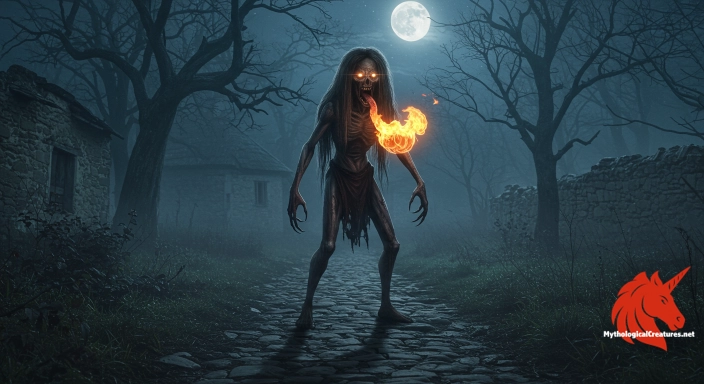
Samca
Samca - Represents the dangers of supernatural malevolence and the efficacy of protective magic in Romanian folk belief, particularly in safeguarding vulnerable children and expectant mothers
the legend in five swipes.
the legend in five swipes.
When was Samca first written about?
Samca is a notorious malevolent spirit deeply rooted in Romanian folklore, known for instilling dread among vulnerable communities. Born out of an environment where supernatural explanations were entwined with everyday existence, her legend has long served as both a cautionary tale and a reflection of societal anxieties. Tales concerning her earliest appearances indicate an origin steeped in ancient pagan traditions later amalgamated with emerging Christian cautionary narratives. Her mythic presence, often linked to the mystery of the night and lunacy, reflects the cultural interplay between light and darkness within Eastern European rural life. Folk traditions recount that she emerges at the full moon, marking a time when the veil between this world and the spirit realm thins considerably. The stories of Samca were historically used to explain sudden illnesses and fatalities among infants and expectant mothers, rendering her a fearsome symbol of fate’s abrupt cruelty. Rural communities developed elaborate protective rituals against her, underscoring the collective need to ward off unseen evils. Over time, her tale evolved to incorporate elements from both native legends and imported mystic symbols, cementing her status as a complex cultural archetype. Beliefs about Samca have persisted despite the advent of modernity, serving as a reminder of the lingering influence of ancient myth. Her enduring narrative encourages a confrontation with the darker, inexplicable facets of human existence.
The Source Texts Behind Samca
Sourced from a blend of oral tradition and early documented accounts, the story of Samca has been recorded in a variety of texts and folklore compilations spanning centuries. Early historians and ethnographers were captivated by her persona, with accounts appearing as early as the centuries following the spread of Christianity in Eastern Europe. Notable among these records is the description by Rabbi Moses Gaster in 1900, whose accounts highlight the uncanny similarities between Samca and other child-stealing entities across cultures. Multiple versions of the legend exist, each carefully preserving regional nuances and variations in her portrayal. In folk incantations passed down orally, she is identified by a plethora of names, each revealing a different facet of her malevolence. Over time, the recorded narratives have evolved into a rich tapestry of myth, combining supernatural lore with practical magical safeguards. The diverse sources range from written manuscripts and folklore collections to the shared memories of community elders. Some variants focus on her interaction with children, while others recount encounters with expectant mothers, underscoring her role as a multifaceted menace. Despite the variations, the consistent theme remains her role as a spiritually disruptive force. This multiplicity of sources reinforces the idea that folklore is a dynamic entity, ever-adapting to the cultural context in which it survives.
What does Samca look like?
The physical manifestation of Samca is a striking blend of both human and beastly features, designed to evoke intense terror and awe. In her most recognised form, she appears as a completely naked woman with wild, unkempt hair cascading down to her heels, contributing to an overall aura of untamed ferality. Her small, star-like eyes emit an eerie brightness that clashes with her sinister demeanour, while her iron-like hands end in elongated nails that are as sharp as knitting needles or hook-like similar to sickles. An additional defining feature is her oversized, crooked mouth which perpetually spews fire, symbolising her inner rage and unbridled power. Beyond her human guise, legends recount that she can morph into diverse creatures—a colossal and fierce pig, a grinning dog with menacing teeth, a hairless cat with piercing, fiery eyes, an unsettling crow with bloodshot eyes, or even a gargantuan black spider. Each of these forms is vividly described to stress the dual nature of familiarity and horror. The emphasis on her shifting appearance highlights the belief in her ability to adapt and terrify from multiple angles. Her physical attributes not only serve as symbols of retribution and danger but also reflect the community’s deep-seated fear of the unknown. Vivid details such as glowing eyes, a ferocious mouth and razor-sharp appendages create an image that is impossible to forget. As a result, every retelling of her tale adds another layer to her formidable and indelible physical outline.
Samca: Regional Versions and Local Names
The legend of Samca exhibits notable regional variations, each echoing the unique cultural and social landscapes of the different areas within Romania and its neighbouring regions. In some local traditions, she is depicted with an even more exaggerated grotesque visage, a detail perhaps shaped by rural superstitions and the unique environmental influences of specific villages. Localised accounts often stress her appearance during the full moon's cycle, linking her manifestations with seasonal rituals and celestial events that vary across regions. In portions of the Balkans, where cultural exchanges were frequent, her character assimilated traits from Slavic and Greek mythologies, thus broadening her portfolio of malevolent characteristics. Some communities have even associated her with agricultural forces, as seen in her transformation into a wild, enraged pig in farming villages. Variations in her narrative tend to reflect local concerns—for instance, in areas where livestock and nature played central roles in daily life, her animal forms became particularly pronounced. Stories from different locales also vary in the prescribed methods of protection, often incorporating uniquely regional charms or incantations. Despite these regional disparities, the essence of her malevolence remains consistently terrifying across different cultures. As local adaptations continue to enrich and diversify her myth, they serve as a testament to the dynamic and fluid nature of oral tradition. This ever-evolving regional tradition ensures that her terror is both a shared cultural memory and a uniquely local experience.
Legends Comparable to That of Samca
When juxtaposing Samca with similar figures from other mythologies, one finds striking parallels and fascinating distinctions. Several global cultures feature spirits or demons that threaten the most vulnerable members of society, much like her role in frightening children and endangering expectant mothers. In Slavic traditions, figures such as the night hag or even the infamous Baba Yaga share the ambiguous nature of female demonic forces. Likewise, her ability to shapeshift into different animals finds echoes in other cultures, where shape-shifting is employed as a tool to subvert the natural order and instil fear. The multifaceted approach of assigning numerous names to embody different aspects of her power resonates with similar practices seen in ancient Semitic and Mediterranean talismans. This multiplicity of identities further underscores an enduring human tendency to encapsulate multifarious dangers within complex mythic archetypes. Beyond Eastern Europe, certain aspects of her persona can be likened to the spectral entities of the Mediterranean traditions, where spirits are attributed with both healing and destructive properties. Her role as both a punisher and an omen of misfortune offers a clear window into the dual nature of many mythological beings across various cultures. The legacy of her narrative, thus, mirrors a universal anxiety about the unseen forces that govern destiny. Comparative analysis reveals that while the specific details of her story are unique, the underlying themes resonate with a wider, cross-cultural myth-making tradition.
Samca: From Folklore to Pop Culture
The evolution of Samca over centuries illustrates the transformative power of myth and the ways in which legends adapt to the needs and fears of each generation. Originally emerging as a cautionary embodiment of supernatural retribution, her depictions have gradually incorporated layers of complexity, becoming symbols of both ancient fears and contemporary anxieties. Over time, scholarly works and folk narratives have sought to contextualise her frightening attributes within broader themes of child welfare and reproductive safety. In modern cultural expressions, her image has shifted subtly, serving not only as a warning against the dangers of the night but also as a metaphor for the unpredictable forces of nature and fate. Although the scientific age has replaced many of the beliefs once held in awe, traditional accounts of Samca continue to inspire literature, art, and even modern cinema. The multiplicity of her forms has led some modern interpretations to view her as a tragic figure, caught in the constant interplay between beauty and horror. Contemporary reinterpretations often examine her dualistic nature, suggesting a deeper symbolism related to the complexities of modern identity. Technology and digital media have played a role in reviving her tale, ensuring that the myth remains vividly alive and reinterpreted by new audiences. Ultimately, the legacy of Samca is one of enduring enigma, nurtured by a blend of ancient superstition and modern creativity, as she continues to capture the imagination as both a historic cautionary tale and a subject of contemporary cultural exploration. Her myth, irrevocably bound up with the mystique of the night, remains a potent symbol of our collective fascination with the supernatural.
Interesting Fact
An intriguing aspect of Samca's myth is that she is known by 19 different names, and the act of writing them all down is believed to not only ward off her curse but also to redirect her maleficence back onto herself.
Mythological Treasures
Greek Myths: A field guide to the monsters of ancient Greece
Every monster here earned its place in legend, and each gets a full page of artwork and the story behind it.
Norse Sagas: A field guide to the beasts of the Viking world
Drawn from the saga accounts themselves, with the powers, weaknesses and doom of each being set out.
Egyptian Legends: A field guide to the gods and monsters of ancient Egypt
Guardians of the living and devourers of the dead, with the role each played in judgement.
the legend in five swipes.
Mythology commerce, done carefully
Align your store with our global myth audience
If you sell myth-inspired jewellery, prints, decks, or collectibles, we can feature your brand without overwhelming the reading experience.
Partner with usQuick Creature Info
Features:
Associations:
Our Mythic Legendary Rating:

Also Sometimes Known As:
Habitat:
Supernatural Powers:
Physical Attributes:
Abilities:
Behavior:
Weaknesses:
Lore:
Related Creatures, Tales or Lore
References
Discover Another Mythical Legend You May Not Have Heard Of?
Uncover the mysteries of ancient folklore and expand your knowledge of legendary beings from cultures around the world.
Dare to Meet the Ork....
-8cdc9721-d09e-437e-89ea-64fa357de1b0_small.webp "Depiction of Ork")
The Mythological Creatures Book Series
Yokai, Greek, Norse, Egyptian & Chinese. Five illustrated field guides to the creatures the old stories either warned or told you about.
Curated by the Mythological Creatures Team
Series editor: Mythological Creatures Directory
Primary desk: Hellenic & Ancient Mediterranean Desk
(rev. November 2025)