
Ulmecatl: Ulmecatl is one of the six giant sons of Mixcoatl and Tlaltecuhtli in Aztec mythology.
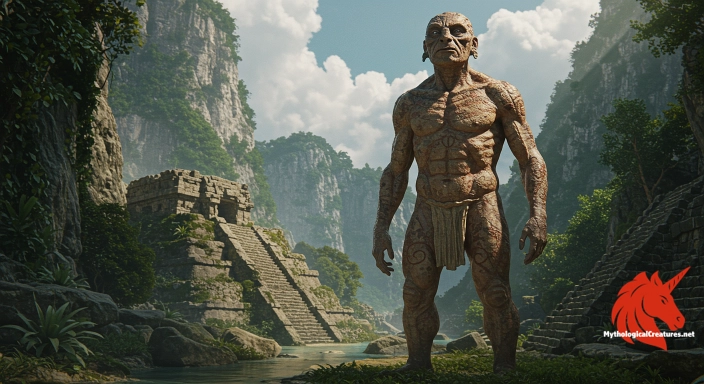
Ulmecatl
Ulmecatl - A pivotal figure in the re-population of the Earth after the Great Flood, Ulmecatl’s legacy is integral to the formation of early Mesoamerican cultures.
the legend in five swipes.
the legend in five swipes.
The Origin Story of Ulmecatl
Ulmecatl emerges from the rich tapestry of Aztec myth, uniquely blending nature’s vitality with the divine legacy of the cosmos. Bearing a name that means 'where the rubber is born,' he encapsulates the creative power behind life and the material essence cherished in ancient rituals. Born as one of the six giant progeny of Mixcoatl and Tlaltecuhtli, his mythic presence is interwoven with the cycles of creation and destruction that defined the Fifth Sun. In narratives passed down through centuries, his role in repopulating the Earth after the Great Flood highlights the Aztec vision of rebirth and renewal. His establishment of Cuetlachoapan, linked to the region now known as Puebla, grounds his ethereal legacy in a specific geographic context. His legendary exploits imbue him with the strength of a creator and the mystique of a nature deity, bridging the realms of gods and mortals. The reverence for Ulmecatl has long served as a cultural anchor, inspiring ceremonies and communal identities throughout the Mesoamerican world. Over time, his evolving story has adapted to embody the hopes and challenges of successive generations. His enduring narrative continues to resonate as both a historical cornerstone and a symbol of eternal regeneration.
How did the story of Ulmecatl change over time?
Ancient codices and oral traditions carefully preserve the fragmented tales of Ulmecatl, portraying him as one of the six giants who reformed the world after cataclysm. Pictorial manuscripts and ritual texts present his legacy alongside those of his divine siblings, establishing him as a pivotal force in the post-flood era of the Fifth Sun. The surviving sources, although varied and sometimes cryptic, embed his myth within broader narratives that celebrate cosmic renewal and the reordering of nature. Creative storytellers have interwoven his feats with symbolic imagery, linking his identity to both the elemental world and human civilisation. Certain accounts underscore his role as a stabilising influence that reintroduced order after the chaos of the Great Flood, while others focus on his contribution to founding vital settlements. The interplay between written records and oral renditions has allowed local communities to adapt his story to regional cultural frameworks. This dynamic transmission enriched his character with nuances drawn from local folklore, ritual practice, and ancestral memory. Ceremonial carvings and mural fragments further attest to his significance in the spiritual and cultural landscape of ancient Mesoamerica. These diverse sources, though not entirely uniform, collectively offer a layered and intriguing portrait of Ulmecatl.
How would you recognise Ulmecatl?
The physical portrayal of Ulmecatl is as grand as his myth, merging imposing stature with a host of mystical attributes. In artistic renditions, he is often depicted as a colossal figure whose contours evoke both the fluidity of water and the solidity of ancient stone. His skin, sometimes imagined with a rubber-like texture and deep earthen hues, symbolises the primordial forces of nature. Vivid illustrations lend him serpentine features that suggest both power and graceful fluidity. Elaborate headdresses, intricate body markings, and sacred glyphs embellish his form, marking him as a vessel of cosmic wisdom. His limbs carry the impression of both raw strength and agility, fusing the robust qualities of terrestrial life with the elegance of myth. Some representations even hint at a subtle transformation in his appearance, mirroring the cycles of day and night. The fusion of naturalistic detail with evocative symbolism creates an image of Ulmecatl that transcends simple physical description. This amalgam of corporeal power and artistic abstraction ensures his portrayal remains both awe-inspiring and enigmatic.
What regional forms of Ulmecatl exist?
Across varied Mesoamerican landscapes, Ulmecatl’s narrative has been adapted to reflect the unique cultural and environmental contexts of each region. In central Mexico, particularly in areas corresponding to modern Puebla, his legacy is intimately connected with the land’s fertility and the emergence of early settlements. Local storytellers have imbued his myth with a distinct regional flavour, emphasising his role as both a creator and a guardian of nature. In some traditions, he is celebrated as a deity who imbued the land with abundance, linking his very name to the origin of life-sustaining natural resources. Artistic depictions in different communities often modify his features to resonate with local aesthetics and indigenous symbolism. Variations in ceremonial narratives portray him both as a fearsome progenitor and as a benevolent force guiding agricultural prosperity. His myth has thus become an adaptable cornerstone, reflecting the cultural values and environmental realities of disparate regions. The localized versions ensure that his legacy is not a monolithic tale but rather a multifaceted myth that intertwines with the daily lives and aspirations of various peoples. In this way, Ulmecatl stands as a unifying yet culturally diverse symbol across the Mesoamerican world.
Which myths echo the story of Ulmecatl?
When compared with similar figures in world mythologies, Ulmecatl occupies a unique niche as a post-deluge progenitor and a symbol of cosmic renewal. His role in re-establishing order after a cataclysm shares similarities with titanic figures found in Greek and Norse legends, where ancient giants or deities emerge to rebuild a shattered world. His connection to the elements of nature and the transformative power of life echoes traits associated with serpentine deities like Quetzalcoatl in Mesoamerican lore. The motif of rebirth inherent in his tale finds resonance in flood narratives from various cultures, underscoring a universal human preoccupation with regeneration. His myth acts as a bridge between the earthly and the divine in a manner reminiscent of figures in both Eastern and Western traditions. Comparisons also emerge with the archetypal heroes of indigenous American narratives who, like Ulmecatl, are tasked with restoring balance and order in the wake of chaos. This convergence of themes highlights the interconnectedness of mythological traditions across continents. At the same time, Ulmecatl’s distinctly Aztec origins and locally nuanced attributes render him a singular figure within the global tapestry of creation myths. Thus, his story not only enriches the Aztec canon but also contributes meaningfully to understanding common patterns in human myth-making.
Ulmecatl: Then and Now
The historical evolution of Ulmecatl’s myth mirrors the broader shifts from pre-Columbian religious practice to contemporary cultural identity. Over the centuries, the intensity of his early mythic narrative has softened into a symbol of natural resilience and cultural rebirth. Modern reinterpretations often fuse ancient imagery with themes of environmental stewardship and the revival of indigenous heritage. His iconography now appears in public art, literature, and festivals that celebrate the rich legacy of Mesoamerican civilisation. Scholars and cultural practitioners alike explore his myth as a means to reconnect modern communities with their ancestral roots. This enduring symbolism serves as both a reminder of past cataclysms and a hopeful vision of renewal in the face of change. Contemporary artists and architects draw on his distinctive features to reinterpret traditional narratives for a modern audience. The spirit of Ulmecatl is continually reinvented through academic research and communal celebration, ensuring his presence remains potent. His legacy, evolving yet timeless, exemplifies how ancient myth can sustain and inspire new expressions of cultural identity.
Interesting Fact
An intriguing detail about Ulmecatl is that his very name links him to the origin of rubber, a material that played a crucial role in ancient Mesoamerican economies and rituals.
Mythological Treasures
Chinese Beasts: A field guide to the dragons and demon kings of Chinese myth
From river dragons to demon kings, with the legends that shaped five thousand years of storytelling.
Japanese Yokai: A field guide to the spirits and demons of Japanese folklore
Fifteen spirits, with the signs to watch for and what the old tales say to do if you meet one.
Greek Myths: A field guide to the monsters of ancient Greece
Every monster here earned its place in legend, and each gets a full page of artwork and the story behind it.
the legend in five swipes.
For myth educators and toolmakers
Built a resource for mythology learners?
If you offer courses, teaching tools, or research platforms focused on myth and folklore, consider a discrete placement on our reference pages.
Introduce your resourceQuick Creature Info
Origin:
Associations:
Our Mythic Legendary Rating:

Also Sometimes Known As:
Habitat:
Supernatural Powers:
Physical Attributes:
Abilities:
Lore:
References
Discover Another Mythical Legend You May Not Have Heard Of?
Uncover the mysteries of ancient folklore and expand your knowledge of legendary beings from cultures around the world.
Dare to Meet the Unhcegila....
The Mythological Creatures Book Series
Yokai, Greek, Norse, Egyptian & Chinese. Five illustrated field guides to the creatures the old stories either warned or told you about.


Curated by the Mythological Creatures Team
Series editor: Mythological Creatures Directory
Primary desk: Americas & Indigenous Traditions Desk
(rev. November 2025)