
Umibōzu: Umibōzu is a giant, black, human-like sea spirit from Japanese folklore, known as a yōkai.
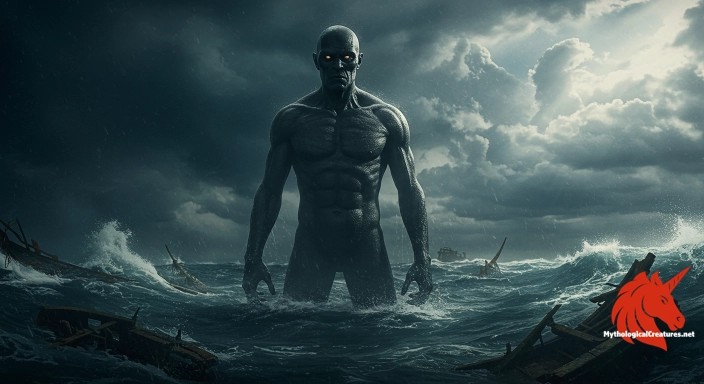
Umibōzu
Umibōzu - Represents the unpredictable and hazardous nature of the sea, serving as a cautionary symbol for sailors.
Origins & First Encounters
Umibōzu stands as one of Japan’s most enigmatic sea spirits, its origins wrapped in the mists of maritime tradition and ancient superstition. Born from the interplay between the human psyche and the unpredictable ocean, this yōkai has long haunted coastal narratives and seafarers’ dreams. Its name, meaning 'sea priest', hints at a dual role of both spiritual authority and forewarning of nature’s wrath. Early attestations of the umibōzu emerge from oral traditions that later crystallised in Edo period artworks and folklore compilations. Mariners recount encounters where calm, placid waters abruptly transformed into tumultuous, stormy seas at its appearance. The creature’s sudden and violent manifestations have cemented its role as a personification of nature’s capricious might. Tales of this spectral entity provided a means for communities to understand and cope with the perils of life at sea. Even in modern times, the umibōzu continues to evoke both reverence and trepidation, symbolising the ancient bond between man and the vast, unknowable ocean.
Source Texts & Tale Variants
Various ancient texts, illustrated compendiums, and oral narratives provide the primary sources of the umibōzu myth, each casting a distinct light on its character. Traditional accounts compiled during the Edo period, including influential picture scrolls and yōkai encyclopaedias, played a pivotal role in shaping its legacy. Sailors’ logs and local folklore from coastal villages contribute additional layers, often recounting eerie encounters that mix reality with the supernatural. Some versions portray the umibōzu as a vengeful spirit exacting retribution on seafarers, while others suggest a more ambiguous presence linked to the merciless sea. Story variants sometimes recount the creature’s peculiar demand for a bottomless barrel as the only means of safe passage. The divergent narratives underscore a fluid mythology where regional experiences and maritime customs colour its portrayal. In settings where traditional rituals persist, the umibōzu is woven into local maritime lore as both omen and moral lesson. These interlaced sources form a rich tapestry that continues to evolve as new generations reinterpret the age-old myth.
Form & Powers
Visually, the umibōzu is depicted as a towering, shadow-like figure that emerges from the depths with an almost tangible aura of dread. Its skin is commonly rendered as a deep, impenetrable black, mirroring the inky darkness of the ocean at midnight. The entity’s form fluctuates between a vaguely human silhouette and an amorphous mass of water and shadow, challenging the limits of mortal description. Some accounts describe its head as smooth and dome-like, evoking the image of a shaven monk or priest, which adds to its eerie sobriety. Witnesses have noted that its eyes sometimes gleam with a faint luminescence, a silent herald of the coming tempest. The creature’s massive presence often seems to dwarf the ships it assails, creating a stark contrast between human fragility and natural force. Water and mist swirl around its form, blurring the boundary between physical matter and spectral illusion. Every detail of its appearance, from its ambiguous facial features to its fluid, almost ethereal edges, contributes to a visage that is both mesmerizing and terrifying.
Regional Faces
The portrayal of umibōzu varies markedly across Japan’s numerous coastal regions, reflecting the diversity of local maritime cultures and environmental influences. In certain parts of the country, the creature is seen as a malevolent force whose wrath must be placated, while in other localities it is regarded with a hint of reluctant respect as a natural guardian of the sea. Communities along the Sea of Japan and in the Inland Sea have, over time, embellished its narrative with unique ritualistic elements and specific methods of appeasement. Some island traditions depict umibōzu as a being with priestly attributes, complete with the semblance of traditional garb, whereas mainland accounts often focus on its overwhelming, spectral presence. These regional adaptations highlight differences in how natural phenomena and maritime dangers are interpreted by local folklore. In areas with long-standing seafaring traditions, specific offerings and rituals are performed to avert the creature’s wrath. Variations in its depiction also suggest that the umibōzu serves as a cultural mirror, reflecting local fears, environmental conditions, and historical encounters with the unpredictable sea. Thus, while its core legend remains consistent, its form and function morph to align with the traditions of each community that retells its tale.
Cultural Parallels
The myth of the umibōzu finds stimulating parallels in other global maritime legends, underlining a shared human attempt to personify the dangers of the sea. Much like the Norse kraken or the Celtic merrow, this sea spirit encapsulates the awe and fear inspired by the vast, uncontrollable ocean. Across cultures, supernatural beings have been invoked to explain the sudden, violent disruptions faced by seafarers, and the umibōzu is no exception. Its distinctive method of demanding a bottomless barrel to pacify its fury echoes folkloric motifs where clever humans outwit overwhelming natural forces. Comparatively, while Western legends often portray sea monsters as beastly and animalistic, the umibōzu retains a humanoid, almost sacerdotal quality. This human-like aspect invites reflections on themes of divine retribution and the ambiguous nature of justice in the face of natural calamity. The creature’s role as a liminal figure between the animate and inanimate world is a notable point of convergence with other mythological entities across Asia and Europe. In this way, the umibōzu not only occupies a unique niche within Japanese folklore but also contributes to a broader, cross-cultural dialogue about humanity’s enduring relationship with the sea.
Legacy & Modern Evolution
The evolution of the umibōzu from a murky maritime omen to a fixture in modern popular culture illustrates the dynamic nature of folkloric adaptation. Originally emerging as an embodiment of the unpredictability and peril of the natural world, the sea priest has since transcended his initial role to become a symbol of the mysterious forces that govern both nature and fate. Edo period artists immortalised its form in woodblock prints and literature, ensuring that the legend was passed down through generations. In contemporary society, the umibōzu has experienced a renaissance through its appearances in manga, anime, and various media projects, reimagined as either a vengeful spirit or a misunderstood guardian of the deep. Modern narratives often explore its duality, presenting the creature as a metaphor for environmental challenges and the human struggle against nature. The reinterpretation of the umibōzu in digital art and film continues to capture the collective imagination of audiences worldwide. Contemporary festivals and cultural events along Japan’s coastlines also celebrate its lore, keeping the ancient myth alive in communal memory. Ultimately, the umibōzu endures as both a relic of old maritime superstitions and a living symbol of the ever-evolving dialogue between human culture and the sea.
Interesting Fact
An intriguing aspect of Umibōzu is its peculiar demand for a bottomless barrel, highlighting the blend of rationality and absurdity found in traditional Japanese folklore.
Sponsor this space
Tasteful, fixed-fee placements for myth projects
No bidding wars or flashing banners. We offer simple placements for a small set of creators and brands aligned with our readers.
Request further detailsQuick Creature Info
Associations:
Our Mythic Legendary Rating:

Also Sometimes Known As:
Habitat:
Supernatural Powers:
Physical Attributes:
Abilities:
Behavior:
Weaknesses:
Lore:
Related Creatures, Tales or Lore
References
Discover Another Mythical Legend You May Not Have Heard Of?
Uncover the mysteries of ancient folklore and expand your knowledge of legendary beings from cultures around the world.
Dare to Meet the Duende....

Curated by the Mythological Creatures Team
Series editor: Mythological Creatures Directory
Primary desk: Asian & Pacific Myth Cycles Desk
(rev. November 2025)