
Urmahlullu: The Urmahlullu is a mythological lion-centaur hybrid with a quadrupedal lion's body and a human upper torso.
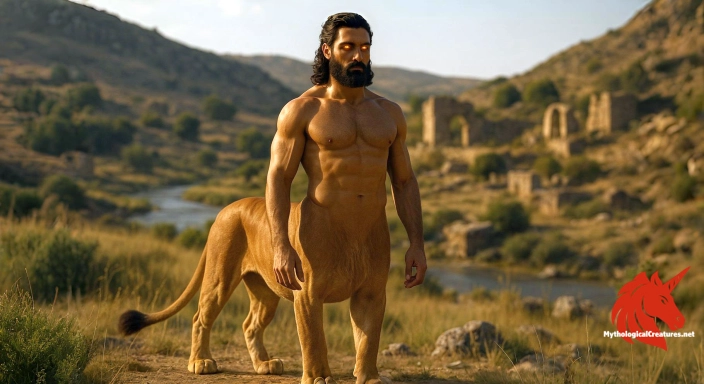
Urmahlullu
Urmahlullu - Symbolises the union of human intellect with the raw power of the animal kingdom, reflecting cultural values of strength and nobility.
Origins & First Encounters
Urmahlullu is a captivating mythological entity whose origins stretch deep into the ancient cultural imagination. Born from the early Sumerian creative ethos, its name suggests a fusion where man intertwines seamlessly with the majesty of the lion. The creature’s initial attestation is found in Sumerian texts, a time when the boundaries between the natural and the divine were particularly fluid. Its unique dual form symbolised the harmonious balance between brute animal strength and human intellect. Over time, these early depictions laid the groundwork for a creature that would capture the collective fantasy of multiple cultures. The blending of a noble lion’s lower half with a human torso not only conveyed physical supremacy but also an enigmatic wisdom. The myth of the Urmahlullu reflected the era’s desire to personify nature’s wild unpredictability alongside civilization’s order and reason. Its continued role in mythic narratives underscores an enduring fascination with beings that defy conventional limitations. In every retelling, the Urmahlullu serves as a reminder of a world where myth and nature are inseparably intertwined.
Source Texts & Tale Variants
The earliest records of the Urmahlullu emerge from ancient Sumerian inscriptions, where its lion-centaur design was intricately described. These primary texts offer tantalising glimpses of how the creature was woven into the fabric of early myth and ritual. Beyond Sumer, echoes of its legend appear in neighbouring regions, where fragmented narratives continue to preserve its image. In medieval Europe, illuminated manuscripts and bestiaries revived its lore, casting it in roles both protective and portentous. Artistic depictions evolved as the creature gracefully migrated from oral traditions into the realm of visual storytelling. Regional storytellers and minstrels adapted its attributes, imbuing the Urmahlullu with characteristics tailored to local moral and spiritual themes. Numerous variants of its legend have surfaced, each offering unique insights into its supernatural qualities and emblematic power. These diverse sources, ranging from ancient clay tablets to Renaissance art, reveal a narrative that is as mutable as it is enduring. The widespread transmission of its myth underscores a dynamic interplay between early textual traditions and later folkloric embellishments.
Form & Powers
The Urmahlullu is renowned for its striking dual anatomy, merging the raw power of a lion with the grace and stature of a human. From the waist down, it possesses the robust body of a feline, complete with muscular legs, a powerful tail, and a coat of rich, tawny fur that exudes regal strength. The lower half is meticulously depicted with sinewy muscles and a sense of natural ferocity that is emblematic of big cats. Ascending from this leonine body, the creature boasts a human torso displaying both strength and sophistication. This upper half is often illustrated with defined musculature, expressive facial features, and a poised posture that speaks of intelligence and nobility. The seamless transition between animal and human forms is rendered with artistic finesse, evoking a sense of harmonious duality. Intricate details such as the blending of a flowing mane into human hair or the softening of facial features underscore its mythical hybridity. The interplay of majestic feline attributes with refined human characteristics creates a form that is both awe-inspiring and mysterious. Overall, every artistic interpretation of the Urmahlullu captures the complexity of its physical existence, showcasing a body that bridges nature’s wildness and human sensibility.
Regional Faces
The depiction of the Urmahlullu changes markedly depending on the cultural and regional context in which it appears. In the ancient Near East, it is frequently portrayed as a potent guardian of sacred spaces, embodying divine authority through its majestic features. Conversely, European portrayals during the Middle Ages and early Renaissance tend to emphasise its allegorical dimensions, often imbuing it with virtues of wisdom and moral strength. Local artistic traditions mould its image to fit regional aesthetics, resulting in variations in detail such as the treatment of fur, musculature, and the configuration of its facial characteristics. In some traditions, the creature is cloaked in elaborate ornamentation that highlights its semi-divine status, while in others it remains a raw symbol of nature’s untamed might. The narrative functions attributed to the Urmahlullu also differ, from a fearsome protector in one tradition to a mystical mediator between realms in another. Differences in symbolism reflect the varied environmental, spiritual, and social landscapes of the cultures that embraced its legend. The adaptability of its iconography has allowed the creature to traverse geographical boundaries, its mythic traits reshaped and reimagined by successive generations. Thus, regional variations reveal a broader and richer tapestry of meaning woven around this enduring mythical figure.
Cultural Parallels
The hybrid nature of the Urmahlullu finds fascinating parallels in a variety of global mythological traditions. Much like the celebrated centaurs of Greek lore, it bridges the gap between raw animal instinct and human sophistication. Comparable imagery is also found in the Egyptian sphinx, whose dual nature is invoked to challenge and enlighten human perceptions. The motif of combining human elements with those of formidable animals recurs in the depiction of creatures such as griffins, reinforcing cross-cultural themes of power and mystery. This common narrative thread reflects a universal fascination with beings that transcend natural boundaries and embody a synthesis of attributes. Several traditions have employed such hybrids as symbols of both protection and the embodiment of dualistic virtues. The Urmahlullu, by virtue of its dual form, invites comparisons with numerous mythic constructs that question the limits of identity and natural law. As a cultural archetype, it participates in a broader dialogue about the intersection of the civilized and the wild. These parallels not only highlight shared human concerns but also enrich our understanding of how myth has been used to explore the complexities of existence.
Legacy & Modern Evolution
The myth of the Urmahlullu has evolved impressively from its early Sumerian roots to its resurgence in medieval art and contemporary fantasy. Over the centuries, its depiction has been continually reshaped to reflect shifting cultural, spiritual, and artistic sensibilities. Its enduring presence in the lore of many regions has allowed it to absorb diverse layers of meaning, from divine guardianship to allegories of inner strength. In the modern era, the creature is occasionally resurrected in literature, film, and visual arts, where it symbolizes the persistent allure of myth that transcends time. Contemporary interpretations often focus on its dual nature as an emblem of the interplay between instinct and intellect, portraying it as a bridge between two worlds. The Urmahlullu now stands as a testament to the power of myth to adapt and endure amid changing societal values. Its image functions as a cultural touchstone, inspiring creative reinterpretations that speak to issues of identity, nature, and power. The evolution of its narrative over millennia exemplifies how ancient motifs continue to influence and enrich modern artistic expressions. In every retelling, the creature remains a symbol of the infinite possibilities that arise when humanity reimagines the natural world.
Interesting Fact
Despite being rooted in ancient Mesopotamian lore, the Urmahlullu has been reinterpreted across diverse cultures, reflecting the timeless appeal of its hybrid nature.
For myth educators and toolmakers
Built a resource for mythology learners?
If you offer courses, teaching tools, or research platforms focused on myth and folklore, consider a discrete placement on our reference pages.
Introduce your resourceQuick Creature Info
Origin:
Features:
Our Mythic Legendary Rating:

Also Sometimes Known As:
Habitat:
Supernatural Powers:
Physical Attributes:
Abilities:
Behavior:
Lore:
References
Discover Another Mythical Legend You May Not Have Heard Of?
Uncover the mysteries of ancient folklore and expand your knowledge of legendary beings from cultures around the world.
Dare to Meet the Gangr....
Curated by the Mythological Creatures Team
Series editor: Mythological Creatures Directory
Primary desk: Hellenic & Ancient Mediterranean Desk
(rev. November 2025)