
Ushi-oni: The Ushi-oni is a fearsome yōkai from western Japan, known for its bovine head and demonic appearance.
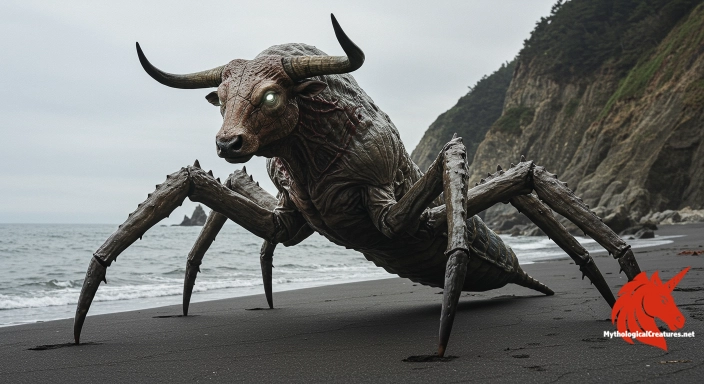
Ushi-oni
Ushi-oni - Acts as a cautionary symbol of the dangers lurking in coastal regions, and is an enduring figure in Japanese mythology.
Origins & First Encounters
The Ushi-oni emerges from the rich folklore of western Japan as a legendary demon whose very name evokes both terror and wonder. Its origins are deeply rooted in a coastal culture where the boundaries between the natural and supernatural were seen as porous and ever-shifting. Ancient village narratives have long depicted this creature as a portent of nature’s unpredictable fury, blending elements of animal strength with otherworldly mystique. Over time, it has embodied the dual emotions of awe and fear, symbolising the precarious balance between human civilisation and the raw forces of the environment. Early attestations of the Ushi-oni appear in regional legends that served as cautionary tales for those venturing near treacherous shores. The creature’s reputation has been shaped and reshaped by generations of storytellers who have infused its myth with local colour and environmental symbolism. Manifesting as both a protector and a predator, the Ushi-oni reflects the complex interplay between humanity and the natural world. Even as modernity reshapes cultural contexts, the haunting image of an ox-headed demon continues to resonate as a timeless emblem of nature’s indomitable spirit. Its enduring presence in myth highlights a legacy where folklore meets environmental uncertainty. With its mysterious origins firmly interwoven with seafaring traditions, the Ushi-oni remains a compelling figure in Japanese mythology.
Source Texts & Tale Variants
The earliest mentions of the Ushi-oni can be found in a patchwork of local oral traditions and illustrated manuscripts from the Edo period. Stories from rural communities along the western coast recount chilling encounters and sudden attacks by this bovine-headed demon, weaving together threads of superstition and practical caution. Various folktales, passed down through generations, encapsulate a creature whose form and ferocity differ from village to village. Early textual sources, though fragmentary, hint at the creature’s evolution from a local evil spirit into a more complex embodiment of nature’s wrath. In certain scrolls and artistic depictions, the Ushi-oni appears as a solitary menace haunting moonlit beaches, a motif that has been echoed in subsequent retellings. The diversity of these early narratives underscores both the adaptability of its myth and its role in local cautionary traditions. Community festivals and seasonal rituals have also preserved variant accounts, each adding layers to its identity and powers. Later adaptations in literature further melded the traditional fearsome image with elements of mystery and moral retribution. As a result, the Ushi-oni appears not as a fixed entity but as a dynamic symbol in Japan’s extensive yōkai lore. These various sources and narrative strands continue to inspire both academic discourse and popular imagination, ensuring the demon’s story endures beyond its historical origins.
Form & Powers
The physical depiction of the Ushi-oni is as striking as it is diverse, with its most consistent feature being a formidable bovine head crowned with curving horns. Its eyes are often described as burning with an eerie luminescence, a trait that adds an especially menacing quality to its appearance. The creature’s body is typically portrayed as a powerful amalgamation of muscle and mystique, combining shaggy, coarse textures with hints of scaled, almost armour-like skin. Limbs that are both robust and unnaturally agile enable the Ushi-oni to traverse not only rugged coastal terrain but also the shallow waters it calls home. In several accounts, its snout and broad face reflect deep ancestral imagery, blending the natural majesty of the ox with supernatural attributes. Some stories even suggest that the creature possesses a serpentine or lizard-like quality in its body structure, thereby enhancing its uncanny presence. The contrast between its animalistic strength and the spectral quality of its gaze has made it a favourite subject for traditional art and modern reinterpretation alike. Variations in its size are noted across different legends, with some depictions showing it as a towering behemoth while others render it as more elusive in scale. Each artistic representation imbues the Ushi-oni with a blend of wild ferocity and inscrutable mystery, ensuring its image remains both impressive and formidable. The fusion of earthly and supernatural elements in its physical form serves as a constant reminder of nature’s inherent unpredictability.
Regional Faces
Regional interpretations of the Ushi-oni reveal a fascinating spectrum of attributes that reflect local environments and cultural concerns. Along the storm-tossed coasts of western Japan, the creature is often portrayed as a manifestation of the sea’s violent temperament, a spirit born from the very waves that lap at the shore. In some localities, the Ushi-oni is not merely a monster but also a symbol of impending natural disasters, inspiring both fear and a peculiar kind of respect. Inland versions of its legend have occasionally blended the demon’s coastal origins with agrarian symbolism, aligning it with the cyclical nature of harvest and decay. In the Chūgoku area, variations of the story include added powers, such as the ability to influence weather patterns or summon tidal waves. Some communities uphold ritualistic practices intended to appease the spirit, demonstrating a unique blend of reverence and trepidation. These regional adaptations serve to integrate the Ushi-oni into local traditions, making it a mirror for communal anxieties and environmental challenges. Artistic renditions in different parts of Japan often highlight subtle differences in its appearance, from the curvature of its horns to the texture of its hide. The varying portrayals underscore the creature’s versatility as a symbol, capable of representing both the benevolent and the malevolent sides of nature. Thus, the Ushi-oni becomes a dynamic figure, its legend continuously reshaped by the cultural and environmental landscapes of its storytellers.
Cultural Parallels
The Ushi-oni stands as a compelling figure whose attributes invite comparisons with mythological creatures from across the globe. Much like the famed Minotaur of Greek mythology, its hybrid form sparks discussions about the blending of human and animal traits to represent the darker forces of nature. Although the Minotaur has been portrayed as an inmate of an ancient labyrinth, the Ushi-oni roams the liminal spaces in coastal landscapes, challenging the norms of the human world. Other cultures, too, have woven bovine or ox-headed entities into their mythic traditions, each reflecting local fears and natural phenomena. This parallel extends to the way both creatures serve as cautionary symbols—warnings of ignoring nature’s caprice or the hubris of seeking to dominate it. In East Asia, similar yokai often embody the tension between humankind and the untamed wilderness, underscoring universal themes of transformation and unpredictability. The depiction of the Ushi-oni also resonates with the broader motif of liminality found in many mythologies, where the boundaries between order and chaos blur. Its multifaceted nature encourages comparative dialogue with other naturally inspired demons and spirits that emphasise environmental retribution. These cross-cultural connections show how societies have long used hybrid creatures as allegories for the uncontrollable forces that shape our world. Ultimately, the Ushi-oni serves as a bridge between diverse mythological traditions, linking Japanese folklore to a broader tapestry of symbolic beings that challenge the human grasp on nature.
Legacy & Modern Evolution
Over the centuries, the Ushi-oni has evolved from a fearsome beachside demon into a multifaceted cultural icon whose legacy permeates modern media and art. Early depictions, rooted in stark folklore and ritualistic warnings, have matured into complex portrayals that question the human relationship with nature. Contemporary reinterpretations in anime, manga, and video games often blend its traditional ferocity with modern aesthetic and narrative sensibilities. This evolution reflects a broader trend of mythological reinvention, where age-old symbols are adapted to engage with contemporary themes such as environmental degradation and the clash between tradition and modernity. Modern artists frequently draw on the Ushi-oni’s evocative imagery to comment on societal anxieties and the inexorable force of nature. Its transformation from a simple cautionary figure to a layered symbol of natural retribution and resilience highlights the evolving nature of folklore. Exhibitions and multimedia shows across Japan continue to celebrate its enigmatic presence, inviting viewers to re-examine the ancient myth through new cultural lenses. The Ushi-oni’s enduring mystique demonstrates how traditional legends can be recontextualised to address current issues while preserving their historical resonance. As its story is retold in various innovative formats, the creature serves as a reminder that folklore is a living tradition, constantly adapting to reflect the prejudices and hopes of each era. Thus, the legacy of the Ushi-oni persists as a symbol of nature’s immense power and the eternal human fascination with the unknown.
Interesting Fact
In some traditions, the Ushi-oni is paradoxically associated with the protection of certain natural locales, indicating a complex role in regional folklore.
Curated sponsor space
One subtle banner. Thousands of myth lovers.
We offer a small number of curated sponsor spots for relevant books, courses, games, and art. No clutter, just well-matched partners.
Partner with usQuick Creature Info
Our Mythic Legendary Rating:

Also Sometimes Known As:
Habitat:
Supernatural Powers:
Physical Attributes:
Abilities:
Behavior:
Weaknesses:
Lore:
References
Discover Another Mythical Legend You May Not Have Heard Of?
Uncover the mysteries of ancient folklore and expand your knowledge of legendary beings from cultures around the world.
Dare to Meet the Panthoibi....
Curated by the Mythological Creatures Team
Series editor: Mythological Creatures Directory
Primary desk: Asian & Pacific Myth Cycles Desk
(rev. November 2025)