
Vassago: Vassago is a demon featured in classical demonological grimoires such as the Lesser Key of Solomon and the Book of the Office of Spirits.
Vassago
Vassago - Vassago is noted for his divinatory powers and his role in revealing hidden truths, making him a key figure in occult practices.
Origins & First Encounters
Vassago is an enigmatic demon whose origins are recorded in medieval demonological grimoires, most notably within the pages of the Lesser Key of Solomon and the Book of the Office of Spirits. His name, variously rendered as Vasago or Usagoo, has come to be associated with the revelation of hidden truths and the uncovering of long-forgotten secrets. He is often portrayed as a spirit with a dual nature, embodying both the potential for benevolent insight and the unpredictable temperament common to infernal beings. His early attestations reveal a complex figure who straddles the boundary between a neutral intermediary and a being laden with mystic significance. Over time, Vassago’s character has absorbed layers of myth, reflecting shifting perceptions in occult and esoteric circles. The cultural context surrounding him ties closely to the medieval fascination with summoning and communing with the unseen world. Some traditions suggest that his role may have been influenced by ancient pagan deities, later absorbed into the framework of demonology. The enduring curiosity about his nature speaks to a broader human impulse to seek understanding of the mysterious forces that govern fate and destiny. This layered persona continues to intrigue both scholars and practitioners of the occult, making him a central figure in many mythological narratives.
Source Texts & Tale Variants
The primary textual references to Vassago are found in demonological works such as the Lesser Key of Solomon, where his abilities and rank among the infernal spirits are meticulously described. The Book of the Office of Spirits offers an alternative account, contributing additional details about his nature and the means by which he is to be invoked. Within these grimoires, his role as a revealer of lost objects and secrets is consistently highlighted, emphasising his importance to practitioners of ritual magic. Different manuscripts reveal subtle variations in his portrayal, sometimes listing him as a regal figure endowed with prophetic capacities and other times as a more enigmatic guide through the labyrinth of hidden knowledge. Notably, these sources provide elaborate instructions, including sigils and incantations, to summon him for divination purposes. The differences across these texts have allowed for a spectrum of interpretations, with some versions portraying Vassago as more benevolent and others as solely a purveyor of forbidden lore. Over the centuries, the transmission of these grimoires has resulted in a patchwork of narratives that enrich his myth. Later occult commentaries and revisions further embellish his story, ensuring that his character remains a topic of debate and reinterpretation among modern scholars and mystics alike.
Form & Powers
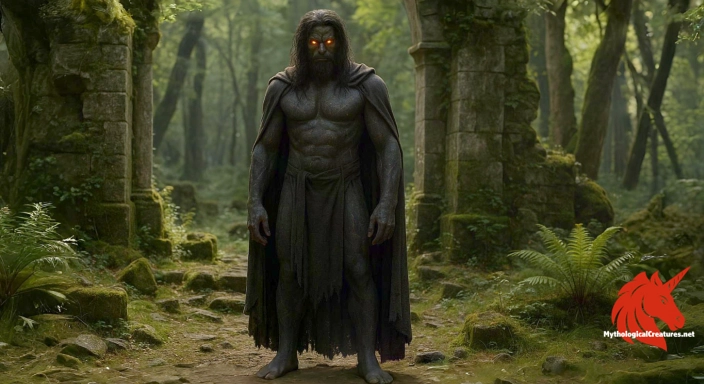
Descriptions of Vassago’s physical form are as fluid and multifaceted as the lore surrounding him. Some traditions depict him as a noble yet spectral figure, whose appearance shifts subtly between human and monstrous qualities. His visage is often said to be marked by an eerie radiance, with eyes that glimmer like distant stars, suggesting the depth of his esoteric knowledge. In artistic renditions, he is sometimes adorned with a crown fashioned from twisted iron and bone, symbolising his authority among infernal beings. Variations in his portrayal include a tall, imposing stature that transcends mortal proportions, radiating a presence that is both captivating and disquieting. Certain accounts describe him with attributes that border on the angelic, such as delicate, translucent wings that contrast sharply with his darker elements. His skin is occasionally noted to bear intricate arcane symbols, reinforcing his identity as a repository of hidden lore. The interplay of light and shadow around his form is a recurrent theme in descriptions, evoking an otherworldly blend of beauty and terror. These varying physical descriptions illustrate the inherent ambiguity of demonic imagery and the power of myth to reinvent itself through different eras and cultural lenses.
Regional Faces
While Vassago’s origins lie in European demonology, his myth has been subject to regional reinterpretations that imbue his character with local colours. In Mediterranean occult traditions, for instance, he is sometimes celebrated as a mediator who bridges the realms of the divine and the infernal, a reflection of the area’s rich lineage of magical practices. Southern European narratives often cast him as a benevolent spirit capable of unearthing lost relics and forecasting events, aligning his image with broader themes of resurrection and renewal. In the British Isles, particularly in Scottish occult lore, his persona has been intertwined with ancient Celtic traditions, where the veil between the natural and supernatural is notably thin. Eastern European adaptations, meanwhile, often merge his characteristics with those of local folklore spirits, leading to hybrid depictions that include both healing and prophetic attributes. These regional variants not only highlight the adaptability of his myth but also underscore the diverse cultural interpretations of power, wisdom, and danger. In many areas, rituals invoking his name are tailored to address local superstitions and concerns, such as the protection against malevolent forces or the search for hidden treasure. Ultimately, the regional adaptations of Vassago’s image serve to enrich his legacy, illustrating how folklore evolves by absorbing and reflecting the values and fears of different communities.
Cultural Parallels
Vassago’s role as a purveyor of hidden wisdom invites comparison with several figures from diverse mythological traditions. Like the trickster gods of ancient lore, he embodies the paradox of enlightenment through chaos, revealing that the path to truth is often fraught with uncertainty. His qualities resonate with those of ancient deities such as Thoth, whose association with knowledge and the occult bridges the gap between divine inspiration and mortal understanding. There are intriguing parallels between his narrative and that of other entities in the Goetic hierarchy, wherein each spirit encapsulates distinct aspects of the mysterious and the forbidden. The duality of his character, straddling benevolence and danger, is reminiscent of figures found in Middle Eastern, African, and Asian mythologies, where beings of light and shadow often coexist. In many cultures, the messenger who brings esoteric information is a recurring motif, underscoring universal human quests for wisdom beyond the tangible. His function as a revealer of lost truths mirrors the archetypal role of seers and oracles found across global mythic traditions. Such comparative analysis not only emphasises the interconnectedness of mythologies worldwide but also highlights recurring themes of chaos, wisdom, and the complex interplay of destiny and free will in human narratives.
Legacy & Modern Evolution
The evolution of Vassago’s myth reflects the broader transformation of demonological imagery from the medieval period to contemporary occult practices. Once confined to the pages of ritualistic grimoires, his depiction has been continuously reimagined to suit the spiritual and cultural landscape of each successive era. During the Renaissance, his figure was reassessed through the lens of humanistic inquiry and artistic expression, often portrayed with an element of tragic nobility. In modern times, the revival of interest in esoteric traditions has seen Vassago emerge not merely as a malevolent demon but as a complex symbol of hidden knowledge and transformative power. His legacy is now interwoven with modern occult and paranormal narratives, where practitioners draw on his reputed abilities to explore the unknown realms of the subconscious. Contemporary literature, film, and digital media have contributed to a dynamic reinterpretation, repurposing his image in a myriad of creative and often subversive ways. This modern legacy is characterised by a nuanced understanding of his myth, one that challenges simplistic categorizations of good versus evil. Scholars, occultists, and enthusiasts continue to debate and reinterpret his role, ensuring that Vassago remains a vibrant and evolving figure within the pantheon of myth and magic.
Interesting Fact
Unlike many demons known solely for malevolence and destruction, Vassago is particularly noted for his ability to reveal secret knowledge and predict future events, making him a unique figure in demonological studies.
Partner with Mythological Creatures
Bring your myth-based world into ours
From game settings to narrative worlds, we work with partners who treat myths with care. Share your project for a potential sponsor slot.
Partner with usQuick Creature Info
Features:
Our Mythic Legendary Rating:

Also Sometimes Known As:
Habitat:
Supernatural Powers:
Abilities:
Behavior:
Lore:
References
Discover Another Mythical Legend You May Not Have Heard Of?
Uncover the mysteries of ancient folklore and expand your knowledge of legendary beings from cultures around the world.
Dare to Meet the Aeacus....
Curated by the Mythological Creatures Team
Series editor: Mythological Creatures Directory
Primary desk: Hellenic & Ancient Mediterranean Desk
(rev. November 2025)