
Venilia: Venilia is a Roman nymph and deity associated with the winds and the sea.
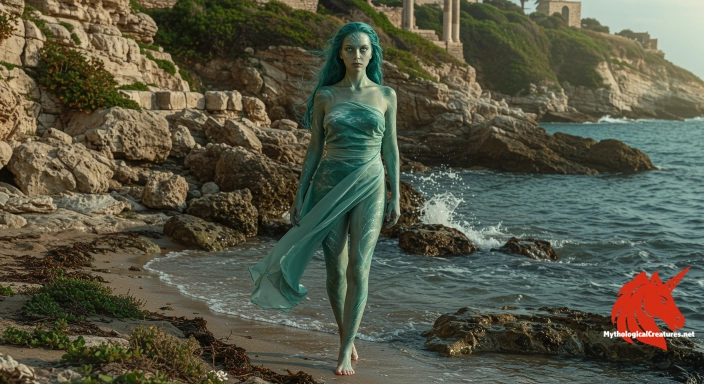
Venilia
Venilia - Venilia represents the vital natural forces of the sea and winds and is invoked in maritime contexts. Her pairing with Salacia as the paredrae of Neptune underlines her importance in the Roman pantheon.
Origins & First Encounters
Venilia is a venerable Roman deity intricately associated with the forces of both wind and sea, embodying the volatile yet life‐giving aspects of nature. Born from the mythic tapestry of ancient Rome, she emerges as a radiant nymph whose story is interwoven with themes of transformation and elemental power. Early literary sources such as those by Virgil and Ovid first brought her multifaceted character to life, situating her at the confluence of maritime mystery and breezy effervescence. Her familial ties further compound her mythos, being the sister of Amata and noted as the wife of either Janus or Faunus, which in turn enriches the narrative of divine interrelations. This network of relationships extends to her offspring, with figures such as Turnus, Juturna, and Canens contributing to the classical understanding of natural forces. The ancient Romans revered her as an emblem of nature’s dual temperament, reflecting both gentle caresses and formidable tempests. A subtle interplay of benevolence and might characterises her presence, symbolising the ever-changing moods of the sea and sky. Over time, her enduring iconography has come to signify the timeless and dynamic interplay between humanity and the natural world. Her legend continues to inspire, bridging classical antiquity and the perennial human fascination with the elemental forces.
Source Texts & Tale Variants
Ancient literary sources contribute richly to the diverse portrait of Venilia, with texts by Virgil and Ovid providing some of the earliest attested narratives of her existence. Multiple versions of her story have survived over time, each embellishing different facets of her character and divine role. Some accounts highlight her identity as a nymph embodying the gentleness of the air and the majesty of the sea, while others overlay more complex mythic attributes. Variations in the tradition place her marital union either with Janus or with Faunus, each version offering a distinct interpretation of her place within the divine family tree. Her offspring—Turnus, Juturna, and Canens—feature in these narratives, adding layers of symbolic meaning that interweave human endeavour with nature’s power. Venilia is also frequently paired with Salacia, a companion who serves as a paredrae to Neptune, thereby linking her directly to the vast domain of the ocean. The multiplicity of her story variants demonstrates not only the richness of Roman myth but also the adaptability of her legend in different cultural and literary contexts. Lesser-known poetic fragments and mosaic depictions further expand her mythic profile, capturing both her serene and tempestuous sides. These primary sources collectively contribute to an evolving narrative that remains a fertile field for mythological interpretation and artistic reinterpretation.
Form & Powers
In artistic and literary renditions, Venilia is often envisioned with an ethereal grace that mirrors the delicate interplay of wind and water. Her hair is depicted as a cascade of flowing locks that ripple like the surf on a gentle shore, evoking the ceaseless motion of both sea and breeze. The imagery frequently lends her an almost luminescent presence, with skin that shimmers subtly in the interplay of light and shadow. Her eyes, deep and reflective, are said to capture the vast mystery of an endless ocean and the shifting hues of the sky. Many portrayals suggest a slender, elegant form that embodies both strength and fragility in perfect balance. Artistic interpretations sometimes adorn her with flowing garments that appear to be woven from the very essence of air and the froth of waves. Small details such as crowns of delicate sea shells or diadems reminiscent of soft cloud formations enhance her otherworldly beauty. Variations in her depiction allow for a range of interpretations, from the tender caress of a summer breeze to the formidable presence of a gathering storm. This fluid aesthetic not only strengthens her association with nature but also ensures that her image remains open to continual artistic reinvention.
Regional Faces
Although Venilia’s origins lie in the heart of Roman myth, her cult and iconography have been adapted by various regions over the centuries. In coastal areas of the ancient Roman world, she was frequently celebrated as an essential deity whose calming influence could tame wild seas and protect seafarers. Local communities often integrated her worship into maritime festivals, where rituals emphasised her role as a guardian of the coastal and aquatic domains. In more inland regions, the emphasis on her association with the wind prevailed, and she was invoked during seasonal changes and agricultural rites. Over time, creative syncretism led some cultures to merge her identity with indigenous water spirits or sylph-like beings, creating a hybrid deity that resonated with local traditions. These adaptations varied in detail, with regional art often depicting her in attire and with accoutrements that reflected local aesthetics. The melding of her myth with native folklore illustrates how her story was flexible enough to encompass both the maritime and aerial aspects of the natural world. Communities adapted her symbolism to address local concerns, ranging from safe navigation to bountiful harvests. In this way, Venilia transcended her original Roman character to become a versatile symbol embraced in diverse cultural landscapes.
Cultural Parallels
Venilia’s character invites comparisons with similar figures across a multitude of mythological traditions, illustrating the universal appeal of deities embodying natural forces. Her dual dominion over wind and sea is echoed in Greek mythology, where deities and nymphs alike capture the capricious and nurturing aspects of nature. Comparable figures appear in various European folklores, where water sprites and air elements are celebrated as vital, life‐affirming presences. In many traditions, a subordinate goddess often accompanies a supreme god, much as Venilia is paired with Neptune’s counterpart Salacia, affirming her role as an essential complement to more towering divine personas. This recurrent motif—of a lesser yet influential deity facilitating the majesty of nature—appears in Celtic and Scandinavian lore through the veneration of local spirits. Despite differences in name and cultural context, the shared imagery of fluidity, grace, and potency cements a bond among these diverse mythic figures. The cross-cultural resonance of her attributes highlights a broader human tendency to personify the unpredictable and life-giving forces of the natural world. Illustrations and poetic descriptions alike serve to underline this interconnection, suggesting that the admiration for nature’s duality is a timeless and borderless sentiment. In this comparative landscape, Venilia stands as a testament to the enduring power and universality of myth throughout human history.
Legacy & Modern Evolution
The myth of Venilia has evolved significantly from its early Roman origins into a symbol with multifaceted modern resonance. Classical literature and art once depicted her as a subtle yet potent embodiment of nature’s creative and destructive forces, a portrayal that resonated with ancient audiences. As centuries passed, her image was reinterpreted by Renaissance artists and later influenced a variety of creative endeavours, ensuring that her myth continued to captivate the imagination. In modern times, her legacy has broadened to include representations in literature, visual arts, and even astronomical nomenclature, with the naming of Venilia Mons on Venus underscoring her timeless allure. Contemporary artistic expressions often highlight the interplay of wind and water as a metaphor for natural balance and renewal, drawing on her ancient symbolism. Her figure has lent inspiration to discussions around environmental conservation, linking the ancient reverence for elemental forces with modern ecological awareness. The adaptive nature of her myth has allowed her to remain relevant amidst shifting cultural and scientific paradigms, proof of the enduring human fascination with the forces that govern our world. Modern reinterpretations often blend classical motifs with current artistic sensibilities, creating rich, hybrid images that reimagine her role. This continuous evolution reflects a dynamic narrative that bridges the past with the present, ensuring that Venilia remains a vibrant emblem in the collective cultural consciousness.
Interesting Fact
An intriguing aspect of Venilia's myth is her dual association with both the winds and the sea, highlighting the interconnectedness of air and water in the natural world and demonstrating how ancient deities continue to influence contemporary culture through astronomical naming conventions.
Limited sponsor opportunity
One slot, carefully chosen partners
We only feature a small number of relevant sponsors at any time. If you create serious myth content, we would like to hear from you.
Partner with usQuick Creature Info
Origin:
Features:
Associations:
Our Mythic Legendary Rating:

Also Sometimes Known As:
Habitat:
Supernatural Powers:
Physical Attributes:
Abilities:
Behavior:
Lore:
Related Creatures, Tales or Lore
- SSalacia
- AAmphitrite
- TThalassa
References
Discover Another Mythical Legend You May Not Have Heard Of?
Uncover the mysteries of ancient folklore and expand your knowledge of legendary beings from cultures around the world.
Dare to Meet the Phantome....
Curated by the Mythological Creatures Team
Series editor: Mythological Creatures Directory
Primary desk: Hellenic & Ancient Mediterranean Desk
(rev. November 2025)