
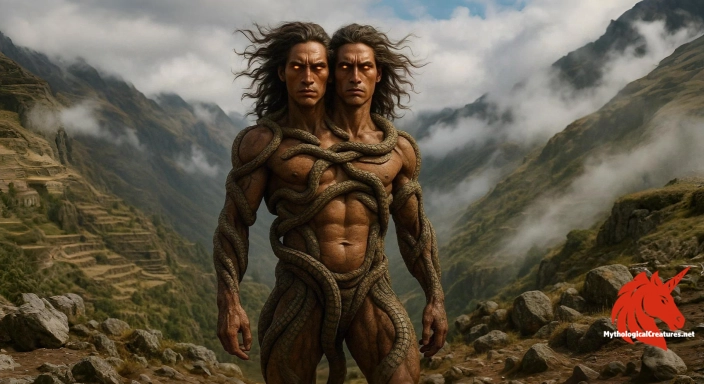
Wayra Tata: Wayra Tata, known as the Father of Wind, is an Andean deity depicted as a two-headed humanoid entwined with serpents.
Wayra Tata
Wayra Tata - A central figure in pre-Columbian Andean belief systems, Wayra Tata governed the wind and rains vital for agriculture and fertility.
Origins & First Encounters
The figure of Wayra Tata captivates with its potent embodiment of elemental forces, reflecting a deep bond between the Andean people and the dramatic natural world. Hailing from the pre-colonial traditions of the Puruhá Quechuas and Aymaras in the high Bolivian and Peruvian Andes, this deity has long been regarded as a pivotal force in local cosmology. His name, meaning 'Father of Wind', encapsulates both the life-giving and destructive powers of nature, a duality that resonated with ancient agricultural cycles. Emerging from rich indigenous practices, his early worship was tightly interwoven with seasonal rituals and ceremonies that honoured the unpredictable moods of the weather. Early attestations of Wayra Tata, though primarily conveyed orally, reveal a complex character revered for invoking both nourishing rains and fierce storms. Rituals dedicated to him often involved communal offerings and symbolic gestures meant to appease and harness his volatile energy. His myth exemplifies the Andean appreciation for balance, where the same deity could be invoked to bless the land or warn of impending calamity. This enduring legacy continues to influence cultural memory, symbolising the delicate dance between creation and destruction intrinsic to the natural world.
Source Texts & Tale Variants
Ancient oral narratives and fragmented colonial accounts provide glimpses into the multifaceted worship of Wayra Tata across the Andean highlands. Diverse versions of his myth have been preserved through the vibrant storytelling traditions of the Puruhá and Aymara communities. Although detailed written records are scarce, early Spanish chroniclers and local scribes noted his dramatic iconography and elemental character. Indigenous artefacts, including ceremonial objects and rock engravings, offer further evidence of his significance in pre-colonial ritual practices. Some accounts portray him strictly as a weather god controlling unpredictable winds and torrential rains, while others hint at a broader symbolic role in the cycles of nature. Ethnographic research has revealed that his narrative was often interlaced with shamanic traditions, where his dual-headed visage was seen as emblematic of spiritual balance. The variations in his myth underscore the adaptability of indigenous lore in the face of external influences and environmental challenges. Over time, these narrative strands have merged, ensuring that the dynamic legend of Wayra Tata remains a vibrant part of Andean cultural heritage. The continued retelling of these stories reinforces his legacy as a deity whose reach extended well beyond the tangible, entering the realm of symbolic cosmic power.
Form & Powers
The iconography of Wayra Tata is marked by a striking human form that is both authoritative and enigmatic, most notably characterised by his two distinct heads. Each head is rendered with a penetrating gaze that seems to reflect the dual nature of the skies—calm and tempestuous. Elaborate serpents wind their way around his entire body, from head to toe, embodying a connection to ancient earth energies and the cyclical nature of life. These serpentine forms, often depicted with intricate detailing, serve as symbols of both regeneration and latent danger. The god’s robust physique is interlaced with graceful elements that suggest an elegant fluidity inherent in the movement of the wind. In many traditional portrayals, he is adorned with embellishments reminiscent of intricate Andean textile designs, where vibrant colours and geometric patterns enhance his supernatural presence. His outstretched limbs evoke the expansive reach of a force that commands both the atmosphere and the natural order. The dual-headed form introduces a powerful metaphor for the balance of opposing forces, while the coiled serpents underscore themes of rebirth and continuity. Overall, the vivid imagery employed in his depictions remains a testament to the intricate relationship between human perception and the elemental world.
Regional Faces
Depictions of Wayra Tata vary significantly across the Andean region, each reflecting the local environment and cultural nuances of the highland communities. In some areas, his image is portrayed with a formidable intensity that underscores the destructive power of gale-force winds prevalent in mountainous terrains. Other traditions emphasise his benevolent side, casting him as a guardian deity whose timely rains assured fertile harvests and sustained life. Local festivals and rituals in diverse regions harness unique symbolic elements, from distinctive colour palettes to indigenous patterns, that add a personal touch to his myth. In certain Bolivian communities, his depiction is interwoven with shamanistic elements, where his power is invoked to heal or to balance nature’s extremes. Peruvian adaptations sometimes present him as a mediator between the human world and the spiritual realm, reflecting a deep-seated belief in the interconnectedness of all natural forces. The interpretation of his dual-headed form also differs regionally, with some communities accentuating a clear division between creative and destructive energies, while others embrace a more holistic unity. These regional variations not only enrich the narrative of Wayra Tata but also highlight how local experiences of nature shape the evolution of myth. Such diversity in representation reveals the flexibility and resilience of indigenous myths in surviving the test of time and external influence.
Cultural Parallels
Wayra Tata’s dominion over wind and rain finds a striking parallel in various mythological traditions across the globe. Much like Aeolus in Greek mythology, who held sway over the capricious winds, Wayra Tata embodies the unpredictable nature of the atmospheric realm. His dual-headed portrayal resonates with comparative themes of duality found in many cultural narratives, embodying both creative and destructive forces. Similar figures appear in other indigenous mythologies, where deities represent the interconnectedness of natural elements and the balance necessary for life. The serpentine imagery that surrounds him echoes symbols commonly found in Mesoamerican and Pacific traditions, where snakes often represent wisdom, renewal, and the cyclical nature of life. This confluence of features has prompted comparisons with other wind deities who are celebrated both for their benevolence and their capacity to unleash chaos. The universal human effort to personify the untamed forces of nature is evident in Wayra Tata’s myth, bridging geographical and cultural divides. In this light, his narrative shares a kinship with stories of natural gods from diverse societies, reflecting a shared understanding of nature’s dualistic qualities. Such cross-cultural connections underscore the timeless appeal of myths that seek to explain and personify the elemental world.
Legacy & Modern Evolution
The enduring myth of Wayra Tata has experienced significant transformation from its pre-colonial origins to its modern reimaginings. Initially, his worship was intimately connected with agrarian cycles and the unpredictable moods of the weather in the Andean highlands. Despite the disruptive impact of European colonisation, key elements of his character survived, thanks in large part to the resilience of indigenous cultural practices. In recent decades, there has been a notable revival in interest, with artists and cultural practitioners reinterpreting his legacy in a contemporary context. Modern depictions often merge traditional symbols with new artistic expressions, reflecting a society that honours its ancient roots while embracing modern aesthetics. The adoption of his name by high-performance sports cars, such as the Huayra Pronello Ford and the Pagani Huayra, is a testament to his enduring association with speed, power, and an untamed force of nature. His evolving image has also been utilised in cultural festivals and academic discourses, reinforcing his relevance to discussions about environmental harmony and indigenous identity. As modern communities seek to reconnect with their ancestral heritage, Wayra Tata stands as a potent symbol of nature’s eternal and dynamic spirit. His storied past, replete with layers of myth, ritual, and artistic reinterpretation, continues to inspire a dialogue between the ancient and the modern, reminding all of the ever-present power of the natural world.
Interesting Fact
The modern sports cars, including the Pagani Huayra and the Huayra Pronello Ford, pay homage to Wayra Tata, highlighting how his ancient mythological legacy continues to inspire innovation.
Support the directory
Promote your myth project and fund more research
Sponsor placements help keep this directory growing and free to use while giving your work a focused, relevant audience.
Learn how sponsorship worksQuick Creature Info
Origin:
Features:
Associations:
Our Mythic Legendary Rating:

Also Sometimes Known As:
Habitat:
Supernatural Powers:
Physical Attributes:
Abilities:
Behavior:
Lore:
References
Discover Another Mythical Legend You May Not Have Heard Of?
Uncover the mysteries of ancient folklore and expand your knowledge of legendary beings from cultures around the world.
Dare to Meet the Ypotryll....
Curated by the Mythological Creatures Team
Series editor: Mythological Creatures Directory
Primary desk: Americas & Indigenous Traditions Desk
(rev. November 2025)