
White dragon: The white dragon, known in Welsh as Y Ddraig Wen, is a mythological dragon steeped in symbolism.
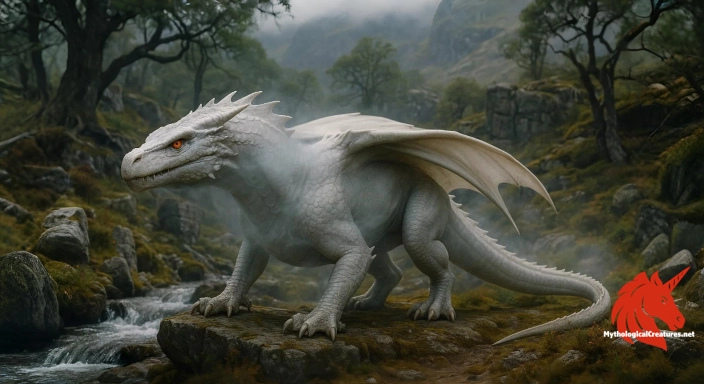
White dragon
White dragon - The white dragon stands in stark contrast to the native red dragon, symbolizing historical and mythological conflicts in Britain.
Origins & First Encounters
The white dragon occupies a significant position in Welsh myth, emerging as a potent symbol of the Anglo-Saxon presence during turbulent historical eras. Its very name, Y Ddraig Wen, invokes images of a majestic creature whose origins are intertwined with longstanding cultural conflicts. Early narratives imbued the dragon with an aura of mystery, representing foreign influences that challenged indigenous traditions. Over time, storytellers used its image to encapsulate the struggle between native Britons and invading forces. The white dragon was not merely a mythical beast but a visual metaphor reflecting the complexities of identity and resistance. Its earliest attestations appear in medieval traditions where symbolism and allegory often merged in striking ways. As the dragon’s legend evolved, it came to represent both menace and transformation within the cultural narrative. The lore surrounding the creature captures the dynamic interplay of power, myth, and history, endowing it with a timeless quality that continues to fascinate. Its ambiguous role as an emblem of both danger and renewal contributes to its enduring status in the mythic imagination. Even today, the white dragon's legendary presence provokes reflection on the impact of historical change and cultural convergence.
Source Texts & Tale Variants
Ancient manuscripts and medieval chronicles hint at the multifaceted origins of the white dragon within the rich tapestry of Welsh mythology. Various texts, though fragmentary, portray the creature as a symbol linked with foreign forces, often contrasting it with more celebratory native emblems. Multiple story variants circulate in tradition, some depicting the dragon as an omen foretelling shifts in power and others as an allegorical representation of cultural displacement. Oral traditions preserved in bardic verses add layers of nuance, each narrative adapting the beast’s character to reflect local historical experiences. Some accounts elevate the white dragon’s role to that of a spectral adversary whose emergence signals both the onset of conflict and the possibility of renewal. The diversity of these sources underscores the flexible symbolism of the dragon, allowing it to be reinterpreted across generations. In certain medieval retellings, the white dragon appears as part of a dualistic myth structure that juxtaposes native and foreign elements. Even as the majority of surviving documents focus on other legendary creatures, the story of the white dragon remains subtly interwoven into the cultural fabric. This multiplicity of versions reflects the evolving nature of myth, where narrative and iconography adapt to shifting historical circumstances. The enduring appeal of these sources lies in their capacity to evoke a sense of mystery and cultural continuity.
Form & Powers
The white dragon is frequently envisioned as an imposing creature with a sinuous, elongated body covered in luminous, alabaster scales. Its head, often portrayed with keen, penetrating eyes, bespeaks an intelligence that is as formidable as it is enigmatic. Artists and storytellers alike have depicted the dragon with expansive, tattered wings that suggest both its capacity for flight and its role as a harbinger of change. The radiance of its white exterior is sometimes described as having an ethereal glow, casting subtle reflections that enhance its mysterious allure. Its powerful limbs, adorned with razor-like claws, contribute to an image of a beast capable of both beauty and brutality. Variations in artistic renditions sometimes include a spiked tail and other accentuating features such as hints of silver along its form. Each detail is crafted to underscore not only the creature’s physical prowess but also its symbolic significance as a mark of foreign intrusion. The white dragon’s size is rendered with grandiosity in many accounts, ensuring that its appearance is both awe-inspiring and intimidating. This careful blend of aesthetic grace and latent menace makes the creature’s physical portrayal rich in metaphor. Every scale and every line of its physique is laden with meaning, melding natural wonder with the allegory of invasion and transformation.
Regional Faces
In different regional traditions, the white dragon assumes varied forms that mirror local histories and cultural tensions. Within Welsh lore, it is often set in stark contrast to the more familiar red dragon, with the white version symbolising an external, often adversarial force. In areas influenced by the migrations and settlements of the Anglo-Saxons, its depiction emphasises qualities of alienation and the intrusion of unfamiliar power. Local accounts sometimes imbue the creature with a sense of tragic nobility, portraying it as an exile whose presence underscores the clash between native and invader. Borderland traditions elevate the dragon into roles that intersect with both myth and the everyday, casting it as an omen of change in times of social upheaval. Some regions incorporate the white dragon into broader narratives involving cosmic battles or supernatural encounters, which elevates its mythic stature. The creature’s depiction can differ considerably, with some communities viewing it as part of a dualistic struggle while others see it as a singular emblem of dislocation. These regional variations highlight the adaptive nature of myth, as the white dragon's attributes morph to reflect distinct local experiences. Despite these differences, a recurring theme persists—the use of the white dragon as a mirror reflecting the impact of foreign influence on indigenous culture. Its shifting portrayals serve to reinforce regional identities and the nuanced stories of historical conflict.
Cultural Parallels
When placed alongside similar creatures from other mythologies, the white dragon offers a compelling study in contrast and comparison. Much like many Eastern dragons, which are often seen as auspicious protectors, its Western counterpart is shadowed by the weight of invasion and cultural estrangement. In European lore, dragons typically epitomise chaos and formidable power, a motif that the white dragon mirrors with its association with the Anglo-Saxon incursions. Similar mythic beasts in Norse traditions also embody the duality of destruction and transformation, further enhancing the white dragon’s role as both a harbinger and a symbol of change. Comparative narratives reveal that while many dragons personify natural forces or spiritual guardianship, the white dragon occupies a space defined by its political and cultural connotations. Its story, in many respects, underscores the universality of the dragon motif across diverse cultures while highlighting specific local interpretations. In some traditions, dragons serve as emblems of wisdom or divinity, yet the white dragon’s legacy is marked by the burdens of historical conflict. Cross-cultural analysis shows that the symbolism of dragons often adapts to the historical and societal contexts of each community. The thematic overlap with dragons in other cultures illuminates common archetypal elements—rebirth, duality, and the liminality between order and chaos. Such comparative insights reveal how the white dragon is both a unique product of its region and part of a broader mythological tapestry.
Legacy & Modern Evolution
The historical evolution of the white dragon narrative mirrors the shifting dynamics of power and identity through the ages. In the early medieval period, it functioned as a stark emblem of foreign influence and the turbulence that accompanied cultural upheaval. As centuries passed, interpretations of the creature evolved, gradually shifting from a literal beast into a rich symbol of political and cultural contestation. The renaissance of interest in myth led to a reimagining of its persona, blending ancient allegory with emerging nationalistic sentiments. In modern times, the white dragon is revived in literature and visual arts, often portrayed with layers of irony and complex symbolism. Contemporary renditions frequently explore themes of transformation, representing the tension between heritage and the forces of change. The creature’s image has been adapted to reflect current dialogues on migration, cultural exchange, and identity politics. It continues to inspire creators who use the dragon as a metaphor to discuss historical memory and the impact of external influences. The enduring legacy of the white dragon lies in its ability to resonate across time, remaining relevant in both academic and popular discourse. Its mythic journey underscores how traditional symbols can evolve to articulate modern concerns about difference, power, and resilience. Through art, literature, and heraldic usage, the white dragon maintains a potent presence as a reminder of the perpetual interplay between myth and history. Thus, its modern legacy stands as a testament to the timeless power of myth to influence cultural narrative and identity.
Interesting Fact
An intriguing aspect of the white dragon is its role as a symbolic representation of foreign influence, starkly contrasting with the red dragon’s embodiment of Welsh identity.
Sponsor this space
Tasteful, fixed-fee placements for myth projects
No bidding wars or flashing banners. We offer simple placements for a small set of creators and brands aligned with our readers.
Request further detailsQuick Creature Info
Associations:
Our Mythic Legendary Rating:

Also Sometimes Known As:
Habitat:
Supernatural Powers:
Physical Attributes:
Abilities:
Behavior:
Lore:
Related Creatures, Tales or Lore
- RRed Dragon
- WWyvern
- EEuropean Dragon
References
Discover Another Mythical Legend You May Not Have Heard Of?
Uncover the mysteries of ancient folklore and expand your knowledge of legendary beings from cultures around the world.
Dare to Meet the Fulla....
Curated by the Mythological Creatures Team
Series editor: Mythological Creatures Directory
Primary desk: Northern & European Folklore Desk
(rev. November 2025)