
Yacumama: Yacumama is an enormous aquatic serpent from the Amazon Rainforest renowned as the 'Mother of Water.
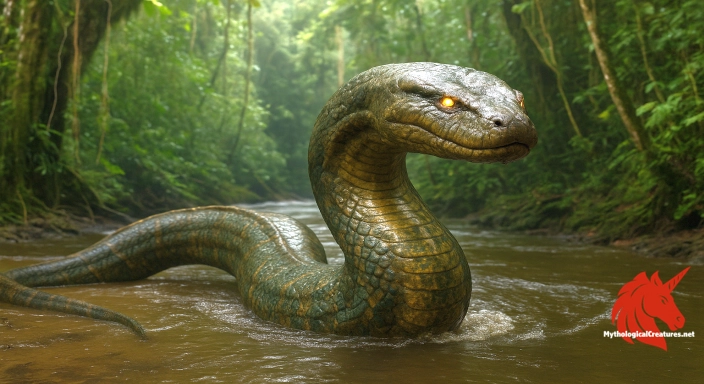
Yacumama
Yacumama - Embodies both the life-giving and destructive power of water, symbolising the dual nature of the Amazon’s aquatic realm.
Origins & First Encounters
Yacumama is a legendary, colossal aquatic serpent whose origins are steeped in the mysteries of the Amazon Rainforest. This creature draws its name from the Quechua words 'yaku' and 'mama', meaning water and mother respectively, which underscores its revered role as the progenitor of all aquatic life. Its earliest attestations are found in the oral traditions of indigenous communities, where elders passed down vivid tales of its awe-inspiring presence. Embedded in these stories is an intricate blend of respect, fear, and wonder that reflects the unpredictable power of nature. Many locals believe that the creature governs the flow of rivers and the health of the surrounding ecosystems, intertwining natural phenomena with spiritual beliefs. The myth of Yacumama has long served as both a cautionary tale and a celebration of life's central connection to water. Its storied presence reinforces the intimate relationship between the environment and the cultural identity of the Amazon peoples. Over time, the legend has come to symbolise nature’s dual capacity to nurture and to threaten. As a timeless emblem of the watery depths, Yacumama continues to captivate the imagination of both local communities and those exploring the wider realms of myth.
Source Texts & Tale Variants
Ancient oral accounts from the indigenous peoples of the Amazon constitute the primary wellspring of the Yacumama legend, preserving its details through generations. Written records by early colonial observers also mention its enigmatic presence, although these reports often reflect the biases of European chroniclers. Variants of the tale have emerged over time, with some versions portraying Yacumama as a benevolent guardian while others emphasise its fearsome and destructive nature. Many narratives suggest that the creature can sense the presence of living beings, drawing a sharp boundary between the sacred and the mundane. Some traditions state that the sound of a conch horn can prompt the serpent to announce its presence, adding an auditory element to the myth. These diverse streams of storytelling have been captured in both regional folklore compilations and modern anthologies. The multiplicity of accounts demonstrates a deep-seated cultural resonance with water as a life-giving yet unpredictable force. Subtle differences in these tales mirror the varied environmental contexts of the Amazon basin, from swift rivers to tranquil lakes. As a result, the story of Yacumama remains a vibrant tapestry woven from centuries of narrative evolution.
Form & Powers
Descriptions of Yacumama evoke the image of an immense, sinuous serpent gliding through the murky waters of the jungle. Its body is often depicted as being covered in scales that shimmer with hues of silver and green, reminiscent of liquid reflections on a flowing river. The creature’s form is said to undulate with a grace that belies its formidable size, suggesting both fluidity and latent power. Many accounts mention eyes that glow with a mysterious luminescence, hinting at ancient wisdom and a supernatural alertness to its surroundings. Observers describe a vast, elongated jaw armed with rows of teeth, capable of capturing any creature that comes too close. Intricate patterns are frequently noted on its skin, patterns that seem to echo the natural flow of water channels throughout the rainforest. Some variants even note the presence of subtle fins or ridges along its back, which enhance its aquatic appearance. These detailed portrayals vary in their specifics, yet consistently evoke the image of a being both majestic and intimidating. The overall depiction of Yacumama thus remains a powerful blend of beauty, danger, and mystery, perfectly attuned to the wild waters it inhabits.
Regional Faces
Across the vast Amazon basin, the legend of Yacumama adapts to the distinct cultural and environmental nuances found in different regions. In certain Peruvian communities, the creature is regarded as a gentle guardian whose presence brings fertility and balance to the waterways. Conversely, some Ecuadorian villages recount tales of a darker, more formidable version that presages natural calamities such as floods. In regions of Brazil, local lore often intertwines Yacumama with other water deities, merging multiple mythic elements into a singular powerful spirit. These regional variations can be seen in the differences in physical descriptions, with some accounts portraying it with iridescent, colourful scales and others as a shadowy, almost spectral entity. Local storytelling often ties the serpent’s appearance to seasonal changes, emphasizing its role in the cyclical patterns of nature. The creature is sometimes even linked with agricultural rituals, where its presence is invoked to ensure the prosperity of crops reliant on river water. These adaptations not only reflect the diverse ecological settings of the Amazon, but also the rich tapestry of indigenous belief systems. Ultimately, Yacumama serves as a dynamic symbol whose traits are continuously reshaped by the people who live under its legendary shadow.
Cultural Parallels
Yacumama shares thematic resonances with numerous mythological aquatic serpents from various cultures around the world. Much like the Nāga of Southeast Asian lore, it embodies a dual nature of benevolence and menace linked to the mysteries of water. Its portrayal is reminiscent of European sea serpents and dragons, where vast, sinuous forms capture the imagination with both awe and trepidation. Similar to the tales of Mami Wata in African and Caribbean traditions, the legend underscores the fluid boundary between the natural world and the spirit realm. Cross-cultural comparisons reveal that many ancient societies used serpentine figures to personify the primal power of water, a force capable of both creation and destruction. The recurrent motif of water as a life-giving yet unpredictable element unites these legends, offering insights into humanity’s long-standing fascination with the natural world. While Yacumama holds a distinctly Amazonian identity, its thematic parallels with global myths highlight universal human experiences. The interplay between nurture and danger, ever-present in water-based symbolism, is a common thread that reinforces these cross-cultural connections. Through such comparative analysis, Yacumama is seen not only as a local myth but also as part of a broader, shared legacy of water deities and mythical serpents.
Legacy & Modern Evolution
The evolution of the Yacumama myth spans from its ancient oral traditions to its prominent role in modern cultural dialogues. In early narratives, the creature’s tale was deeply interwoven with the everyday lives and spiritual practices of indigenous peoples, directly reflecting a symbiotic relationship with the natural environment. As colonial encounters and modern scholarly interests emerged, these oral accounts were gradually recorded, lending the myth an enduring documented presence. Over the centuries, interpretations of Yacumama have expanded, with contemporary storytellers and artists reimagining it as a symbol of environmental fragility and respect for nature. The creature is now often invoked in discussions about the conservation of the Amazon, highlighting the balance between human activity and natural ecosystems. Modern representations in literature, film, and visual arts have enriched its mystique, merging traditional iconography with contemporary environmental concerns. The enduring appeal of Yacumama illustrates how myth adapts to reflect societal challenges and changing worldviews. Today, the legacy of this mighty water serpent serves as both a reminder of the ancient wisdom held by native cultures and a poignant call to protect one of the world's most vital natural habitats. In this way, Yacumama continues to inspire a renewed reverence for nature and the enduring power of myth in the modern era.
Interesting Fact
An intriguing aspect of Yacumama is how indigenous practices, such as blowing a conch horn before entering the water, demonstrate a deep cultural ritual intertwined with the natural phenomenon of this legendary serpent.
Partner with Mythological Creatures
Bring your myth-based world into ours
From game settings to narrative worlds, we work with partners who treat myths with care. Share your project for a potential sponsor slot.
Partner with usQuick Creature Info
Origin:
Features:
Associations:
Our Mythic Legendary Rating:

Also Sometimes Known As:
Habitat:
Supernatural Powers:
Physical Attributes:
Abilities:
Behavior:
Lore:
References
Discover Another Mythical Legend You May Not Have Heard Of?
Uncover the mysteries of ancient folklore and expand your knowledge of legendary beings from cultures around the world.
Dare to Meet the Angel....
Curated by the Mythological Creatures Team
Series editor: Mythological Creatures Directory
Primary desk: Americas & Indigenous Traditions Desk
(rev. November 2025)