
Zacatzontli: Zacatzontli is an Aztec god of the day road, serving as a divine protector of merchants and travelers.
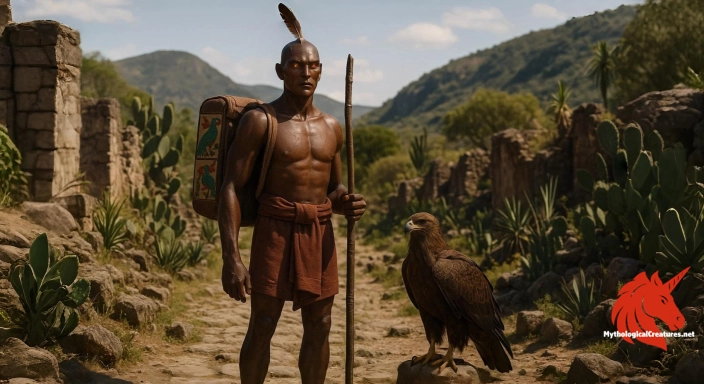
Zacatzontli
Zacatzontli - Represents the safe passage and divine protection of merchants and travelers along sacred roads in Aztec society.
How did Zacatzontli enter folklore?
Zacatzontli emerges as a striking and enigmatic figure within the Aztec pantheon, emblematic of the sacred journey that unites sky and earth. His role as the god of the day road underscores the profound cultural emphasis on movement, the passage of time, and the interconnection of travel with divine favour. He appears to have been venerated from the early eras of Aztec civilization, with his name—often interpreted as 'Lord of the Road'—encapsulating both authority and guidance. His association with the sun and the clear blue skies reflects a symbolic alignment with the beginning of each day and the promise of safe passage. The deity’s mythology weaves together themes of commerce, travel, and cosmic order, endowing ordinary journeys with spiritual significance. His depiction as a protector of merchants situates him at the heart of economic and social life, where each journey becomes a pilgrimage under divine watch. Artistic and ritual expressions of his image reveal a god who is as much a guardian of practical endeavours as he is a symbol of the celestial order. The enduring reverence for Zacatzontli highlights the Aztec belief in a world where the divine and the mundane are intricately interlaced. His myth continues to resonate through cultural memory, embodying the timeless human need for guidance along life’s ongoing road.
Zacatzontli: How the Tale Was Told and Retold
The ancient codices and temple murals that reference Zacatzontli provide a rich, albeit fragmentary, tapestry of his significance in Aztec belief systems. Various manuscripts from the pre-Columbian period capture his essence through symbolic imagery, including his distinctive staff and the backpack filled with quetzals. Narratives preserved by indigenous chroniclers portray him as an ever-present guide, whose imagery was meticulously recorded through a combination of art and oral tradition. Diverse story variants detail his protective interventions along treacherous routes, thus cementing his status as a patron of commerce and safe travel. Certain historical documents suggest that he was closely examined in ritual practices designed to secure prosperous journeys. The thematic recurrences seen in these sources underscore his importance as both a celestial navigator and a benefactor to merchants. Multiple regional accounts, though varying slightly in detail, converge on the depiction of Zacatzontli as a deity whose symbols always evoke movement and transformation. The survival of these narratives, through both written and oral forms, testifies to the deific role he played in the everyday lives of the Aztec people. Over centuries, these primary texts have become invaluable in reconstructing the layered mythos of a god who guided not only bodies, but also souls, along the day road.
Zacatzontli: Physical Form and Supernatural Powers
Zacatzontli is often depicted with a vivid iconography that sets him apart from more traditional Aztec deities. In artistic renditions, his left hand clutches a sturdy staff, emblematic of authority and the measured progression along the sacred road. His right hand is portrayed as bearing a backpack teeming with resplendent quetzals, each bird symbolising life, beauty, and the prosperity of commerce. A singular feather, rather than an elaborate headdress, adorns his head, marking him as unique among his peers and enhancing his mystical allure. The presence of an eagle motif, representing the sun’s brilliant guide, lends an air of celestial vigilance to his figure. His form is rendered with human-like traits, yet it is imbued with otherworldly embellishments that speak to divine energy. The interplay of light and shadow in many depictions further alludes to his role in bridging the earthly realm with cosmic forces. Each detail—from the finely carved staff to the delicate arrangement of quetzal feathers—reinforces the message of a deity who is both protector and guide. The careful integration of these symbols in his physical representation highlights a balanced fusion of power, grace, and the inherent beauty of the natural world.
What do different regions call Zacatzontli?
Across different regions of Mesoamerica, the portrayal of Zacatzontli exhibits fascinating variations that reflect local cultural priorities and environmental influences. In central Mexican territories, where Aztec traditions held strong sway, his imagery remains closely aligned with canonical depictions, emphasising the disciplined order of the day road. Peripheral communities, however, have adapted his iconography to incorporate indigenous elements such as regional feather designs and motifs inspired by local wildlife. In some areas, additional symbols—drawn from the surrounding natural landscape—are integrated, thus tailoring his image to the specific needs and experiences of local merchants and travellers. Such modifications often include unique artistic flourishes that enhance his guiding role and incorporate motifs symbolising local prosperity. The variations in his depiction speak to a broader cultural dialogue, wherein the central myth is continually reinterpreted by diverse groups. These regional adaptations demonstrate the fluidity of myth and the manner in which the divine is reshaped to mirror local realities. As communities adapted his story to their own contexts, Zacatzontli became not just a deity of the overarching Aztec cosmos but also a familiar guardian intimately connected to local traditions. The adaptability of his image across regions underscores his enduring appeal and the dynamic evolution of Mesoamerican mythological narratives.
Zacatzontli: Related Figures Across Cultures
The attributes of Zacatzontli invite a rich comparative analysis with similar deities in both neighbouring and distant cultures. His role as a protector of merchants and traveller is mirrored in the Mayan god Ek Chuáj, with both figures embodying the fusion of commerce and divine oversight. Drawing broader parallels, one may observe echoes of this dual guardianship in figures such as the Greek Hermes, who similarly presided over trade and safe passage. While the mediums and symbols differ, the fundamental need to safeguard journeys—be they physical or spiritual—resonates across these mythologies. Zacatzontli’s utilisation of natural elements, such as the eagle and quetzals, sets a distinctive tone that is both regionally specific and universally recognisable. Each culture’s vision of a travel deity underscores the human imperative to find guidance in the vast uncertainties of journeying. Cross-cultural examination reveals that while iconographic details may be uniquely adapted, the underlying symbolism of safe passage and economic prosperity remains a common thread. The shared motif of protection during travel bridges geographical and temporal divides, revealing how ancient societies sought to impose order upon the chaos of movement. In this manner, Zacatzontli stands as a testament to the universal archetype of the guardian of the road, harmonising the disparate elements of commerce, nature, and the divine.
Zacatzontli: Then and Now
The legacy of Zacatzontli has evolved remarkably from its ancient roots into a modern emblem of cultural pride and resilience. Early depictions carved in temples and immortalised in codices have inspired contemporary artists and cultural practitioners to reimagine his image within modern contexts. His distinctive symbols, notably the singular feather and the quetzal-laden backpack, have transcended their original ritualistic meanings, becoming potent signifiers of indigenous heritage and identity. Modern reinterpretations often cast him as a guardian not only of physical traders but also of the intangible journeys of community and tradition. Festivals, public art installations, and cultural narratives continue to celebrate his role in bridging the celestial and the earthly. His evolving portrayal speaks to a broader renaissance of respect for pre-Hispanic traditions and the arts of Mesoamerica. As new generations reclaim these ancient narratives, Zacatzontli’s image fosters a renewed connection with the past while inspiring hope for the future. His myth serves as a reminder of the enduring human reliance on guidance and protection along life’s ever-changing road. In modern cultural discourse, he is celebrated as a symbol of perseverance, resourcefulness, and the profound intersection between nature and civilisation.
Interesting Fact
An intriguing aspect of Zacatzontli is his deliberate lack of a conventional headdress, replaced instead by a singular feather which accentuates his unique identity and focus on the road ahead.
Sponsor this space
Tasteful, fixed-fee placements for myth projects
No bidding wars or flashing banners. We offer simple placements for a small set of creators and brands aligned with our readers.
Request further detailsQuick Creature Info
Origin:
Features:
Associations:
Our Mythic Legendary Rating:

Also Sometimes Known As:
Habitat:
Supernatural Powers:
Physical Attributes:
Abilities:
Behavior:
Lore:
Related Creatures, Tales or Lore
- EEk Chuáj
- QQuetzalcoatl
- TTlahuizcalpantecuhtli
References
Discover Another Mythical Legend You May Not Have Heard Of?
Uncover the mysteries of ancient folklore and expand your knowledge of legendary beings from cultures around the world.
Dare to Meet the Dilang....
Curated by the Mythological Creatures Team
Series editor: Mythological Creatures Directory
Primary desk: Americas & Indigenous Traditions Desk
(rev. November 2025)