
Adrammelech: Adrammelech is an ancient Semitic god mentioned in the Hebrew Bible, recognised as the deity of Sepharvaim.
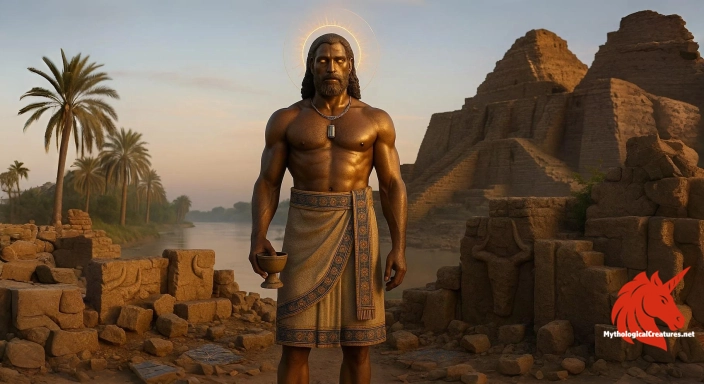
Adrammelech
Adrammelech - Represents the divine kingship and local religious practices of the ancient twin cities, reflecting the syncretism between Semitic and Mesopotamian cultures.
Origins & First Encounters
Adrammelech emerges as a formidable figure among ancient Semitic deities, his very name resonating with regality as it translates to 'Magnificent King'. Voluminous records, though few in extent, attest to his role as a divine overseer connected to the twin sanctuaries of Sepharvaim. The brief reference in the Book of Kings hints at a complex identity layered with both political and religious authority. His origins, deeply embedded within the milieu of Mesopotamian civilisation, evoke images of potent guardianship and celestial kingship. Many believe he epitomised the synthesis of urban splendour and the enigmatic forces of nature. A closer look at his background suggests that early worship may have intertwined elements of solar symbolism with royal power. His initial attestation, firmly placed within a biblical context, also spurred subsequent reinterpretations across diverse cultural traditions. The interplay between his divine sovereignty and the earthly realm amplifies the aura of mystery surrounding his legacy. His presence, though fleeting in written accounts, speaks volumes about the intricate tapestry of ancient spiritual and political life.
Source Texts & Tale Variants
The primary evidence for Adrammelech is found in ancient texts like the Hebrew Bible, where his name is mentioned amid the pantheon of deities associated with Sepharvaim. Additional remnants from the wider Near Eastern tradition, including fragmented inscriptions and oral accounts, enrich his narrative with tantalising possibilities. Various versions of his lore appear in texts that have been reinterpreted over time, sometimes linking him to local guardianship of prominent urban centres. Some traditions portray him not only as a deity of cities but also as a patron of cosmic order, suggesting a layered significance in ritual practices. Hellenistic reinterpretations have occasionally merged his character with similar divine archetypes, thereby expanding his mythological boundaries. Later Jewish mysticism reassembled his identity, often casting him in roles far beyond his original context. Disparate accounts and loose allegorical references have allowed storytellers to adapt his symbolism for different eras. Although the canonical descriptions are brief, these multifaceted sources have generated a rich spectrum of story variants that continue to intrigue scholars. The cumulative evidence from ancient texts and folklore has thus woven a diverse narrative that transcends strictly biblical confines.
Form & Powers
While explicit physical descriptions of Adrammelech are sparse in the ancient records, artistic interpretations have filled the gap with imaginative elaboration. He is frequently envisioned as a towering figure, his stature amplified by an almost otherworldly presence. In some depictions, he bears the regal accoutrements of a king, such as a distinguished crown and a sceptre that symbolises his mighty authority. The interplay between human and divine aspects is often highlighted by a luminous aura, suggesting cosmic energy suffusing his form. Intriguing iconography sometimes introduces elements like stylised wings or horned motifs, hinting at a connection to universal forces. The duality implicit in his association with twin cities has inspired some artists to render him with paired features or mirrored aspects. Variations across regions have led to portrayals that range from a fierce warrior-like presence to that of a dignified celestial monarch. The blend of anthropomorphic and mythic elements in his depictions underscores the rich imaginative legacy surrounding his character. Despite the limited scripted details, these imaginative portrayals continue to offer insight into the ancient ideal of divine magnificence.
Regional Faces
Across the ancient Near East, the character of Adrammelech underwent fascinating regional adaptations that highlight the interplay of local cultural influences. In the cities along the Euphrates, particularly around the twin centres believed to correspond to Sepharvaim, he was often portrayed as a guardian deity with strong ties to civic identity. Mesopotamian interpretations imbued him with attributes reminiscent of other local gods, aligning his persona with both imperial power and cosmic regulation. In contrast, later adaptations within Jewish traditions refashioned his image into a more enigmatic figure, at times even associated with infernal realms. Variations in iconography across regions have reflected distinct aesthetic and religious sensibilities, ranging from elaborate regalia to more austere, mystically charged representations. Local myths sometimes imbue him with a dual aspect, echoing the twin nature of his associated cities, which underscores the importance of symmetry in ancient symbolism. Communities residing on the fringes of the Mesopotamian heartland often employed his cult as a marker of both protection and divine favour. The enduring regional diversity in his depictions speaks to a broader pattern of cultural exchange and adaptation across ancient societies.
Cultural Parallels
Adrammelech’s complex identity invites comparisons to other deities who occupy liminal spaces between divine majesty and earthly rule. His attributes echo those of Mesopotamian luminaries like Marduk and Assur, for whom kingship and cosmic order were deeply intertwined. Similar to the way Greek mythology reimagined Zeus as both a supreme deity and a symbol of natural law, Adrammelech’s legacy reflects the venerable archetype of a celestial king. Cross-cultural parallels can also be drawn with Canaanite gods whose dual natures expressed both benevolence and an almost fearsome authority. His evolution from an obscure mention in sacred texts to a figure later absorbed into demonological hierarchies is reminiscent of shifts seen in other ancient deific traditions. In some modern interpretations, his image is aligned with the archetype of the fallen or transformed god, thereby highlighting a pattern observed in the reinterpretation of ancient divinities. Comparative analysis reveals that his role was not static, but rather fluid and responsive to the retelling by varying cultures over the centuries. This blend of similarity and singularity ensures that Adrammelech remains a compelling study in the evolution of myth across different traditions.
Legacy & Modern Evolution
The historical evolution of Adrammelech is as layered and complex as the regions from which his myth emerged. Early references painted him as a potent symbol of sovereignty in ancient Mesopotamia, a facet that was gradually recontextualised through successive cultural and religious lenses. Over time, changes in political and social structures facilitated his transformation from a revered god to a more ambiguous, sometimes even demonic, figure in later literature. Modern scholarship has revived interest in his original context, prompting a re-examination of his significance in rituals and cosmology. Artistic representations throughout the medieval and renaissance periods began to merge his identity with broader archetypal images of divine kingship and infernal power. Today, he is often rediscovered in academic discourse and reimagined in contemporary literature and visual arts as a symbol of ancient mystery and transcultural resonance. His legacy, replete with reinterpretation and adaptation, mirrors the dynamic nature of myth-making across time. New artistic and scholarly endeavours continue to explore the delicate balance between divinity and mortality encapsulated in his persona. Thus, Adrammelech endures as a testament to the mutable boundaries between myth, history, and cultural memory.
Interesting Fact
Adrammelech is notably linked with the duality of Sepharvaim, reflecting an ancient tradition of duality in divine representation and the regional significance of twin city-states.
Advertising opportunity
Showcase your mythology project
We offer limited sponsor placements for books, courses, games, and creators aligned with our audience.
View partnership optionsQuick Creature Info
Origin:
Our Mythic Legendary Rating:

Also Sometimes Known As:
Habitat:
Supernatural Powers:
Abilities:
Lore:
Related Creatures, Tales or Lore
- MMoloch
- BBaal
- CChemosh
References
Discover Another Mythical Legend You May Not Have Heard Of?
Uncover the mysteries of ancient folklore and expand your knowledge of legendary beings from cultures around the world.
Dare to Meet the Vör....

Curated by the Mythological Creatures Team
Series editor: Mythological Creatures Directory
Primary desk: Hellenic & Ancient Mediterranean Desk
(rev. November 2025)