
Aglibol: Aglibol is a moon god from ancient Palmyra who was worshiped as part of a divine triad alongside Bel and Yarhibol.
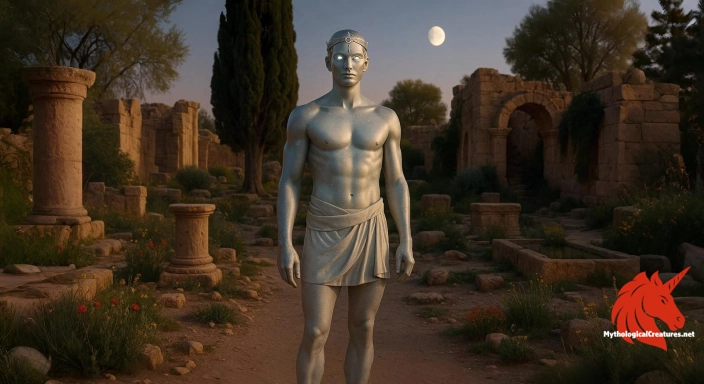
Aglibol
Aglibol - Aglibol played a key role in the religious practices of ancient Palmyra, highlighting the syncretism of lunar and solar worship.
Origins & First Encounters
Aglibol emerges from the mystique of ancient Palmyra, a city that served as a crossroads of cultural exchange and religious innovation. His origins lie within a north Syrian immigrant community whose traditions wove together diverse lunar and celestial motifs. The earliest epigraphical inscription dating to 17 BCE marks his formal introduction into the religious landscape, testifying to a legacy that has endured across centuries. As part of a sacred triad alongside Bel and Yarhibol, Aglibol's celestial responsibilities have always been intertwined with a broader cosmic order. His worship reflects a delicate balance between the powers of the night and the visible energies of the sun, as seen in his enduring association with the sun god Malakbel. The mythos surrounding him is steeped in an interplay between tradition and adaptation, underscoring the fluid nature of ancient religious practices. Devotees esteemed him not merely for his lunar attributes but also as a symbol of cyclical renewal and mystical transformation. His active role within Palmyra’s ritualistic ceremonies offers a vivid glimpse into an era where deities were intricately linked to both daily existence and cosmic phenomena. This vibrant synthesis of myth and history portrays a divinity who, though enshrined in the quiet depths of night, illuminated the spiritual aspirations of his community.
Source Texts & Tale Variants
Aglibol’s worship and narrative are primarily documented through a series of epigraphical records and ancient inscriptions. The earliest extant mention of his name appears in a 17 BCE inscription that quickly aligns him with the sun god Malakbel. A number of bilingual and monolingual inscriptions, some dating to 122 CE, stand as enduring testaments to his veneration by the Bene Komare. These inscriptions, carved into stone and preserved on temple walls, reveal a structured devotion that celebrated his celestial powers. Reliefs in the Temple of Bel, where his image appears alongside that of Malakbel, further underscore the integral role he played in local cult practices. Records of his involvement in sanctuaries such as the Sacred Garden highlight his participation in communal rites and rituals. While elaborate mythic narratives remain sparse, the surviving epigraphical evidence invites a rich tapestry of interpretative narratives that blend oral tradition with recorded piety. The enduring inscriptions not only solidify his importance in Palmyrene religious life but also have paved the way for multiple narrative variants over subsequent generations. The cumulative textual artefacts affirm that his cult was dynamic and deeply embedded in the cultural fabric of his time.
Form & Powers
The sparse archaeological record does not provide a complete physical portrait of Aglibol, yet a number of reliefs and altar inscriptions offer visual clues that evoke his celestial character. In various reconstructions, his form is depicted wearing symbols commonly associated with the lunar cycle, such as a delicate crescent crown or a soft halo of silver light. The stylistic traits of Palmyrene art suggest that his image was rendered through elegant, elongated features that mirror the graceful course of the moon across the night sky. His representation is often complemented by flowing garments that seem to capture the transient beauty of nocturnal mists. Some interpretations imagine his eyes as imbued with an enigmatic glow, reflecting an otherworldly wisdom and serene composure. The accompanying inscriptions hint that his figure was portrayed in a stylised manner that blended human form with abstract celestial motifs. Interplay of light and shadow in these fragmented depictions adds an ethereal quality to his countenance, hinting at cosmic order in minute details. Although the exact proportions remain a matter of scholarly debate, his portrayals balance human elements with transcendent symbolism, inviting modern reconstructions and imaginative depictions.
Regional Faces
Although Aglibol’s central worship was rooted in Palmyra, regional interpretations of his divine essence emerged across north Syrian and neighbouring communities. In these peripheral areas, local veneration adapted his lunar attributes by merging them with indigenous symbols and traditional practices. Some communities accentuated his role as a guardian of the night, embellishing his depiction with mystical and protective characteristics. In particular, rural traditions sometimes linked his influence to agricultural cycles, attributing fertility and seasonal renewal to his celestial guidance. The visual portrayals in these locales often adopted simpler, more austere motifs compared to the elaborate artistry of Palmyra. Regional artisans incorporated local patterns and distinct colour palettes, which added a unique charm to his iconography. In settings influenced by broader Semitic traditions, Aglibol’s identity was occasionally interwoven with that of other moon deities, thus enriching his mythological narrative. Despite these variations, the essential elements of lunar symbolism and his status as a celestial force remained consistent. Such regional adaptations illustrate the flexibility of myth in accommodating local cultural narratives while preserving core themes of divine luminescence. This dynamic interplay between central tradition and local reinterpretation underscores the enduring resonance of his worship.
Cultural Parallels
The spheres of divine influence occupied by Aglibol invite intriguing parallels with a host of lunar deities from disparate ancient cultures. His lunar domain resonates with that of Sin from the Mesopotamian pantheon, where the moon symbolically governed both time and the mysteries of the cosmos. Comparable attributes can be noted with Greek lunar figures whose dualities between light and darkness echo his enigmatic presence. In many respects, Aglibol shares a kinship with deities who, across various cultures, embodied the transformative powers of the night. The close association between him and the sun god Malakbel mirrors a broader motif of celestial balance found in many polytheistic traditions. In Hellenistic settings, for example, the interplay between solar and lunar forces was often depicted as essential for establishing order in the universe, a theme that also resonates in Aglibol's narrative. Comparative analysis reveals that, despite regional peculiarities, many cultures venerated lunar entities as mediators between the earthly and the divine. This cross-cultural dialogue highlights a shared symbolic language that links Semitic traditions with those of the Mediterranean basin. Ultimately, Aglibol’s myth serves as a bridge connecting diverse understandings of time, transformation, and the sacred rhythm of nature. Such reflections underscore the universal allure of the moon as a symbol of mystery and eternal change.
Legacy & Modern Evolution
The story of Aglibol’s worship is one of gradual transformation that spans from the time of ancient inscriptions to the era of modern archaeological rediscoveries. His cult, deeply embedded in the religious life of Palmyra, evolved as the cultural and political landscapes shifted through Hellenistic and Roman epochs. Over the centuries, his initially strict association with lunar phenomena broadened to encapsulate themes of cosmic harmony and the ceaseless passage of time. Renewed academic interest, spurred by new epigraphical finds and artistic reinterpretations, has rekindled the enigmatic allure of his myth. Contemporary scholars and enthusiasts now see him as a symbol of the delicate balance between light and darkness, a dichotomy that continues to inspire artistic and literary creations. Museums and cultural exhibitions often cast his relics in a new light, blending historical authenticity with innovative creative expression. This modern reinvigoration has not only preserved his image but also expanded it to resonate with broader cultural narratives about the endurance of myth. Enthusiasts appreciate his evolution from a local deity into a figure emblematic of the interplay between tradition and modernity. His legacy, therefore, provides valuable insights into how ancient mythologies adapt and thrive in changing cultural contexts, ensuring that Aglibol remains a luminous figure across the ages.
Interesting Fact
One intriguing aspect of Aglibol's cult is his integration into a triad with Bel and Yarhibol, showcasing a sophisticated interplay between lunar and solar deities that defined Palmyrene religious identity.
Curated sponsor space
One subtle banner. Thousands of myth lovers.
We offer a small number of curated sponsor spots for relevant books, courses, games, and art. No clutter, just well-matched partners.
Partner with usQuick Creature Info
Origin:
Associations:
Our Mythic Legendary Rating:

Habitat:
Supernatural Powers:
Physical Attributes:
Abilities:
Behavior:
Lore:
References
Discover Another Mythical Legend You May Not Have Heard Of?
Uncover the mysteries of ancient folklore and expand your knowledge of legendary beings from cultures around the world.
Dare to Meet the Amemasu....

Curated by the Mythological Creatures Team
Series editor: Mythological Creatures Directory
Primary desk: Hellenic & Ancient Mediterranean Desk
(rev. November 2025)