
Akhkhazu: Akhkhazu, also known as Ahhazu, is a female demon from Akkadic mythology who later became part of Babylonian myth.
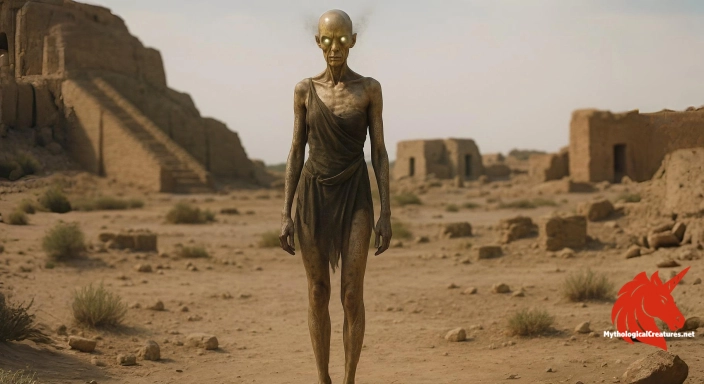
Akhkhazu
Akhkhazu - Akhkhazu personifies the terror of disease in ancient Mesopotamian demonology, serving as an embodiment of divine retribution through plague.
Origins & First Encounters
Akhkhazu emerges from the ancient tapestry of Akkadian and Babylonian myth, signifying both illness and supernatural retribution. Her origins can be traced back to early Mesopotamian traditions where she is also known by the Sumerian name Dimme-kur, a title that adds to her mysterious allure. Although the term itself appears in a male form, her character is vividly portrayed with feminine qualities, a paradox that intrigues scholars and enthusiasts alike. She is chiefly identified as a demon of jaundice, a condition that symbolically mirrors the corrupting influence of disease in human society. Early texts reveal that she was integrated as part of a feared trio of demons, each tasked with inflicting particular afflictions upon humankind. Communities of the ancient world feared the sudden onset of fever and plague, associating such calamities with her wrath. Her narrative reflects the interplay between physical decay and divine punishment, resonating deeply within the cultural and ritualistic practices of the time. Every retelling of her myth reinforces the notion that natural maladies were often interpreted through a supernatural lens. In every whispered lore and ritual incantation, Akhkhazu embodies the dread of forces beyond mortal control, a legacy that has endured through the ages. Her presence in myth continues to remind us of an era when the mysteries of disease were intricately woven with the fabric of spirituality.
Source Texts & Tale Variants
Ancient cuneiform tablets and ritual incantations provide a fragmented yet evocative glimpse into the lore of Akhkhazu. Her narrative appears in both Akkadian and Babylonian texts, reflecting the fluid nature of myth as it travelled across diverse cultures. In select manuscripts, she is referred to as ‘the seizer’, a title that underscores her feared capability to bring about sudden epidemics. Sumerian sources, where she is known as Dimme-kur, reveal further layers of her identity by merging earlier traditions with evolving myths. Stories often place her within a trio of demonic entities, alongside Labasu and Labartu, each responsible for various forms of affliction. Ritual texts and incantatory passages attribute outbreaks of fever and jaundice to her malevolent intervention, thereby infusing her myth with a dark, cautionary tone. Variations in her portrayal from different texts highlight local adaptations that reflect the particular experiences of communities facing unexplained plagues. These ancient narratives, though dispersed and sometimes cryptic, collectively offer a rich mosaic of her role in the ancient understanding of disease. The enduring presence of her name in these sources speaks to a deep-seated cultural need to explain the sudden and severe impacts of illness. In this way, Akhkhazu’s story is pieced together from multiple voices echoing across centuries of human experience.
Form & Powers
Descriptions of Akhkhazu’s form are steeped in a symbolic ambiguity that merges the human with the monstrous. Early artistic representations, though fragmented, suggest a visage marked by a disquieting duality—combining elements of eerie beauty with unsettling decay. Her eyes, said to emit an unearthly light, evoke the pallid glow of jaundice, a visual metaphor for internal corruption and affliction. Depictions occasionally show her draped in tattered robes that mirror the disarray seen in those stricken by plague. Some accounts portray her body with deliberate distortions, such as disproportionate limbs or a gaunt, skeletal frame, echoing the ravages of relentless illness. This contrast between soft, almost beguiling features and marks of physical deterioration intensifies her enigmatic presence. The rendering of her skin in jaundiced hues further ties her appearance directly to the very afflictions she is believed to impose. In later artistic recreations, subtle modifications in her form underscore the unpredictable nature of the plagues she represents. Such portrayals not only capture the terror associated with disease but also invite viewers to ponder the delicate boundary between allure and repulsion. Overall, the physical iconography of Akhkhazu serves as a powerful visual narrative of both beauty corrupted and suffering incarnate.
Regional Faces
Across the Mesopotamian region, the figure of Akhkhazu is reinterpreted in ways that reflect specific local experiences of disease and spiritual warfare. In Akkadian lore, she is depicted with a raw immediacy that mirrors the sudden onslaught of illness in a vulnerable community. Babylonian narratives, in contrast, often embed her within a more ritualised framework, where elaborate ceremonies were performed to counteract her nefarious influence. Her Sumerian identity as Dimme-kur offers another layer, suggesting a primordial force tied to the elemental aspects of nature and the inevitability of divine retribution. In some urban centres, her image intermingled with that of protective deities, an integration that highlights the dual nature of fear and hope in confronting plague. Rural traditions, meanwhile, recount vivid tales of her roaming the outskirts during times of epidemic, emphasising the immediacy of her threat. Local healers and priests adapted her myth to suit their own medical practices and spiritual interventions. Even within broadly shared cultural territories, the nuances in her portrayal illustrate how distinct communities negotiated the relationship between natural calamities and supernatural accountability. Cross-cultural exchanges further enriched her myth, instilling additional symbolic layers that responded to regional particularities. Such variations underscore the broader human endeavour to interpret and manage the unpredictable forces of disease through myth.
Cultural Parallels
Akhkhazu’s myth finds intriguing parallels with female demonic figures across various ancient traditions, each embodying a similar nexus of disease and divine retribution. Her role as a bringer of plague resonates with other figures in the Near Eastern mythos, where the sudden appearance of illness is often personified through supernatural agents. A comparison with demons such as Lamashtu reveals common themes in which a female presence is tasked with punishing the living through physical affliction. Her depiction also shares similarities with other cultural narratives in which groups of demons work in concert to unleash calamity, a motif found in several Mediterranean and Anatolian traditions. This triadic structure reinforces ideas of collective malevolence and the compartmentalisation of destructive forces. The dual nature of beauty and horror in her portrayal is echoed in global folklore, wherein many cultures blend allure with terror to embody the unpredictable character of epidemics. Such cross-cultural intersections illustrate how diverse societies have historically used personification as a means to confront and rationalise the ravages of disease. The symbolic resonance of her attributes extends beyond Mesopotamia, offering a common denominator in the universal human experience of suffering. In essence, Akhkhazu’s narrative serves as a comparative bridge linking a spectrum of mythic representations of pestilence. Her enduring legacy in various cultural traditions highlights the shared human inclination to personify and combat the invisible forces of illness.
Legacy & Modern Evolution
Over the centuries, the portrayal of Akhkhazu has undergone significant transformation, mirroring shifts in both literary traditions and societal perceptions of disease. Her original character, steeped in the fear of sudden epidemics, evolved into a multifaceted symbol that encompassed both warning and artistic inspiration. Medieval retellings imbued her with moral and didactic overtones, casting her as a figure whose terrifying influence served as a cautionary tale against human hubris. In more modern contexts, her image has been revitalised in horror literature and visual art, where artists have drawn on her ambiguous gender and spectral beauty to evoke a timeless sense of dread. Contemporary interpretations often portray her as a tragic archetype—a personification of nature’s indiscriminate punishment blended with an almost melancholic allure. As society has grappled with new outbreaks and continues to explore the connection between myth and medicine, her symbolism has taken on fresh relevance. Academic studies have re-examined her myth as a reflection of ancient strategies to understand and manage the forces of disease. Digital media and exhibitions now celebrate her complex iconography, inviting audiences to reinterpret her legacy through modern lenses. Through these evolving depictions, Akhkhazu remains emblematic of the ever-present interplay between fear, beauty, and the inexorable impact of illness. Her journey from an ancient demon of jaundice to a modern muse underscores the enduring power of myth to capture the human condition.
Interesting Fact
An intriguing aspect of Akhkhazu is the disparity between the masculine form of her name and her clearly feminine nature, reflecting the nuanced dynamics of linguistic tradition and myth in ancient Akkadic texts.
Advertising opportunity
Showcase your mythology project
We offer limited sponsor placements for books, courses, games, and creators aligned with our audience.
View partnership optionsQuick Creature Info
Origin:
Features:
Our Mythic Legendary Rating:

Also Sometimes Known As:
Habitat:
Supernatural Powers:
Physical Attributes:
Abilities:
Behavior:
Lore:
Related Creatures, Tales or Lore
- LLamashtu
- LLilitu
- LLabartu
References
Discover Another Mythical Legend You May Not Have Heard Of?
Uncover the mysteries of ancient folklore and expand your knowledge of legendary beings from cultures around the world.
Dare to Meet the Thurathadi....
Curated by the Mythological Creatures Team
Series editor: Mythological Creatures Directory
Primary desk: Hellenic & Ancient Mediterranean Desk
(rev. November 2025)